Chintō Kata — A Personal Exploration of Martial Strategy in Wadō-Ryū Karate
· by Roger Vickerman Renshi (7th Dan) · Kata
Chintō (鎮闘) has always been, for me, one of the most intriguing and strategically rich kata in the Wado-Ryu syllabus. It was not a form I connected with immediately in my early training, but as my understanding deepened, so too did my appreciation for the kata’s subtlety, martial logic, and layered applications. Chintō blends tactical evasion, sharp directional changes, clever weight shifts, and a fusion of striking and grappling concepts—all expressed with the quiet sophistication characteristic of Wado-Ryu.:contentReference[oaicite:1]{index=1}
The kata is believed to originate from a Chinese martial artist—perhaps a shipwrecked sailor—who came into contact with the famous Matsumura. After a duel ending in stalemate, Matsumura is said to have helped the man return home in exchange for learning his fighting method. What we practise today may well be Matsumura’s attempt to encode that system. Regardless of the historical accuracy, the narrative reflects the kata’s flavour: adaptive, angular, and deeply practical.:contentReference[oaicite:2]{index=2}
Why Chintō?
Chintō stands out because it is both combatively sound and artistically refined. It is not theatrical for the sake of performance; instead, every movement hints at coherent tactical strategy: managing space, unbalancing the opponent, drawing power from rising and falling actions, and transitioning seamlessly between striking, locking, and throwing.:contentReference[oaicite:3]{index=3}
Key Concepts Explored in the Video
1. Taisabaki — Body Management
The kata opens by taking us off the line—not as a block, but as a deliberate evasion. As I often tell students, “boxers don’t block—they slip.” This principle of taisabaki, or shifting the body with intent, runs through the entire form. Chintō encourages proactive movement rather than reactive defence.:contentReference[oaicite:4]{index=4}
2. Meotode — Husband-and-Wife Hands
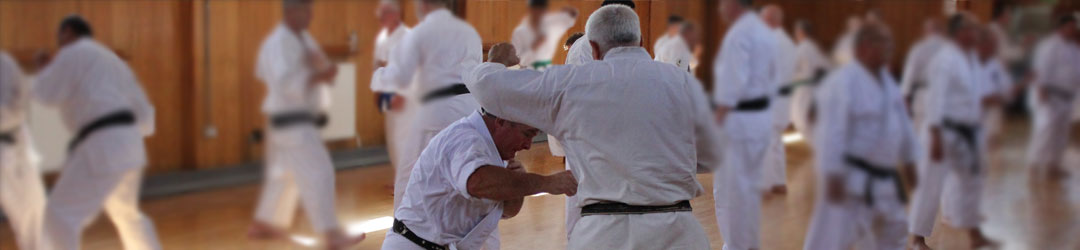
Early in the kata we see one hand control while the other strikes. This paired-hand principle—meotode—is fundamental to Wado. It shows how the hands should complement each other: one creating opportunity, the other delivering effect. In partner drills demonstrated in the video, this concept becomes clear in limb control, striking, and redirection.:contentReference[oaicite:5]{index=5}
3. Throws and Joint Manipulation
Turning actions in Chintō are rarely about simply facing a new direction. They often position the practitioner for throws such as irimi-nage or hip-based takedowns. Forearm strikes combined with weight drops suggest elbow attacks or joint locks. These are subtle, efficient, and highly functional movements—nothing flamboyant, but very real in combative value.:contentReference[oaicite:6]{index=6}
4. Tenchi — Heaven and Earth
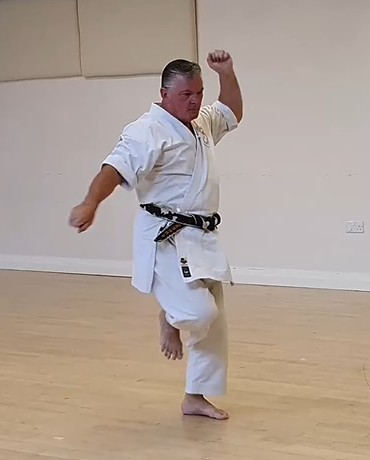
Where most kata operate on horizontal planes, Chintō uses verticality. We rise. We drop. These movements aren’t decorative; they are tactical responses to changing force. A one-legged posture may appear stylised, yet in our demonstration we show how it supports maintaining an arm bar or applying a choke on the ground. Chintō constantly reminds us that combat is multi-dimensional.:contentReference[oaicite:7]{index=7}
5. From Compliant to Non-Compliant Practice
Partner work begins cooperatively, but Chintō encourages gradual progression toward realistic, resistant training. With repetition, the mechanics become ingrained, and the applications begin to surface naturally in freer movement. The goal is not to memorise isolated techniques but to embody principles that emerge under pressure.:contentReference[oaicite:8]{index=8}
Kerry Moore Sensei’s Relationship with Chintō
“I’ll admit, Chintō wasn’t a kata I immediately gravitated towards. It didn’t ‘tickle me pickle,’ as I’ve said before. But over time, and especially through deeper study of its applications, I’ve come to respect it deeply. So much so that I’ve made it a personal project for 2024—one I plan to dive into fully. There’s a great deal of disagreement about Chintō, from how it starts to which leg moves first. But that ambiguity is a strength. It invites exploration.”
In Summary
Chintō is not merely a beautiful kata—it is a strategic system wrapped in subtle movement. Whether you are interested in throws, angled footwork, vertical transitions, or its roots in jiu-jitsu principles, the kata has something to offer. In Wado-Ryu, we speak often of softness, blending, and redirection. Chintō embodies these ideas not as abstract philosophy, but as practical, applied technique.:contentReference[oaicite:9]{index=9}
If you have not spent much time exploring this kata, I encourage you to revisit it. Work it slowly. Experiment with angles. Drill with a partner. And as always, take what is useful, adapt it to your understanding, and enjoy the journey.
Watch the video on YouTube or join the conversation on Facebook.
What does Chintō reveal to you about Wado-Ryu strategy? Share your thoughts and experiences—let’s continue learning together as a martial arts community.