Jion – Calmness, Strength, and Subtlety
· by Roger Vickerman Renshi (7th Dan) · Kata
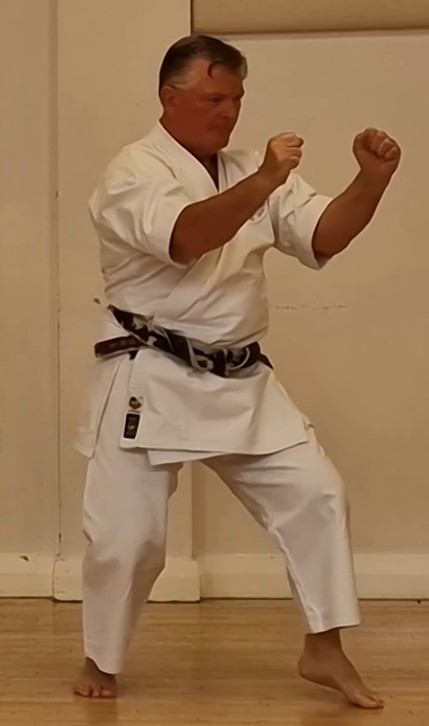
Jion is a kata often surrounded by reverence, history, and no small measure of mystery. With the support of Kerry Moore Sensei (Shinkido) and Kash Bansal in our deep dive video, we’ve put together a full breakdown of Jion—exploring not only the movements, but the thinking behind them.
As always, let me say—this is how I’ve been taught and how I practise it. If your instructor teaches Jion differently, please do it their way. It’s about courtesy and respect. These are suggestions, not commandments.
First Impressions
Jion feels deceptively simple on the surface—strong lines, fundamental stances, and clean techniques. But once you begin breaking it down, it’s full of nuance and subtle shifts in timing, direction, and intent. It’s a kata that rewards clarity of movement but punishes overthinking.:contentReference
Right at the start, many karateka instinctively shift backward. In our exploration, we look at how dropping into the stance with intention—rather than retreating—changes the energy completely. There’s a subtle kuzushi even before the uke delivers their mae geri.:contentReference
Technique and Structure
We cover several key sequences and what they reveal when you stop treating them as “block then strike,” and start seeing them as timing, entry, and control.
Jōdan Uke Variations
The first rising action can be used as sonoba (deflection), while the next becomes a more assertive entry—timed with the step, not after it. That distinction changes everything, especially when you translate kata mechanics into combative rhythm.
Taishō Application
We explore the difference between striking straight and using a hyperbolic arc—particularly useful when your opponent changes stance mid-exchange. The comparison is memorable: like thread pulled off a spinning reel, or the arc of a lunar trajectory. It’s a striking reminder that efficient paths aren’t always straight ones.
Juji Uke – Beyond “X-Block”
As a simple block, I’m not a big fan. But it becomes far more convincing when one arm is treated as a strike and the other as a clearing motion. We also discuss explanations attributed to Ōtsuka III Sōke, using the chest and Seishan-style structure to drive through the exchange.
Gaiwan / Naiwan Uke + Gyakuzuki
Hip action is critical here. You’ll hear me stress the idea of “hip the opposite way” repeatedly—because it is essential not only for kata accuracy, but for sparring function too.
Final Combinations – Shutō / Tetsui
Getting the correct arm position inside or outside is far easier when you understand the preparation for shutō. And yes—don’t forget your kiai on the final strike. Not everyone shouts “Jion”, but make sure your technique speaks clearly.
Historical Context and Influences
Jion is considered one of the “Temple Kata,” alongside Jitte and Ji’in—although only the first two are practised in Wadō-Ryū. There’s fascinating speculation around the name itself. Written in kanji, “Jion” is often translated as “love and kindness”—an odd name for such a powerful kata, and one reason many believe it may have links to Southern Chinese Buddhist temples.
We also explore how, in the early 20th century, both Funakoshi and Mabuni wrote the name “Jion” in katakana, suggesting it may have been a phonetic borrowing—perhaps Chinese in origin. Later, in the 1930s, the name was written in kanji, possibly reflecting the political climate of the era and a push toward “Japanese” framing.
There is even a compelling theory that Itosu may have created Jion by blending and adapting techniques from Ji’in and Jitte, possibly converting weapon-based kata into empty-hand versions. Whatever its origin, the kata passed through familiar hands—Matsumura, Itosu, Funakoshi, Mabuni—and into Wadō-Ryū via Ōtsuka I Sōke.
Revisiting Core Concepts
As we near the end of this kata series, Jion is a good opportunity to revisit some key ideas that sit beneath all kata practice:
- Angles and Direction: the angle of a movement tells you where you need to be in relation to the attacker—not just where the attack is coming from.
- One Technique, A Thousand Applications: the same shape could be a barge, an arm drag, a lock, or a throw setup. The technique lives in your intent, not your shape.
- Transferable Skills: motifs from Naihanchi and Kushanku reappear in Jion—control grips, body angles, and structural choices.
- Tegumi and Hidden Wrestling: Okinawan wrestling is often hidden in plain sight—control and grip frequently lead straight into a throw.
- Maai (Distance and Timing): it’s not about being close or far, but being in the right place with the right rhythm.
Final Thoughts
As always, these are interpretations—kaisetsu. Use them if they help, ignore them if they don’t. The aim is to explore and experiment, not to dictate.
If there’s one thing I’ve taken from working on Jion, it’s this: Jion and Jitte work best as a pair. What one lacks, the other offers. Much like Naihanchi and Seishan, they form a dialogue—not a monologue. You can’t fully understand one without the other.
Watch the video on YouTube or join the conversation on Facebook.
What does Jion reveal to you about timing, structure, and strategy? Share your reflections and training experiences—let’s keep learning together as a community of martial artists.