Ippon Kumite No.4 – Yonhon Me: Angle, Entry and Structural Collapse in Wadō-Ryū
· by Roger Vickerman Renshi (7th Dan) · Paired Practice
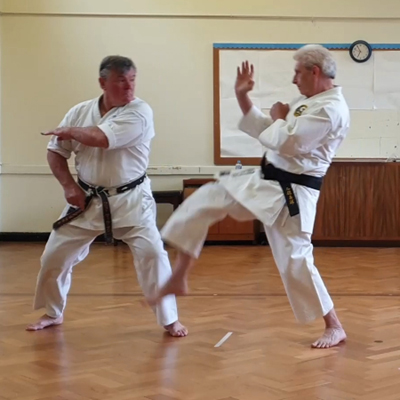
Ippon Kumite No.4 – Yonhon Me develops the principles seen earlier in the series, but introduces a deeper study of angle, entry, and the relationship between kata and paired application.
Based on movements from Pinan Nidan, this sequence explores how to move off the centre line, use the body to generate technique, and create kuzushi through connection rather than force.
From Pinan Nidan to Ippon Kumite
The origins of this Ippon Kumite can be seen clearly in Pinan Nidan, particularly in the turning movements and arm actions that combine inward and outward rotation.
At a basic level, this may be performed as a simple defensive movement. However, as understanding develops, the emphasis shifts towards using the body to create the technique — allowing the arms to follow rather than lead.
For beginners, stepping off the line and covering safely is sufficient. For more experienced practitioners, the movement becomes more refined: stepping back first, then turning, so that the body drives the technique.
Distance and Entry
A key teaching point in this sequence is the understanding of ma-ai (distance).
The attack uses okuri ashi mae geri chūdan, which requires the attacker to move from fighting distance into kicking range. This highlights an important principle — technique must be delivered from the correct distance, not forced from too far away.
Similarly, tori must take position correctly rather than pushing forward blindly. The stance should be taken with purpose, allowing the technique to emerge from correct positioning rather than reaching or overextending.
Turning Off the Line
As the attack comes in, tori steps back and turns, using the body to move off the centre line. This is not simply a defensive reaction, but the beginning of control.
The turning action allows the hips and body to connect with the arms, creating a unified movement. Whether expressed through naiwan or gaiwan, the key point is that the body drives the technique, not the arms in isolation.
This creates both protection and opportunity — avoiding the attack while preparing the entry.
Entry and Control
Following the initial movement, tori enters with jōdan shuto uchi, using the body and hip to drive the action forward. Depending on the situation, this may pass cleanly through to the target, or it may meet resistance.
If the arm is strong and blocks the line, the movement adapts. Rather than forcing through, tori uses the arm as a point of contact — trapping and controlling it while continuing to move forward.
This is an important Wadō principle: the technique must adapt to what is felt, rather than following a fixed pattern.
Kuzushi and Structural Collapse
The final phase of the technique introduces a more pronounced application of kuzushi.
Through a combination of arm control, body movement, and pressure through the knee, uke’s structure is compromised. Two variations are commonly seen:
- Direct pressure to the neck and shoulder, creating a backward imbalance
- A hooking action around the arm, combined with nagashi and pressure through the knee, producing a deeper collapse through the spine
In both cases, the effect is significant. Uke’s posture is disrupted to the point where counter-attack becomes extremely difficult.
This highlights an important lesson — effective technique is not about striking alone, but about controlling the opponent’s structure.
Feeling Rather Than Forcing
A central theme in this Ippon Kumite is the idea of responding to what is felt.
If the path is clear, the technique flows directly through. If resistance is encountered, the movement adapts — trapping, controlling, and redirecting.
This requires sensitivity and awareness, not just mechanical repetition.
More Than a Sequence
Although presented as a formal exercise, Ippon Kumite No.4 contains several key Wadō principles:
- moving off the centre line
- using the body to drive technique
- understanding and applying ma-ai
- adapting to resistance
- creating kuzushi through structure
For this reason, it should be studied not simply as a sequence, but as a method for understanding how movement, timing, and control come together.
Final Thoughts
Ippon Kumite No.4 builds on the earlier forms and introduces a more sophisticated relationship between kata and application.
When practised carefully, it reveals how subtle changes in angle, timing, and body use can have a significant effect on the outcome of an exchange.
Like all Wadō practice, it rewards careful study — not just of what is done, but of how and why it works.