Ippon Kumite No.5 – Gohon Me: Flow, Angle and Continuous Control in Wadō-Ryū
Based on movements from Pinan Shodan
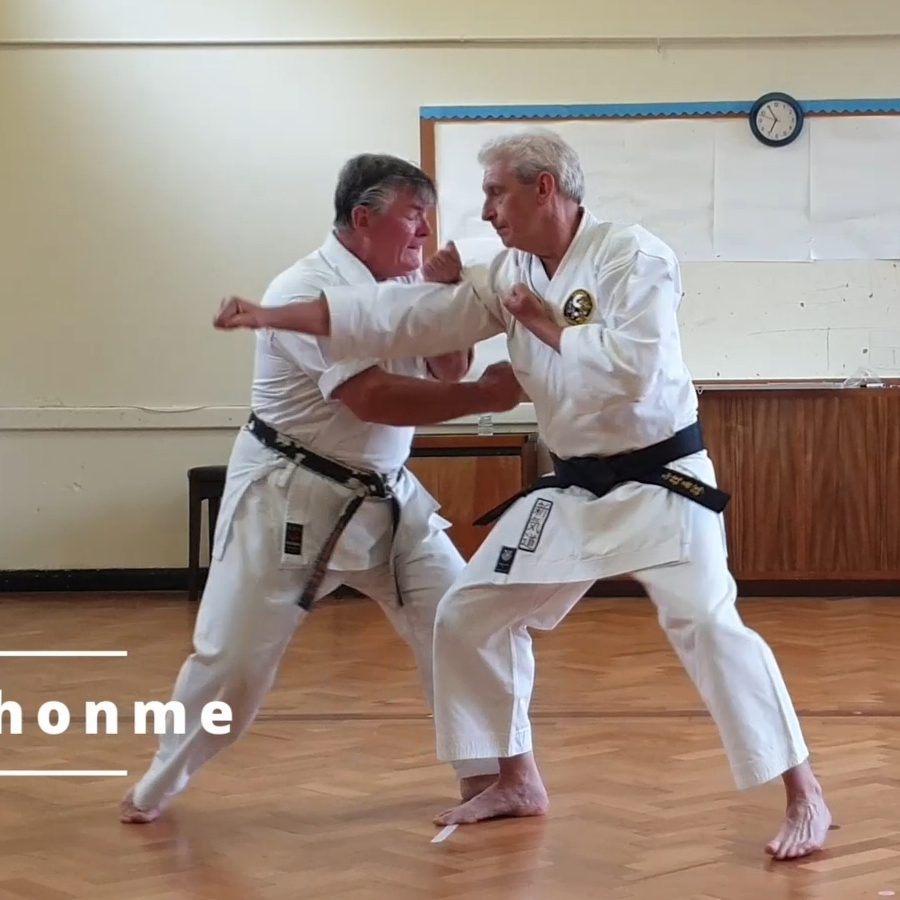
Ippon Kumite No.5 – Gohon Me builds directly on the earlier forms, introducing a more fluid expression of movement, connection, and control. Drawing its origins from Pinan Shodan, the sequence reflects the characteristic shuto actions of the kata, but within a paired context where timing, positioning, and body use become essential.
At first glance, the movement appears straightforward. However, as with all Wadō practice, its depth lies not in the sequence itself, but in how the body is used to create and sustain the technique.
From Pinan Shodan to Ippon Kumite
The roots of this Ippon Kumite can be clearly seen in the opening movements of Pinan Shodan, particularly in the double hand actions that resemble shuto application.
What appears as a simple blocking and striking combination in kata becomes, in paired work, a study of:
- moving off the centre line
- coordinating both hands simultaneously
- creating connection through contact
- maintaining flow into the next technique
This transformation from kata to application highlights a key Wadō principle — movement must be alive and adaptable, not fixed.
Distance, Simplicity and Learning Progression
The formal method of movement uses:
- okuri ashi (sliding step)
- tsugi ashi (following step)
both forwards and backwards.
However, for beginners, particularly at lower grades, stepping straight back is often encouraged as a valid starting point. The priority is not complexity, but understanding ma-ai (distance) and safely creating space from the attack.
By simplifying the footwork, students can focus on:
- correct body alignment
- coordinated hand movement
- awareness of timing
As understanding develops, the more refined footwork can be reintroduced without compromising the underlying principles.
Moving Off the Centre Line
As Uke attacks with Jōdan Junzuki, Tori steps back — but not directly along the original line.
Instead, the movement subtly shifts the body off the centre line. By placing the rear foot slightly in line with the front, Tori repositions their centre, ensuring that the attack passes to the side of the head rather than through it.
This is a critical detail.
If performed correctly:
- Uke’s punch will no longer align with Tori’s centre
- Tori gains both safety and positional advantage
- the technique begins from a place of control rather than reaction
From Uke’s perspective, this shift should be clearly felt — if the punch still travels directly towards the face, the movement has not been sufficient.
Two Hands, One Movement
A defining feature of this waza is the simultaneous use of both hands.
- One hand rises in a jōdan suri uke (gaiwan) action
- The other delivers a chūdan strike
This is not two separate techniques, but a single unified movement, driven by the body.
The coordination of both hands creates:
- immediate defensive cover
- simultaneous offensive intent
- connection with Uke’s attacking arm
The arms do not act independently — they are guided by the movement of the body and centre.
Connection, Rotation and Kuzushi
Following the initial contact, the punching hand uses a suri action to draw Uke in. This is where the technique begins to evolve beyond simple block and counter.
Through:
- subtle rotation of the arm
- connection to Uke’s limb
- and coordinated hip movement
Tori creates a spiralling action that applies both twist and downward pressure.
This has a significant effect on Uke:
- their structure begins to collapse
- balance is compromised
- resistance becomes increasingly difficult
The final Gyakuzuki is delivered at close range (knee to knee), not as a reaching strike, but as the natural conclusion of the body’s movement and control.
Going Beyond the Line
A key teaching point in this Ippon Kumite is that movement does not stop at the point of evasion.
It is not enough to move off the attacking line — one must move beyond it.
If Tori stops too early:
- the attack may still connect
- or Uke may be able to re-engage immediately
The movement must carry through, ensuring that:
- the attack is fully avoided
- position is established
- control is maintained
This reflects the Wadō concept of continuous motion — nothing is static, and nothing is incomplete.
Zanshin – Before, During and After
As with all Ippon Kumite, the technique does not end with the strike.
Zanshin — awareness — must be maintained throughout:
- before the attack
- during the exchange
- and after the technique is completed
A common mistake is to disengage mentally once the sequence is finished. However, true practice requires continued awareness, readiness, and presence.
This is not simply etiquette — it is an essential part of martial understanding.
What Uke Should Feel
From Uke’s perspective, several key elements should be experienced:
- the loss of centre line as Tori shifts position
- the spiralling, downward pressure through the arm
- the sensation of supporting Tori’s weight
- the inability to counter effectively once balance is broken
If these elements are not present, the technique is likely being performed with the arms rather than the body.
More Than a Sequence
Although presented as a formal exercise, Ippon Kumite No.5 contains several important Wadō principles:
- moving off the centre line
- using both hands as a unified action
- creating connection rather than collision
- applying rotation to generate kuzushi
- maintaining flow from defence into attack
- preserving awareness throughout the exchange
Final Thoughts
Ippon Kumite No.5 continues the progression of the series, deepening the relationship between kata and application.
Through careful practice, it reveals how subtle adjustments in angle, timing, and body use can transform a simple movement into an effective and controlled technique.
Like all Wadō practice, it is not the outward form that matters most — but the quality of movement that brings it to life.
Follow the link for the full detailed breakdown video.