Naihanchi Kata: The Hidden Power of Stillness in Wadō-Ryū Karate
· by Roger Vickerman Renshi (7th Dan) · Kata
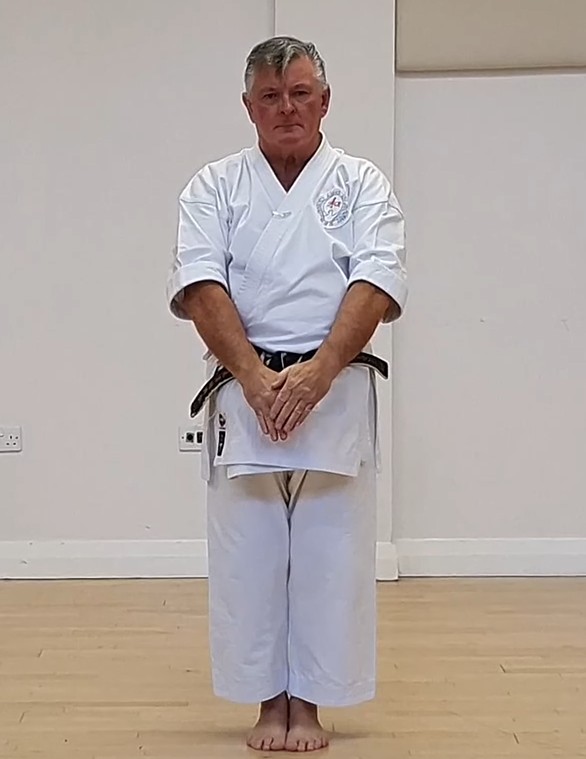
Naihanchi (内歩進) – known as Tekki in some traditions – is one of the most misunderstood yet profoundly important kata within Wado-Ryu Karate. Characterised by its lateral movements, low stance, and compact line, it invites us to explore structure, posture, and internal power generation at close range rather than through large, expansive movements.
Often likened to an iceberg, what we see on the surface of Naihanchi is only a small part of its depth. Behind the simple-looking pattern lies a lifetime of study in balance, breath, and the fine mechanics of striking, blocking, and maintaining integrity under pressure.
Understanding the Kata
Unlike Kushanku or the Pinan series, Naihanchi is performed along a single horizontal line. There are no formal turns or leaps, only movement from side to side. This apparent simplicity shifts the focus away from choreography and towards quality: how we connect the feet to the floor, align the spine, and organise the body as a unified structure for delivering and receiving force.:contentReference[oaicite:0]{index=0}
Key Takeaways from Naihanchi
- Structural Integrity and Stance Mastery: Central to this kata is Naihanchi-dachi. The stance is built like an equilateral triangle: feet flat, arches dropped, knees gently inward over the feet, and weight centred. Done correctly, it creates a strong base for both applying power and resisting force from any direction.:contentReference[oaicite:1]{index=1}
- Training the Internal Body (Naiko): Naihanchi offers an excellent platform for internal training – setting the lats, flattening the back, engaging the hips as anchors whilst keeping the arms relaxed and responsive. It is like “putting on a suit of armour”: the structure is engaged, but not rigid.:contentReference[oaicite:2]{index=2}
- A Feeder for Seishan: Many of the postural elements we rely on in Seishan – including Tate and Yoko Seishan concepts – are first explored in Naihanchi. Without a real understanding of Naihanchi’s alignment and stance work, our later kata risk becoming superficial.:contentReference[oaicite:3]{index=3}
- Application without Hip Rotation: Traditionally, Naihanchi does not rely on large hip twists for power. Instead, it uses centrifugal force, breath, and shifts in the centre of gravity. This “stillness in motion” challenges modern habits and encourages us to rediscover how much power we can produce from pure structure and intent.:contentReference[oaicite:4]{index=4}
- Strategic Eye and Head Movement: The head turns and lines of sight in Naihanchi are not cosmetic. Each look, lift, and subtle turn influences balance and alignment, teaching us to coordinate awareness, posture, and response on a very fine level.:contentReference[oaicite:5]{index=5}
Practical Applications and Historical Insights
In the accompanying video, Roger Vickerman Renshi and Kerry Moore Sensei (Shinkido Martial Arts) explore Naihanchi’s lesser-seen bunkai, focusing on grappling, wrist control, and arm locks at close range. Elbow strikes (Empi), wrist breaks, and takedowns all emerge naturally from the kata’s compact movements when distance is shortened and intent is sharpened.:contentReference[oaicite:6]{index=6}
The session also touches on the influence of Motobu Choki, famed for his fighting ability, who regarded Naihanchi as the kata that never failed him in real combat; and on the kata’s evolution from Chinese “Nifanchi” through Matsumura, Itosu, and Motobu. Differences in stance width, hip use, and expression across these lines remind us that Naihanchi has always been alive, interpreted and reinterpreted through experience.:contentReference[oaicite:7]{index=7}
Finally, the kata is used to demonstrate how immense power can be generated without visible hip twist – relying instead on posture, breath, and connected chains of muscle and structure, echoing the teachings of senior Japanese stylists such as Tomiyama Sensei.:contentReference[oaicite:8]{index=8}
Naihanchi’s Place in Your Training
Naihanchi is more than a short, sideways kata; it is a mirror for our Karate. For newer students, it provides a framework to refine posture, stance, and basic striking mechanics. For senior practitioners, it becomes a life-long laboratory for exploring subtle power, internal connection, and mental focus.:contentReference[oaicite:9]{index=9}
It is well worth dedicating extended time solely to this kata – perhaps even a year of focused practice – to begin to appreciate what Motobu, Ohtsuka, and other masters saw in it. Train with intensity, but also with patience. Explore both the obvious and the hidden sides of its movements and philosophy.
Continue the Journey
If you are interested in deepening your understanding of Wado-Ryu beyond external form, Naihanchi is an ideal companion. It will continually test, challenge, and refine your Karate, no matter how many years you have been training.
Watch the video on YouTube or join the conversation on Facebook.
What are your thoughts on Naihanchi? Share your interpretations and training experiences so we can continue learning and growing together as a Wado-Ryu community.