Exploring the Depth of Pinan Godan in Wadō-Ryū Karate
· by Roger Vickerman Renshi (7th Dan) · Kata
Pinan Godan (平安五段) is the culmination of the Pinan series—a kata that represents both a technical milestone and a philosophical shift in the practitioner’s journey. Bringing together fluid directional changes, grappling elements, dual-hand techniques, and the iconic jump, Godan challenges the student to harmonise power, precision, and intention at a higher level than ever before.
This kata builds on everything introduced across Shodan through Yondan, but pushes further. It expands how we think about movement—not just across the horizontal plane, but vertically; not just in terms of blocking and striking, but in terms of throws, joint locks, and off-balancing strategies. In this sense, Pinan Godan stands as a bridge between foundational practice and Wado-Ryu’s more advanced kata such as Seishan.
Understanding the Kata
By the time a student reaches Pinan Godan, they have already internalised much of the Pinan structure—stances, core transitions, and basic applications. Godan builds on this familiarity by introducing more sophisticated interpretations. Throws, joint manipulations, and multi-directional movement prepare the practitioner for kata that require deeper analysis and more nuanced body control.
Key Takeaways from Pinan Godan
- Joint Locks and Throws: Godan is rich in techniques that hint at grappling and joint manipulation. Movements that are often seen as blocks can be reinterpreted as setups for takedowns, limb control, or submission-style restraints. This marks a clear evolution from the striking-centric nature of the earlier Pinan kata.
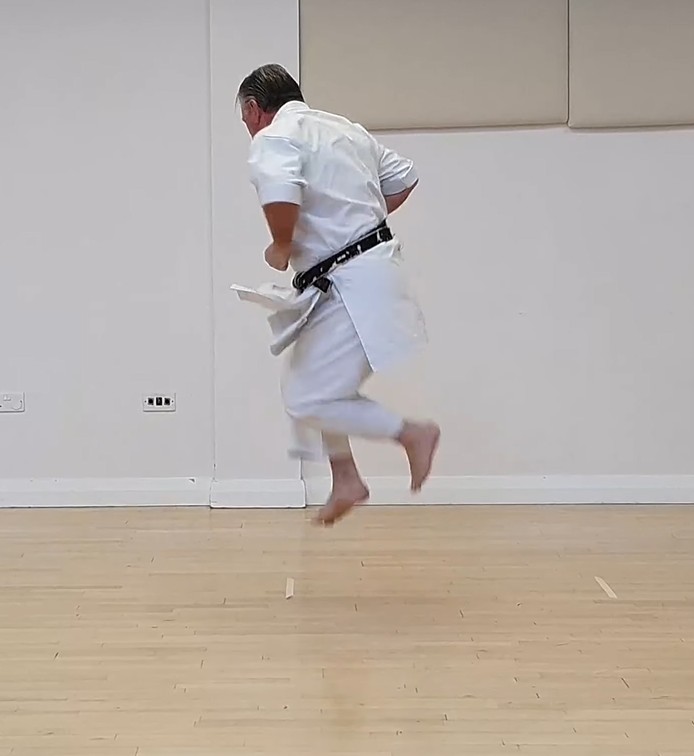
- Directional Expansion — The Introduction of Verticality: While previous kata focus on horizontal movement, Godan introduces a key vertical element: the jump. This reinforces the idea that real combat occurs in three dimensions, requiring practitioners to adapt to changes in height, momentum, and terrain.
- Explosive Power and Dynamic Transitions: The jump sequence tests the practitioner’s ability to generate power through coordinated hip and leg engagement. Executed properly, the movement reflects functional evasion or repositioning, rather than a mere display of athleticism.
- Kata-Based Sparring (Kumite Integration): At the Godan stage, students begin to explore how kata transitions flow into semi-live drills. The fluidity of Godan lends itself well to this exploration, demonstrating how the kata’s principles manifest dynamically under pressure.
- Influence of Seishan: Many similarities exist between Pinan Godan and Seishan—stance structure, weight transitions, and dual-hand coordination all subtly prepare the practitioner for the demands of higher kata.
Breaking Down Key Techniques
Juji Uke: More Than a Block
The crossed-arm action commonly labelled as Juji Uke varies across schools. Some treat it as a traditional block, while others interpret it as a mechanism for joint manipulation and limb control. Understanding both interpretations deepens the kata’s tactical versatility.
The Iconic Jump Sequence
This signature movement often challenges students, especially when posture and hip alignment are overlooked. When executed correctly, the jump becomes a practical expression of evasion and explosive repositioning, enhancing both agility and tactical awareness.
Oroshi Zuki — The Descending Strike
The downward punch in Pinan Godan, Oroshi Zuki, is more than a simple strike. Its potential applications include breaking posture, controlling the opponent’s centre line, or setting up finishing techniques—whether striking-based or grappling-based.
Tegumi and Kuzushi
Grappling concepts such as tegumi (Okinawan grappling) and kuzushi (off-balancing) appear frequently within Godan’s movements. Recognising these layers transforms standard arm motions into highly functional takedowns or controls.
Bringing Pinan Godan to Life
To practise Pinan Godan effectively, students must shift from memorisation to interpretation. Power should originate from coordinated whole-body movement; transitions must be intentional; and each technique should reflect a realistic purpose. Godan rewards those who study deeply and apply creatively, both in solo kata and paired training.
A Look at Applications
In the accompanying video, Sensei Roger Vickerman (7th Dan Renshi, Chubu Karate) and Sensei Kerry Moore (Shinkido Martial Arts) examine the kaisetsu of Pinan Godan, unpacking its throws, locks, directional changes, and principles that prepare practitioners for advanced training within Wado-Ryu.
If you're refining your kata or exploring how the Pinan series connects to the broader Wado-Ryu curriculum, this breakdown of Pinan Godan is an invaluable resource. Watch the analysis below and join the ongoing discussion within our community.
Watch the video on YouTube or join the conversation on Facebook.
How has Pinan Godan influenced your understanding of Wado-Ryu Karate? Share your thoughts below and help us continue growing together as a community of dedicated martial artists.