Datsuryoku (脱力) — The Release of Unnecessary Tension in Wadō-Ryū
· by Roger Vickerman Renshi (7th Dan) · Principles
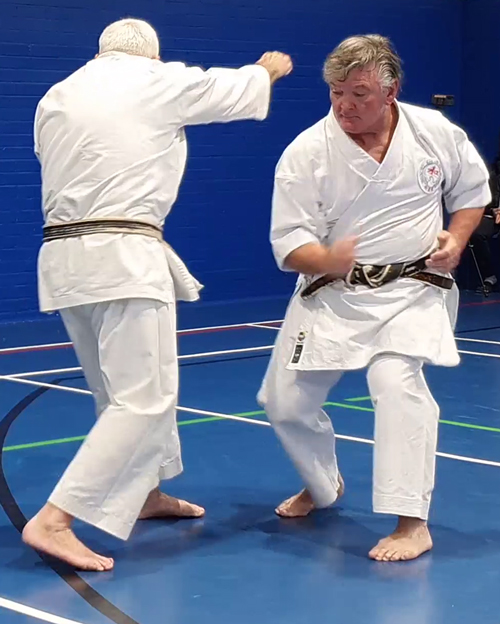
Datsuryoku (脱力) sits at the heart of Wadō-Ryū, even though it is often under-named and over-missed. Literally meaning “removal of strength” or “release of unnecessary tension,” it is not a single relaxed moment, but a continuous action — the deliberate absence of excess muscular effort so that movement remains free, flow remains uninterrupted, and power can travel cleanly through the body.
Without datsuryoku, none of the higher Wado principles truly function. When tension creeps into the shoulders, breath locks in the chest, or the body stiffens in anticipation, timing collapses — and with it the subtle efficiency that defines Wado-Ryū. Datsuryoku is how we remove what blocks correct movement and uncover strength that is already there.
What Datsuryoku Means in Wadō-Ryū
In Wado terms, datsuryoku is the intentional absence of excess effort, allowing the body to express key qualities:
- Dōsa — movement remains free
- Ryūsui — flow is uninterrupted
- Hadō — power can travel through the body
- Shizumu — weight can settle naturally
- Omomi — heaviness arrives with the technique
These are not “added” through forcing the body — they are revealed as tension is removed.
Key Characteristics of Datsuryoku
Selective Relaxation
Datsuryoku does not mean limp or passive. Structure is maintained. Muscles activate only when necessary — and crucially, tension disappears immediately after use. This is why high-level Wado can look calm and fluid even at speed.
Timing Over Force
In Wado, timing creates power — and tension destroys timing. Datsuryoku allows the body to respond instantly, rather than fighting itself. When the body is not “pre-loaded” with tension, technique becomes faster, quieter, and more accurate.
Internal Quietness
Externally, datsuryoku may look relaxed. Internally, it feels alert, connected, and ready to settle or move at any moment. This internal quietness is essential for Ryūsui — the ability to flow without interruption.
Non-Telegraphing
Datsuryoku removes the visible cues that usually give technique away: no shoulder lift, no held breath, no preparatory tension. The opponent feels the result without seeing the cause — one of the most practical expressions of Wado efficiency.
How It Connects to Other Wado Principles
Datsuryoku is not simply “one principle among many.” It is the condition that allows everything else to operate: dōsa, ryūsui, hadō, shizumu, omomi — and more. If the body is tense, these ideas become theoretical. If the body is released, they become physical reality.
Where You’ll Feel It Most
Datsuryoku becomes especially clear when you train areas that demand structure without stiffness:
- Naihanchi posture and transitions
- Kihon Kumite entries and finishes
- Kumite Kata
- Close-range body control and striking
It is often described by senior practitioners with a phrase that captures its paradox perfectly: “Nothing is forced, yet nothing is weak.”
Common Misunderstandings
- Datsuryoku is not floppy relaxation
- Datsuryoku is not lack of intent
- Datsuryoku is not slowness
It is active relaxation with structure — removing what blocks correct movement and power.
Closing Thoughts
Datsuryoku is the silent factor behind those moments in kata and partner work that feel effortless and inevitable. In Wadō-Ryū, strength is not added — it is uncovered. The more you explore Wado kata and principles, the more clearly you will see datsuryoku sitting beneath the surface, quietly supporting everything you do.
Upcoming filming sessions & YouTube releases
Stay tuned for new Kata deep-dives and historical features on our YouTube channel.
Join our mailing list for updates