Jūryoku (重力) — Using Gravity in Wadō-Ryū
· by Simon Sheridan · Principles
Jūryoku (重力) means gravity. It is something acting on us constantly, yet in karate we can easily spend much of our training trying to work against it. We brace, lift, push and tense when often a more natural solution is simply to allow the body to fall, settle or move with gravity.
Within Wadō-Ryū this idea fits naturally with the way we use taisabaki, body weight, relaxation and economical movement. Gravity can help us leave the line of attack, accelerate the body, change level and add mass to a technique. Rather than thinking of a drop as a separate action before a technique, the drop itself can become part of the technique.
Gravity Is Already Giving Us Movement
A common way of beginning movement is to push ourselves from one position to another. This works, but it can introduce unnecessary muscular effort and often gives the movement a visible preparation. An alternative is to release the body in the direction we want to travel and allow the centre of mass to begin moving under gravity, with the legs guiding and supporting that movement.
This is a subtle distinction. Jūryoku is not simply bending the knees or deliberately squatting. The aim is not to collapse the posture. The body remains organised, but instead of fighting to hold the centre at a fixed height we allow weight to settle and use that change to initiate or assist movement.
Jūryoku and Taisabaki
Wadō taisabaki is concerned with changing our relationship to an attack rather than simply trying to stop it. A small drop of the centre can change the line of the body without requiring a large step. Combined with turning or diagonal movement, gravity can therefore become part of our evasion.
Instead of first avoiding and then preparing a counter, the body can drop, turn and move off line as one continuous action. This is particularly important in Wadō because effective taisabaki should not leave us disconnected from the opponent. We want to remove the target while retaining position, structure and the ability to act.
Generating Force and Power
Gravity also gives us a simple source of acceleration. If the body's mass is allowed to descend while a strike is being delivered, the technique is no longer produced by the arm alone. The movement of the whole body contributes to the action.
The timing is crucial. Dropping first and punching afterwards separates the movements. Punching and then dropping wastes the opportunity. When the settling of the body and the technique arrive together, body weight can be transmitted through the strike while the practitioner remains comparatively relaxed.
This also helps explain why powerful Wadō technique does not always look powerful. There may be little obvious winding-up or muscular effort. The visible movement can be small, while the mass of the body is being organised and delivered efficiently.
Speed Without Trying to Be Fast
Jūryoku can also contribute to speed. Muscular tension often means that one group of muscles is working against another. If we first have to push, lift or prepare the body before moving, we have added another action before the technique has even begun.
Allowing the centre to release removes some of that preparation. The body begins to move as soon as balance is allowed to change, and the legs then control and redirect that movement. In this sense, speed is not always created by trying to move the limbs faster; it can come from removing the things that slow the whole body down.
Moving More Naturally
We already use gravity this way outside the dōjō. Natural walking is not a sequence of rigid positions. We continually allow our balance to move forward and then place the next foot to receive the body. Good Wadō movement can have the same quality: the body moves and the feet support the movement, rather than the feet moving first and dragging the body after them.
This connects jūryoku closely with datsuryoku. If unnecessary tension prevents the body from settling, gravity cannot be used freely. Relaxation allows the centre to move; structure ensures that movement remains controlled and useful.
Finding Jūryoku in Kata
Kata gives us an ideal environment in which to explore this. A change in stance does not always need to be interpreted as simply stepping from one fixed position into another. Sometimes the important part is the movement of the centre between those positions.
Look for places where the body lowers, turns or changes direction. Ask whether you are mechanically placing the feet and then performing a technique, or whether the body's weight can begin the movement and allow the stance and technique to emerge from it. A movement that initially feels like several separate actions can become one continuous action: release, move, settle and strike.
This can make kata faster and more fluid without rushing it. The purpose is not to perform the sequence more quickly, but to remove unnecessary stops and starts. Gravity helps connect one movement to the next.
Kihon Kumite No. 1 — A Clear Example
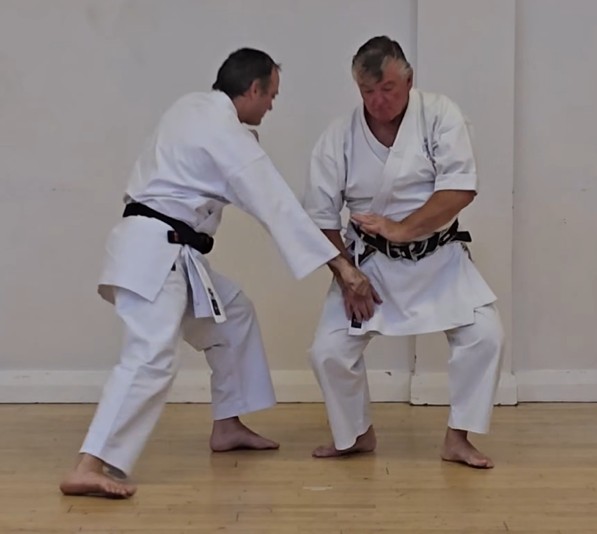
A useful place to feel this principle is Kihon Kumite No. 1. In the second defensive movement, the defender drops the body and then turns to deal with the attack. It is easy to see the drop merely as a way of getting underneath or away from the incoming technique, but it can do considerably more than that.
As the centre drops, gravity has already started moving the body. The turn can grow out of that movement rather than being performed as a separate muscular action. The same descending body weight that helps remove us from danger can then contribute to the counter punch. Evasion, taisabaki and power generation are therefore not three separate events — they are different consequences of the same coordinated body movement.
This is an important Wadō idea. We have not dropped and then turned and then generated power. Ideally, the drop creates the conditions for the turn, the turn creates the position for the counter, and the movement of the body's mass contributes to the force of the punch.
Common Misunderstandings
- Jūryoku is not simply bending the knees
- Jūryoku is not collapsing the posture or becoming heavy and immobile
- Jūryoku is not dropping before every technique
- Jūryoku is not a replacement for correct structure, timing or taisabaki
The useful principle is to recognise when gravity can do work that we might otherwise try to perform with unnecessary muscular effort.
Connecting the Principles
Like many Wadō principles, jūryoku becomes most interesting when it stops being considered in isolation. Datsuryoku allows the body to release; jūryoku allows gravity to act upon that released body; taisabaki gives that movement direction and purpose; and correct timing allows the resulting body mass to contribute to technique.
Seen this way, gravity is not an additional technique that we have to learn. It is a force that is already present. Our task is simply to stop fighting it unnecessarily and learn how to use it.
Closing Thoughts
Jūryoku offers a useful way of looking again at movements we may have performed thousands of times. Where are we lifting when we could settle? Where are we pushing when we could release? Where are we making three movements when gravity could help turn them into one?
In kihon, kata and Kihon Kumite, the principle encourages movement that is more economical, more natural and potentially more powerful. The body does not need to manufacture gravity. It only needs to learn how to cooperate with it.
Upcoming filming sessions & YouTube releases
Stay tuned for new Kata deep-dives and historical features on our YouTube channel.
Join our mailing list for updates