Kaisetsu (解説) and Bunkai (分解) — Understanding the Difference in Wadō-Ryū Karate
· by Roger Vickerman Renshi (7th Dan) · Principles
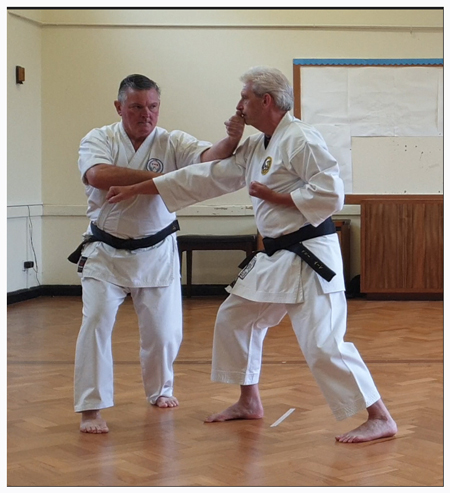
Kaisetsu (解説) and Bunkai (分解) are both concerned with understanding kata, but they lead the student towards different ways of thinking. In much of modern karate, the word bunkai is commonly used to describe kata application. Students are often encouraged to break the movements apart and find the practical fighting technique hidden within each action.
That approach can be useful, especially in the early stages of study. However, within traditional Wadō-Ryū there is a slightly different emphasis. Wadō-Ryū is not simply a system of fixed responses to fixed attacks. It is a system built upon principles: body movement, timing, distance, non-collision, balance breaking and the unity of attack and defence.
For that reason, the term Kaisetsu often gives a better description of how kata should be studied in Wadō-Ryū. Rather than asking only, “What is the application of this movement?”, we ask, “What principle is this movement explaining?”
What Does Bunkai Mean?
The word Bunkai (分解) literally carries the idea of breaking something apart in order to analyse it.
- Bun (分) — to divide, separate, or break apart
- Kai (解) — to untie, solve, analyse, or explain
Together, bunkai can be understood as “analysis through breaking apart”. In karate practice, this usually means taking an individual kata movement and assigning a practical combat application to it.
A movement may be explained as a block, a strike, a joint lock, a throw, a release from a grip, or a method of controlling the opponent. This can be valuable because it encourages students to look beyond the surface of kata and consider how the movements may function with a partner.
The limitation appears when the application becomes too fixed. A kata movement can become reduced to one answer, one opponent, one attack, and one solution.
The Problem with Fixed Applications
When kata is treated only as a collection of fixed applications, students can become trapped by certainty. A movement becomes “this technique” and nothing more.
Real conflict is not fixed. Distance changes. Timing changes. The opponent changes. The angle changes. The pressure changes. A useful kata principle must therefore be adaptable.
This does not mean that applications are wrong. Practical examples are important. But if the example becomes the whole meaning of the movement, the student may miss the deeper lesson.
In Wadō-Ryū, the deeper lesson is usually found in the principle behind the movement rather than in one single interpretation of it.
What Does Kaisetsu Mean?
Kaisetsu (解説) has a different feeling. It is usually translated as explanation, interpretation, commentary, or exposition.
- Kai (解) — to explain, clarify, reveal, or understand
- Setsu (説) — explanation, theory, teaching, or account
Rather than breaking kata into isolated fragments, kaisetsu seeks to explain what the kata is teaching. It asks us to look at the relationship between movement, body structure, timing, direction, and combative principle.
The question is not only:
“What technique does this movement represent?”
The deeper question becomes:
“What principle is this movement teaching?”
Why Wadō-Ryū Tends Towards Kaisetsu
Wadō-Ryū was shaped by Ōtsuka Hironori’s understanding of both karate and Japanese jūjutsu. As a result, the style places great importance on principles that cannot be fully explained by a single fixed application.
These include:
- Taisabaki — body movement and repositioning
- Ma-ai — combative distance and relationship
- Kuzushi — breaking balance and structure
- Nagasu — flowing, receiving and redirecting
- Dōjini — simultaneous action
- Kōbō-ittai — attack and defence as one
These are not merely techniques. They are organising principles. They can appear in kata, kihon, kumite kata, kihon kumite, tanto dori, jiyū kumite and self-defence practice.
A fixed bunkai may show one example of a movement. Kaisetsu allows that movement to reveal the principle that can then be applied in many different circumstances.
Kata as a Record of Principles
One useful way to understand kata in Wadō-Ryū is to see it as a record of principles rather than a catalogue of techniques.
The movements preserve:
- methods of body movement
- methods of receiving and redirecting force
- strategies of positioning
- timing relationships
- methods of controlling balance
- ways of expressing attack and defence together
The physical movement is the vehicle. The principle is the destination.
This is why experienced practitioners may demonstrate different applications from the same kata movement while still being faithful to the kata. They are not necessarily contradicting one another. They may be expressing the same principle in different circumstances.
An Example: Looking Beyond the Surface
Imagine a kata movement that appears to be a simple outside block.
A bunkai approach might say:
“This is a defence against a right punch.”
A kaisetsu approach might also accept that as one possible example, but then look deeper:
- How is the line of attack being changed?
- Is the body moving off the line?
- Is the opponent’s centre being controlled?
- Is the movement receiving, redirecting, striking, or entering?
- Is kuzushi being created?
- What timing relationship is being shown?
Suddenly the movement is no longer just one technique. It becomes an illustration of several interconnected principles.
The Influence of Jūjutsu
Ōtsuka Hironori’s background in Shindō Yōshin-ryū jūjutsu is central to understanding the Wadō approach. In many jūjutsu traditions, the outer form of a technique is important, but the real teaching lies in the principles that make the technique work.
Balance, posture, timing, entry, angle, body shifting and control of the centre are all more important than copying the outside shape alone.
This influence helps explain why kaisetsu feels so appropriate within Wadō-Ryū. It allows kata to be explored as a source of principle, strategy and body method rather than only as a list of hidden fighting tricks.
Bunkai and Kaisetsu Are Not Enemies
It is important not to create an artificial conflict between bunkai and kaisetsu. Bunkai can be useful. Students need practical examples. A movement has to be tested, felt and studied with a partner.
However, a practical application should be a doorway, not the destination.
Bunkai may help reveal a principle. Kaisetsu helps explain the principle so that the student can recognise it elsewhere.
In this sense, the two ideas can work together, but kaisetsu gives a broader and more faithful way of understanding the Wadō-Ryū approach.
What Should the Wadō Student Look For?
When studying kata, it can be useful to ask questions such as:
- What line is being controlled?
- Where is the centre moving?
- How is distance being created or destroyed?
- Is the body avoiding collision?
- How is balance being affected?
- What role does timing play?
- How does the movement relate to taisabaki?
- Is attack and defence being expressed together?
These questions often reveal more than asking only, “What is the application?”
Why This Matters
If kata is approached only through fixed application, the student may collect many techniques but still miss the character of Wadō-Ryū.
If kata is approached through kaisetsu, the student begins to see how the same principles appear across the whole system. The links between kata, kumite kata, kihon kumite, tanto dori, and jiyū kumite become clearer.
The art becomes more integrated. Movements stop feeling like isolated techniques and begin to feel like expressions of a shared body method.
Common Misunderstandings
- Kaisetsu is not vague theory with no practical value
- Kaisetsu is not an excuse to avoid testing movements with a partner
- Bunkai is not useless or wrong
- Kata is not simply a dictionary of fixed self-defence techniques
Kaisetsu should make kata more practical, not less. It encourages the student to understand why a movement works, not merely to memorise one example of how it might be used.
Closing Thoughts
The distinction between Bunkai (分解) and Kaisetsu (解説) reflects two different ways of approaching kata.
Bunkai breaks movements apart to analyse possible applications. Kaisetsu explains and reveals the principles that give those movements meaning.
In Wadō-Ryū, where body movement, timing, balance, non-collision and continuous action are central themes, kaisetsu often gives us a more complete way of understanding what kata is trying to teach.
Kata is not merely a collection of hidden techniques. It is a method of transmitting principles from one generation to the next.
When we study kata through kaisetsu, we begin to see beyond individual techniques and towards the ideas that make Wadō-Ryū unique.
And it is within those principles that the true value of kata is found.