Ma-ai (間合い) — Distance, Timing and Combative Interval in Wadō-Ryū
· by Roger Vickerman Renshi (7th Dan) · Principles
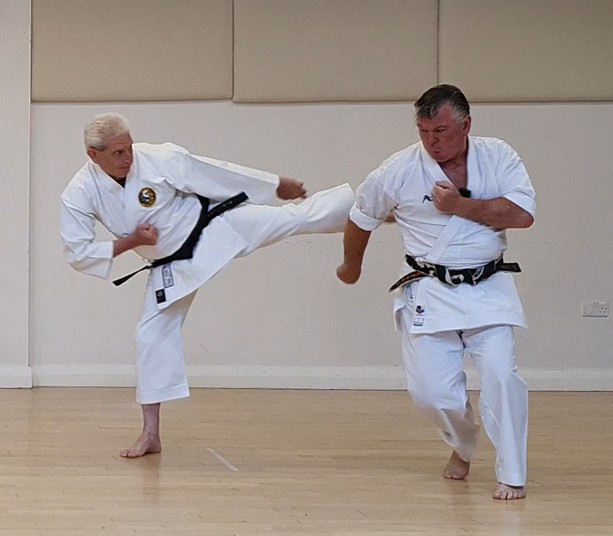
Ma-ai (間合い) is often translated simply as “distance,” but in Wadō-Ryū it means far more than physical range alone. Ma-ai is the living combative interval between two people — the relationship of distance, timing, posture, intention, and possibility. It is not merely how far apart two practitioners happen to be standing. It is whether that distance is favourable, dangerous, stable, collapsing, or about to disappear.
For this reason, ma-ai is never static. It changes constantly as bodies move, posture shifts, intention develops, and opportunity appears. A distance that is safe one moment may become dangerous the next. A gap that looks small may in fact be empty and unusable, while a longer interval may already be under control because timing and line have been taken. In Wadō-Ryū, correct ma-ai is not measured by tape — it is understood through feeling, movement, and relationship.
What Ma-ai Means in Wadō-Ryū
The word itself suggests the meeting of space and timing. In practice, ma-ai includes several inseparable elements:
- distance — how far apart the bodies are
- timing — when that distance can be used or lost
- position — what line, angle, and posture each person occupies
- intention — how likely action is to emerge from that moment
Because of this, ma-ai is best understood not as “range” in the simple sense, but as the entire combative relationship that exists between two people. It tells you whether attack is possible, whether evasion is available, whether entry can succeed, and whether control can be established.
More Than Being Near or Far
A common misunderstanding is to think that ma-ai means standing at the correct distance before something begins. In reality, ma-ai is not a fixed starting position. It is something that is constantly being created, destroyed, adjusted, and manipulated.
Two people may appear to be standing at the same physical distance, yet one has good ma-ai and the other does not. Why? Because line, posture, readiness, and timing are different. One person may be balanced and able to act; the other may be slightly square, overcommitted, or late. The physical gap may look identical, but the combative reality is completely different.
Why Ma-ai Is Central to Wadō-Ryū
Wadō-Ryū does not rely on forceful collision or trading blows at close range. Its character depends on moving at the right moment, taking the correct line, and avoiding the need to oppose force directly. None of this is possible without ma-ai.
When ma-ai is correct:
- Taisabaki becomes effective because the body can move before danger settles fully
- Dōjini becomes possible because defence and response happen within the right interval
- Kuzushi develops more naturally because the opponent is made to overreach or misalign
- Ryūsui can continue because the body is not forced into abrupt recovery
When ma-ai is poor, even strong technique becomes unreliable. The body arrives too early, too late, too square, or too deep. The result is forcing, reaching, bracing, or colliding — all of which move Wadō away from its natural character.
Ma-ai Is Dynamic, Not Fixed
One of the most important lessons in Wadō is that ma-ai is not something you simply “have.” It is something you constantly manage. Sometimes it must be preserved. Sometimes it must be broken. Sometimes it must be stolen from the opponent.
This is why experienced practitioners often appear to control distance without obvious movement. A slight shift of body angle, a subtle change of posture, a small foot adjustment, or a change of timing may be enough to transform the whole relationship. The opponent feels close when they are actually late, or safe when they are already exposed.
Where Ma-ai Appears in Training
Although often discussed as an abstract principle, ma-ai becomes visible everywhere in Wadō practice:
- Kihon — where students begin to understand how posture and movement affect usable distance
- Kihon Kumite — where each form depends on the correct interval for attack, evasion, and entry
- Kumite Kata — where ma-ai becomes more subtle through angle, pressure, and control
- Kata — where line, embusen, and body position all imply changing combative intervals
- Jiyū Kumite — where poor ma-ai is exposed immediately and good ma-ai creates calm control
In each case, the key issue is not how far apart people appear to be, but whether the interval is truly functional.
Ma-ai and the Opponent
Ma-ai is never yours alone. It always exists between two people. This means it is influenced not only by your own movement, but also by the opponent’s posture, balance, confidence, rhythm, and intention.
Good Wadō practice therefore does not treat distance as a neutral measurement. It studies how to influence the opponent so that their sense of ma-ai becomes unreliable. They reach when they should wait. They hesitate when they should move. They overcommit because the line appears open, only to find that the interval has changed before their technique arrives.
In this way, ma-ai becomes strategic as well as technical. It is one of the main ways in which initiative is quietly taken.
Ma-ai and Timing
Distance without timing is incomplete. In Wadō-Ryū, ma-ai is always tied to the moment at which action occurs. This is why the term naturally connects to ideas such as Sen, Go-no-sen, and Sen-no-sen. The same physical distance can be either favourable or unfavourable depending entirely on when the movement takes place.
If the body moves too soon, intention is revealed. If it moves too late, collision becomes more likely. But if the movement occurs at the correct moment, the same distance suddenly becomes alive — opening evasion, entry, or control with very little effort.
Ma-ai and Position
It is also important to remember that ma-ai is shaped by line and angle, not just straight-line separation. A person standing seemingly “close” may actually be poorly placed, while another at similar range may already be in a dominant angle. This is why ma-ai links so closely with Taisabaki and San Mi Tai.
Correct body movement alters the combative interval even if the feet have barely travelled. By changing line, narrowing profile, or taking the stronger angle, the practitioner changes the meaning of the distance itself.
Common Misunderstandings
- Ma-ai is not just physical distance
- Ma-ai is not a fixed gap to be memorised
- Ma-ai is not separate from timing
- Ma-ai is not something that belongs to one person only
It is the living interval between two people, shaped by distance, timing, position, and intention.
How It Connects to Other Wadō Principles
Ma-ai sits quietly beneath many of Wadō’s best-known principles:
- Taisabaki — changing body position changes the interval
- San Mi Tai — the relationship between bodies and space defines usable ma-ai
- Dōjini — simultaneous defence and attack depend on the correct combative interval
- Kuzushi — poor ma-ai often causes the opponent to stretch or misalign
- Ryūsui — flowing movement preserves and transforms distance without interruption
For this reason, ma-ai is not simply one topic among many. It is one of the invisible conditions that allows all the others to function properly.
Closing Thoughts
Ma-ai is one of the most important principles in Wadō-Ryū precisely because it is so easy to reduce to something too simple. It is not just how far away the opponent is. It is whether the relationship of distance, timing, and line allows action to emerge naturally and effectively.
When ma-ai is correct, movement becomes calmer, cleaner, and more efficient. The need to rush disappears. The need to force disappears. Technique begins to feel appropriate rather than imposed. In this sense, ma-ai is not merely a matter of where you stand — it is a matter of whether the moment belongs to you.