Meotode (夫婦手) — Paired Hands in Wadō-Ryū
· by Roger Vickerman Renshi (7th Dan) · Principles
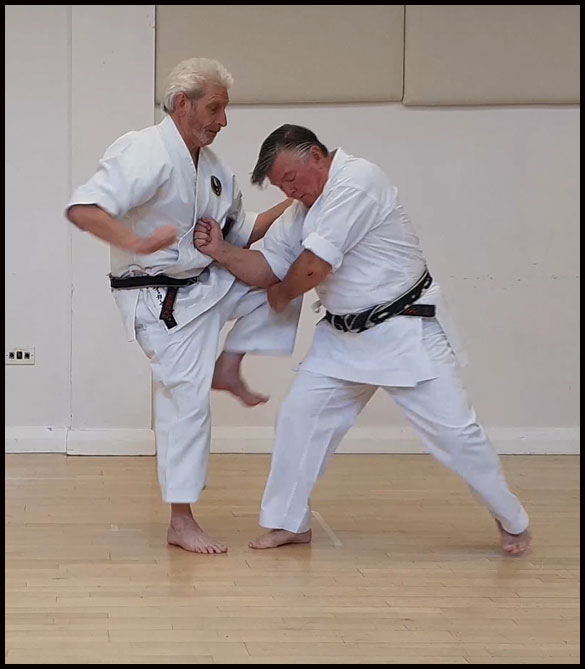
Meotode (夫婦手) is often translated as “husband-and-wife hands”. It describes the coordinated use of both hands working together, where one hand supports, controls, or creates opportunity, while the other delivers the decisive action.
In Wadō-Ryū Karate, this is not simply a matter of using two hands at once. It is a principle of cooperation, timing, and structure — ensuring that each hand has a clear role within the same movement.
Understanding the Meaning of Meotode
- Meoto (夫婦) — husband and wife
- Te (手) — hand
The term suggests a relationship rather than two independent actions. Just as a partnership requires harmony and mutual support, Meotode reflects the idea that both hands must function together with purpose.
One hand does not act in isolation. Each movement is part of a unified whole.
Why Wadō-Ryū Emphasises Meotode
In many beginner approaches to karate, techniques are often practised with a single focus — a block followed by a punch, or a strike delivered with one hand while the other remains passive.
In Wadō-Ryū, this is considered incomplete.
Effective technique requires:
- control of the opponent
- creation of openings
- maintenance of balance and structure
- continuous connection
Meotode allows these elements to occur together. One hand may guide, deflect, or control, while the other completes the technique.
This creates efficiency and removes unnecessary separation between actions.
Support and Decisive Action
Within Meotode, the hands take on complementary roles.
One hand:
- controls or redirects
- establishes contact
- creates opportunity
The other hand:
- applies the technique
- delivers the decisive action
These roles are not fixed. They may change within the same exchange, but they must always remain connected.
The key point is that both hands are active and purposeful.
Meotode in Wadō Movement
Connection Rather Than Separation
Both hands move in coordination with the body. If one hand acts without the support of the other, the technique becomes weaker and less stable.
Continuous Contact
Where contact is made, it is often maintained and used. One hand may remain in contact to control or monitor, while the other completes the technique.
Natural Flow
Movements are not forced or exaggerated. The hands work together naturally, reflecting the overall Wadō principle of efficiency.
Examples in Wadō Training
Meotode is present throughout Wadō practice.
In Kihon Kumite, one hand frequently controls or redirects the attack while the other applies technique. The effectiveness of the movement depends on how well these roles are coordinated.
In kata, many techniques that appear to involve a single action actually rely on both hands working together. One hand often prepares or supports the technique, even if this is subtle.
In kumite, failure to use both hands effectively often results in loss of control. When Meotode is applied correctly, the opponent is managed and controlled throughout the exchange.
Meotode and the Mind
As with other Wadō principles, Meotode depends on the correct mental approach.
If the practitioner focuses only on the striking hand, the supporting role is lost.
If attention is divided or unclear, the movement becomes disconnected.
The aim is a unified intention, where both hands act as part of the same movement, without conscious separation.
Common Misunderstandings
- it is not simply using two hands at once
- it is not performing two separate techniques together
- it is not relying on strength or force
Meotode is about relationship and coordination. Each hand has a role, and both contribute to the effectiveness of the technique.
In Simple Terms
Meotode means that both hands work together, one supporting and one completing the technique.
In Wadō-Ryū, this reflects the broader principle that effective movement is unified, efficient, and connected. When both hands are used correctly, control is established more easily, and technique becomes both simpler and more effective.