Omomi (重み) — Weight / Heaviness in Wadō-Ryū
· by Roger Vickerman Renshi (7th Dan) · Principles
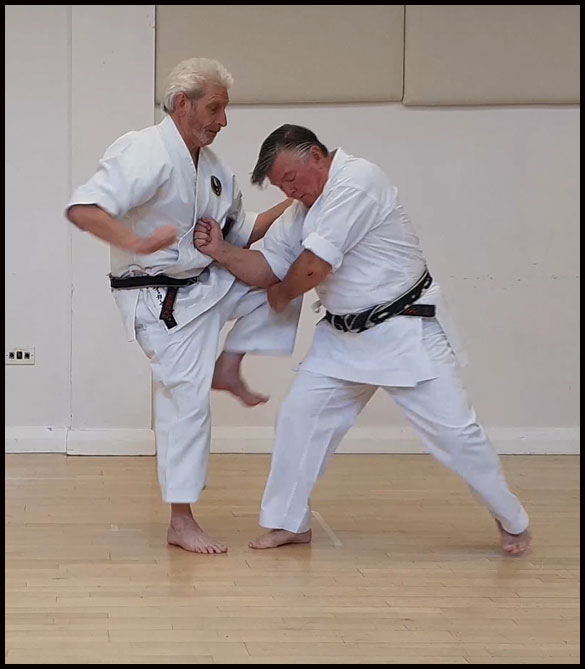
Omomi (重み) is the Wadō word for “weight” or “heaviness,” but it does not mean muscular strength. Omomi refers to the felt body mass behind a technique — the kind of impact where the opponent feels your whole body, not your arm. The strike lands heavy but calm, and the power penetrates rather than snaps.
This is exactly the type of heaviness Wadō aims for: dense, quiet, and unavoidable. It is not created by tensing the shoulder, stamping weight, or forcing a wide stance. It is created by correct timing, correct structure, and correct movement — so the body arrives as one unit.
What It Means to “Hit with Omomi”
In Wadō terms, when a senior says “hit with omomi,” they are pointing you toward a very specific quality:
- The opponent feels your whole body, not just the limb.
- The technique lands heavy but calm — no visible forcing.
- The power enters rather than “snaps” off the surface.
Omomi is not a separate trick you add on at the end — it is the natural result of the body being organised correctly.
How Omomi Works in Wadō-Ryū
Omomi is created by a combination of Wadō principles working together. Remove any one of them and the heaviness disappears:
- Shizumu (沈む) — settling of the centre so body mass can arrive.
- Hadō (波動) — wave transmission so force travels cleanly through the body.
- Dōsa (動作) — correct movement so the body arrives as one connected unit.
- Ryūsui (流水) — continuity without stopping, so technique does not “break” in delivery.
Omomi is the result of connected delivery. It is what happens when timing, posture, and movement align — and nothing unnecessary blocks the transmission.
What Omomi Is Not
- Omomi is not brute force.
- Omomi is not tensing the arm or shoulder.
- Omomi is not wide, rooted stances as a substitute for timing.
- Omomi is not stamping or dropping weight hard.
True omomi feels dense, quiet, and inevitable. It is heaviness that arrives naturally — not heaviness that is “put on.”
Where Omomi Is Most Evident
You’ll feel omomi most clearly in training that emphasises short-range structure and connected body delivery, such as:
- Naihanchi (short-range techniques and posture control)
- Kihon Kumite (especially numbers 3, 7, and 10 See videos examples below)
- Seishan close-range entries and finishing actions
- Body strikes, controls, and decisive close-range transitions
“It feels like being leaned on by the floor.”
Related Terms You May Also Hear
| Term | Meaning | Relation |
|---|---|---|
| Shizumu | Sinking / settling | Creates the condition for omomi to arrive |
| Jū (柔) | Softness / yielding | Allows omomi to enter without collision |
| Chikara | Strength | Not the goal in Wadō delivery |
| Kime | Focus / decisiveness | Secondary to omomi in Wadō (often confused with tension) |
In Simple Terms
Omomi is the heaviness of correct body mass arriving at the right moment. If you’re writing or teaching, “hit with omomi” is both technically accurate and very much Wadō language — because it describes the quality we are trying to produce, not just the technique we are performing.
Kihon Kumite Examples of Omomi
Below are short demonstrations from Kihon Kumite that highlight how omomi appears in Wadō-Ryū practice. Notice how the heaviness comes from timing, structure, and settling — not force.
Kihon Kumite 3
Kihon Kumite 7
Kihon Kumite 10
Upcoming filming sessions & YouTube releases
Stay tuned for new Kata deep-dives and historical features on our YouTube channel.
Join our mailing list for updates