Taisabaki (体捌き) — Body Movement and Evasion in Wadō-Ryū
· by Roger Vickerman Renshi (7th Dan) · Principles
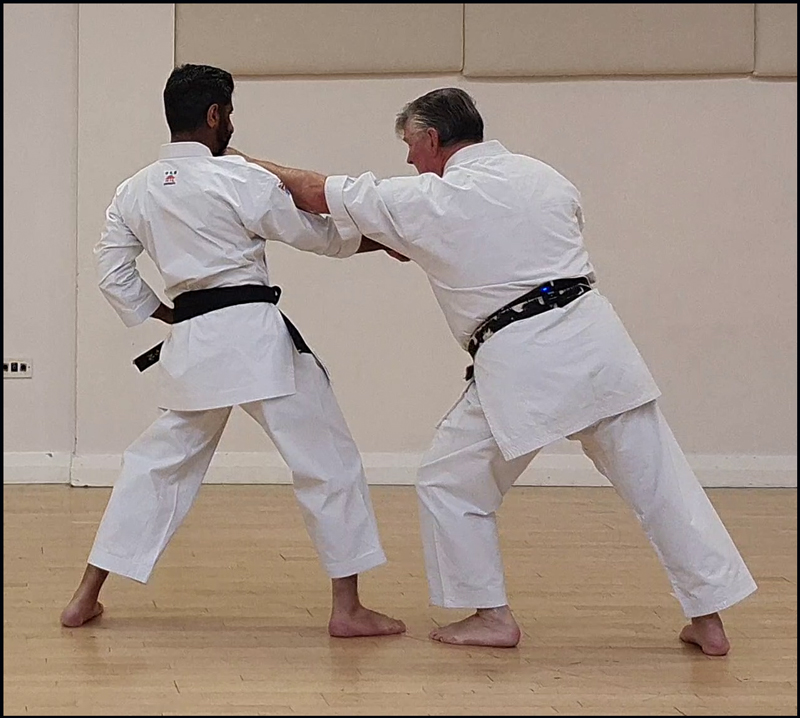
Taisabaki (体捌き) is one of the clearest expressions of what makes Wadō-Ryū distinct. Often translated simply as “body movement” or “body shifting,” the term carries far more depth than a change of position alone. In Wadō, taisabaki is the art of moving the body so that attack is avoided, position is improved, balance is preserved, and opportunity is created — all within the same action.
Without taisabaki, technique quickly becomes hard, linear, and collision-based. The practitioner stays in front of force, tries to oppose it, and ends up relying on strength, speed, or toughness to recover. With correct taisabaki, the body moves in such a way that conflict is reduced before it fully develops. This is why high-level Wadō can appear calm, efficient, and almost effortless: the body is not merely reacting to attack, but reorganising space, angle, and timing in its favour.
What Taisabaki Means in Wadō-Ryū
At its simplest, taisabaki means moving the body appropriately in relation to the opponent. In practice, however, it includes several inseparable qualities:
- evasion — removing the body from the attacking line
- positioning — arriving in a place of advantage
- timing — moving at the correct moment
- continuity — allowing defence, entry, and control to remain connected
For this reason, taisabaki is not a decorative movement added before or after technique. It is the condition that allows the technique to work. The hands may express the result, but the body creates the reality.
More Than Stepping Aside
A common misunderstanding is to think of taisabaki as merely “getting out of the way.” While evasion is certainly part of it, good taisabaki does far more. The movement does not simply escape danger — it simultaneously creates the angle, distance, and alignment from which effective technique can emerge.
In Wadō, this often means that the body moves off the line while at the same time preparing entry. The shift may be small, but its effect is decisive: the opponent loses clear access to your centre while you gain access to theirs.
Why Taisabaki Sits at the Heart of Wadō
Wadō-Ryū is not based on meeting force with force. Its character is shaped by timing, angle, and non-collision. Taisabaki is therefore not one principle among many — it is one of the primary means through which Wadō expresses itself.
When taisabaki is correct:
- Datsuryoku can be maintained because the body is not bracing against impact
- Ryūsui can appear because movement continues without interruption
- Dōjini becomes possible because defence and response happen within the same moment
- Kuzushi develops naturally because position and structure are already being taken
This is why taisabaki links so many other principles together. It is not separate from them; it is one of the ways they are physically expressed.
Key Characteristics of Good Taisabaki
Moving the Centre, Not Just the Feet
Taisabaki is not footwork alone. The feet support it, but the real question is whether the centre has moved. It is entirely possible to take a step and still remain in the line of attack. Correct taisabaki means the whole body has shifted so that the attack no longer finds its intended target.
Economy of Motion
In Wadō, the movement is usually smaller than beginners expect. Large movement often creates delay and exposes intention. Taisabaki should be sufficient, not dramatic — just enough to remove danger and create advantage.
Angle and Line
Good taisabaki changes relationship, not just location. By adjusting the angle, the practitioner moves from a vulnerable line to a stronger one, often taking the outside or inside in a way that weakens the opponent’s structure.
Readiness to Continue
Taisabaki never leaves the body “finished.” The movement must preserve the ability to continue — to strike, enter, control, or flow into the next action without interruption.
Where Taisabaki Appears in Training
Taisabaki is everywhere in Wadō, but it is especially visible in areas where the body must move as one integrated unit:
- Kihon — where line work begins to reveal how posture and movement generate technique
- Kihon Kumite — where moving off line and taking position are essential
- Kumite Kata — where angle, timing, and control become more pronounced
- Kata — where turning, entering, and changing line embody principles rather than choreography
As understanding develops, practitioners begin to see that many techniques once thought of as “blocks” are in fact expressions of taisabaki combined with receiving, entering, and controlling.
Taisabaki and the Opponent’s Balance
One of the most important functions of taisabaki is that it does not only protect the defender — it affects the attacker. When the body moves correctly, the attacker often finds that their line, posture, or balance no longer works in the way they expected.
This is where taisabaki begins to merge with kuzushi. By moving off line while maintaining contact, entering, or adjusting angle, the defender causes the attacker to overextend, twist, settle incorrectly, or become structurally weak. The balance break is not added afterwards. It begins at the moment of movement.
Taisabaki Is Not Running Away
Another common misunderstanding is to think that evasion means retreat. In Wadō, taisabaki is not about escaping engagement and starting again from distance. It is about removing danger while staying connected to the exchange.
Sometimes that means moving slightly away. Often it means moving diagonally, turning, entering, or blending just enough to take the better line. The aim is not absence — it is advantage.
How It Connects to Other Wado Principles
Taisabaki acts as a bridge between many of Wadō’s most important ideas:
- Nagasu / Nagashi — allowing force to pass while guiding it
- Irimi — entering at the correct moment and angle
- Ma-ai — creating and destroying combative distance
- Kōbō-ittai — attack and defence existing as one action
- Ai-nuke — passing without clashing
Because of this, taisabaki is often best understood not as a single technical item, but as a principle that gives life to many others.
Common Misunderstandings
- Taisabaki is not footwork alone
- Taisabaki is not exaggerated circling or theatrical dodging
- Taisabaki is not retreating without purpose
- Taisabaki is not separate from technique
It is body movement that removes danger and creates opportunity in the same moment.
Closing Thoughts
Taisabaki is one of the clearest gateways into understanding Wadō-Ryū properly. Once the body begins to move off line with correct timing, angle, and intention, techniques stop feeling isolated and start becoming connected. Defence no longer needs to be hard. Attack no longer needs to be forced. Control begins to appear through placement, structure, and movement.
In this sense, taisabaki is not simply a method of avoiding attack. It is the means by which Wadō transforms conflict — not by meeting force directly, but by moving the body so well that the need for collision disappears.