Rohai Kata – The Hidden Depths of a Small Kata
· by Roger Vickerman Renshi (7th Dan) · Kata
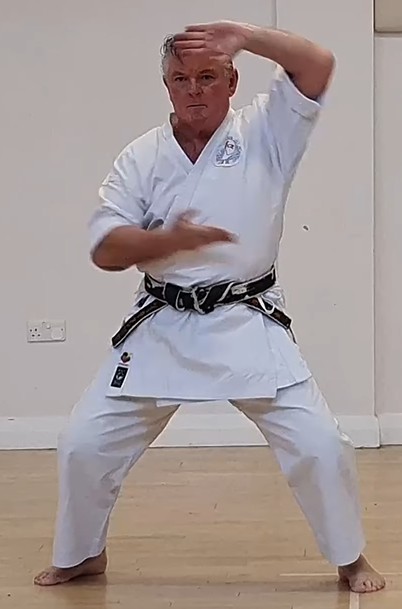
Rohai (鷺牌) is a kata that can easily be underestimated. It’s short. It looks clean. It feels almost simple at first glance. And yet, the deeper we dug into it for this week’s video, the more we realised just how much is hidden in such a compact form. Rohai is a reminder that “small” does not mean “shallow” — in many ways, it means the opposite: refined, concentrated, and essential.
As always, a quick note on lineage and respect: the way we practise Rohai is based on how I was taught by Takamizawa Sensei, with additional influences through Ōtsuka Sensei. If your instructor teaches it differently, please follow their method with courtesy and consistency.
Origins and Background
Rohai is commonly translated as “Vision of the White Heron” or “Image of a Crane”, depending on whether you trace it through Chinese or Okinawan roots. The kata’s characteristic one-legged postures and fluid transitions strongly suggest influence from Southern Chinese White Crane traditions.
Traditionally, there are three versions — Rohai Shodan, Nidan, and Sandan — but in Wadō-Ryū we practise only Rohai Shodan. This mirrors the way Wadō treats Naihanchi: Ōtsuka Sensei I retained the first kata because he felt it contained what was needed without redundancy. The Wadō version is also notably close to the Shitō-Ryū Rohai, likely reflecting Ōtsuka Sensei’s training links through Kenwa Mabuni.
Technical Deep Dive
Although short, Rohai is densely packed with Okinawan principles. When you stop treating it as choreography and begin exploring what the motions do, the kata opens up into a close-range study of balance breaking, sticking control, and efficient body mechanics.
Opening Movements
We begin by taking the opponent off-centre and using the chest — closing and opening — to create kuzushi (unbalancing). A hint of jujutsu logic is present right away: rather than meeting force head-on, we disrupt posture and create opportunity through structure and timing.
Body Mechanics and Flow
Rohai does not suit stiff or overly formal movement. The kata asks for natural relaxation and subtle spirals through the arms, while maintaining protection. We also discuss practical concerns around keeping the body covered without exposing vulnerable lines (including the neck and arteries) — a very grounded, pragmatic approach.
Practical Applications
Throughout the breakdown we alternate between options: grabs, strikes, pulls, and locks. Rohai’s applications are “sticky” and close-quarters. There is also strong use of nagashi — flowing movement that blends and redirects rather than colliding. We also cover two variations in places: one more competition-friendly, and another closer to traditional jujutsu application, depending on your training context.
Key Concepts Explored
Rohai is a superb vehicle for revisiting core ideas that often remain theoretical unless you put them under pressure:
- Maai (間合い): not only distance, but the timing implied by distance — and the shifting “just right” zone between kicking, punching, and grappling ranges.
- Gamaku (ガマク): engagement of the body’s centre, especially the obliques and psoas, supporting stability and explosive action.
- Chinkuchi (チンクチ): connected whole-body release — distinct from “kime” — allowing power to express through short, efficient movement.
- Mochimi (モチミ): heaviness and “stickiness” in strikes and controls — grounded, adhesive body dynamics rather than light, fast, touch-based technique.
Historical Insights
One detail worth highlighting is that the Matsumura associated with Rohai is not Sokon Matsumura (often linked with kata such as Chintō and Bassai), but Kosaku Matsumura — another significant figure in Okinawan martial history. Both Matsumuras taught Itosu and Motobu, which helps explain why these kata threads run so deeply through Okinawan lineages.
The heron imagery is also more than poetic. In Okinawa, herons were admired for stillness, balance, and sudden explosive movement — qualities that Rohai expresses beautifully in its poised transitions and decisive actions.
Closing Reflections
When I first set out to prepare Rohai, I expected it to be quick. But the more we explored, the more depth we uncovered. Every posture, angle, and turn holds meaning once you begin looking underneath. Rohai teaches us that “smaller” can mean more concentrated — and therefore more demanding — because there is nowhere to hide inside the form.
My thanks as always to Sensei Kerry, to Simon (who may have made a surprise appearance in the video!), and to Tanya for her work behind the camera. And thank you to everyone who likes, subscribes, and shares — it genuinely helps keep the channel moving forward.
Watch the video on YouTube or join the conversation on Facebook.
What has Rohai revealed to you in your training? Have the “sticky” applications, one-legged balance, or close-range principles stood out? Share your reflections and let’s keep learning together.