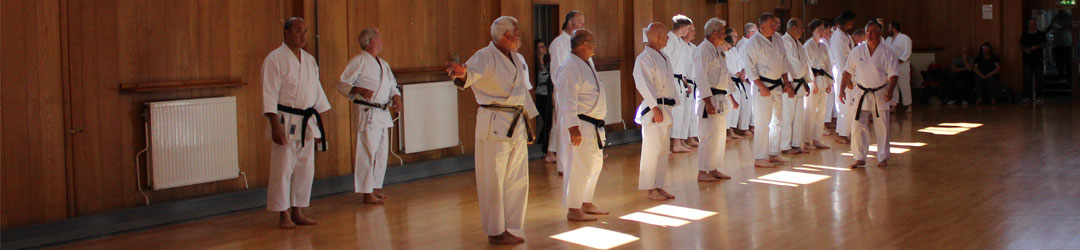
Traditional Karate
Weekly Newsletter • 20 April 2026
Weekly Update from Wadō-Ryū Benkyō
Hello,
Welcome to your 19th Weekly update from Wado-Ryu Benkyo, here is what you will find below:
🥋 1. Course Review and reflections 17th-19th April 2026
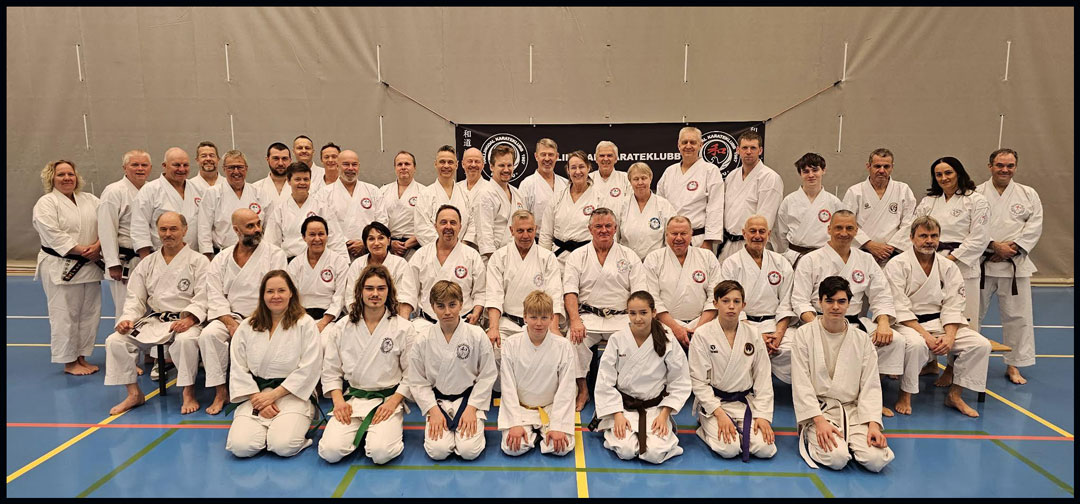
Training Review – Gol, Norway
Three days of training in the beautiful mountain town of Gol provided the perfect setting for focused study and shared exploration. Despite light rain, the atmosphere remained bright, with strong spirit and excellent energy throughout.
Day One – Foundations of Movement and Energy
The first day centred on understanding the role of body movement within Kihon. We explored how movement generates potential energy, and how this energy can be transferred effectively into technique. Even within fundamental practices such as Junzuki and Kette Junzuki, there remains a depth that continues to reveal itself, regardless of years of experience.
A key theme was recognising where one technique ends and the next begins. Each technique has its own life, but must also support and give life to the next. This continuity comes only through correct movement, posture, and connection.
The extended format of the course allowed time to explore these ideas in detail, making small but meaningful adjustments for each participant. We progressed through Junzuki, Kette Junzuki, Junzuki Notsukomi, Gyakuzuki, Kette Gyakuzuki, and Gyakuzuki Notsukomi, finishing the first half of the day with Kette Gyakuzuki Notsukomi. Time passed quickly, but the depth of work achieved was significant.
In the afternoon, we applied these principles in partner work. Beginning with Uke attacking Chudan Gyakuzuki, Tori moved off the line of attack while redirecting the strike. This drew clear parallels with movements seen in Kihon Kumite, particularly in relation to avoiding Sokuto Geri. The emphasis shifted to distance, timing, and the subtle principles of nagasu, inasu, and taisabaki.
Once comfortable with ten-i and ten-tai, we introduced ten-gi, allowing defensive movement to transition into attack. From the initial evasion and redirection, Tori flowed back using ryusui, entering at a weakened 45° angle to achieve full kuzushi. This was then developed further into a neck control and finished with a leg reap, bringing Uke to the ground. The exercise demonstrated how strong attacks can be neutralised and controlled through correct body movement and posture.
This brought the first day’s training to a close.
Day Two – Integration and Application
The second day built directly on the first, reinforcing fluidity, directional change, and the integration of movement principles.
Working with a partner, we examined a different response to Chudan Gyakuzuki. Rather than moving away, Tori entered the attack on the inside line using Nukite, applying noru to guide the attack past the body. Simultaneously, a subtle nagashi disrupted Uke’s balance, allowing a decisive taisho strike to conclude the exchange.
This practice, reminiscent of Kumite Kata No. 9, required precise timing, distance, and refined taisabaki. It continued to reinforce the relationship between ten-i, ten-tai, and ten-gi as a unified expression of movement.
After the break, we explored these same principles within a different context—escaping a double wrist grab. The focus remained on whole-body movement rather than isolated arm strength. Through connected, controlled motion, participants worked to break Uke’s balance and centre, naturally weakening the grip.
To anchor this in familiar practice, we used Kihon Kumite No. 1. The release of the right-hand grip through Gaiwan Uke was driven by body movement, not the arm, followed by a coordinated drop and turn to release the second hand. This proved to be an excellent training method for ensuring that Kihon Kumite is performed with full-body integration.
As with the first day, time moved quickly. The training concluded with continued discussion, reflection, and exchange of ideas well into the evening.
Day Three – Returning to the Source
The final day, though shorter, brought everything together.
We began with Kihon Kumite No. 1 from Uke’s perspective, focusing on body movement, shizumu within the second defence, and the importance of timing. Attention then shifted to the attacking role more broadly—how posture, movement, and intent must be fully realised to create a meaningful and effective attack.
Returning to the very first Junzuki practised on Day One, we revisited how subtle body movements generate distance, prepare the body, and deliver power with speed and precision. With Uke now applying greater pressure, Tori was required to respond with increased sharpness and clarity.
This progression brought the training full circle. Although we ended where we began, the understanding—and the reference point—had fundamentally changed.
After heartfelt goodbyes and a few photographs, it was time to return to Oslo for a final evening before travelling back to the UK.
An excellent three days of training, shared with both old and new friends—and hopefully not too long before we return again.
Saturday sessions to run through 2026 - if you would like to attend a Saturday session for the first time Contact us and let us know and check the Events calendar for future session dates.
🎥 2. This Weeks Long-Format Video
Part 27 - Kihon Fundamentals - Technical Breakdown Part 2
📝 3. Featured Article of the Week
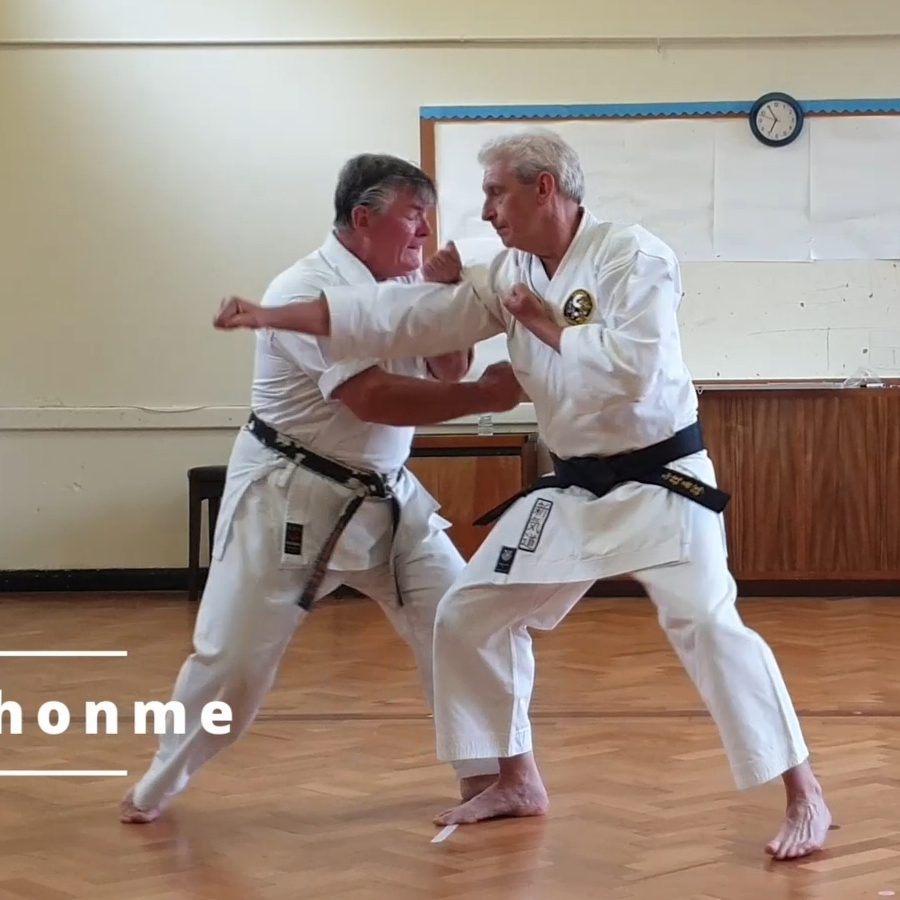
Ippon Kumite No.5 – Gohon Me: Flow, Angle and Continuous Control in Wadō-Ryū
Based on movements from Pinan Shodan
Ippon Kumite No.5 – Gohon Me builds directly on the earlier forms, introducing a more fluid expression of movement, connection, and control. Drawing its origins from Pinan Shodan, the sequence reflects the characteristic shuto actions of the kata, but within a paired context where timing, positioning, and body use become essential.
At first glance, the movement appears straightforward. However, as with all Wadō practice, its depth lies not in the sequence itself, but in how the body is used to create and sustain the technique.
From Pinan Shodan to Ippon Kumite
The roots of this Ippon Kumite can be clearly seen in the opening movements of Pinan Shodan, particularly in the double hand actions that resemble shuto application.
What appears as a simple blocking and striking combination in kata becomes, in paired work, a study of:
- moving off the centre line
- coordinating both hands simultaneously
- creating connection through contact
- maintaining flow into the next technique
This transformation from kata to application highlights a key Wadō principle — movement must be alive and adaptable, not fixed.
Distance, Simplicity and Learning Progression
The formal method of movement uses:
- okuri ashi (sliding step)
- tsugi ashi (following step)
both forwards and backwards.
However, for beginners, particularly at lower grades, stepping straight back is often encouraged as a valid starting point. The priority is not complexity, but understanding ma-ai (distance) and safely creating space from the attack.
By simplifying the footwork, students can focus on:
- correct body alignment
- coordinated hand movement
- awareness of timing
As understanding develops, the more refined footwork can be reintroduced without compromising the underlying principles.
Moving Off the Centre Line
As Uke attacks with Jōdan Junzuki, Tori steps back — but not directly along the original line.
Instead, the movement subtly shifts the body off the centre line. By placing the rear foot slightly in line with the front, Tori repositions their centre, ensuring that the attack passes to the side of the head rather than through it.
This is a critical detail.
If performed correctly:
- Uke’s punch will no longer align with Tori’s centre
- Tori gains both safety and positional advantage
- the technique begins from a place of control rather than reaction
From Uke’s perspective, this shift should be clearly felt — if the punch still travels directly towards the face, the movement has not been sufficient.
Two Hands, One Movement
A defining feature of this waza is the simultaneous use of both hands.
- One hand rises in a jōdan suri uke (gaiwan) action
- The other delivers a chūdan strike
This is not two separate techniques, but a single unified movement, driven by the body.
The coordination of both hands creates:
- immediate defensive cover
- simultaneous offensive intent
- connection with Uke’s attacking arm
The arms do not act independently — they are guided by the movement of the body and centre.
Connection, Rotation and Kuzushi
Following the initial contact, the punching hand uses a suri action to draw Uke in. This is where the technique begins to evolve beyond simple block and counter.
Through:
- subtle rotation of the arm
- connection to Uke’s limb
- and coordinated hip movement
Tori creates a spiralling action that applies both twist and downward pressure.
This has a significant effect on Uke:
- their structure begins to collapse
- balance is compromised
- resistance becomes increasingly difficult
The final Gyakuzuki is delivered at close range (knee to knee), not as a reaching strike, but as the natural conclusion of the body’s movement and control.
Going Beyond the Line
A key teaching point in this Ippon Kumite is that movement does not stop at the point of evasion.
It is not enough to move off the attacking line — one must move beyond it.
If Tori stops too early:
- the attack may still connect
- or Uke may be able to re-engage immediately
The movement must carry through, ensuring that:
- the attack is fully avoided
- position is established
- control is maintained
This reflects the Wadō concept of continuous motion — nothing is static, and nothing is incomplete.
Zanshin – Before, During and After
As with all Ippon Kumite, the technique does not end with the strike.
Zanshin — awareness — must be maintained throughout:
- before the attack
- during the exchange
- and after the technique is completed
A common mistake is to disengage mentally once the sequence is finished. However, true practice requires continued awareness, readiness, and presence.
This is not simply etiquette — it is an essential part of martial understanding.
What Uke Should Feel
From Uke’s perspective, several key elements should be experienced:
- the loss of centre line as Tori shifts position
- the spiralling, downward pressure through the arm
- the sensation of supporting Tori’s weight
- the inability to counter effectively once balance is broken
If these elements are not present, the technique is likely being performed with the arms rather than the body.
More Than a Sequence
Although presented as a formal exercise, Ippon Kumite No.5 contains several important Wadō principles:
- moving off the centre line
- using both hands as a unified action
- creating connection rather than collision
- applying rotation to generate kuzushi
- maintaining flow from defence into attack
- preserving awareness throughout the exchange
Final Thoughts
Ippon Kumite No.5 continues the progression of the series, deepening the relationship between kata and application.
Through careful practice, it reveals how subtle adjustments in angle, timing, and body use can transform a simple movement into an effective and controlled technique.
Like all Wadō practice, it is not the outward form that matters most — but the quality of movement that brings it to life.
Follow the link for the full detailed breakdown video.
📅 4. Upcoming Courses, Events, or Updates
Things you may want to know about:
- Course and events are live on the website events calendar and will be updated regularly so please bookmark it and check it.
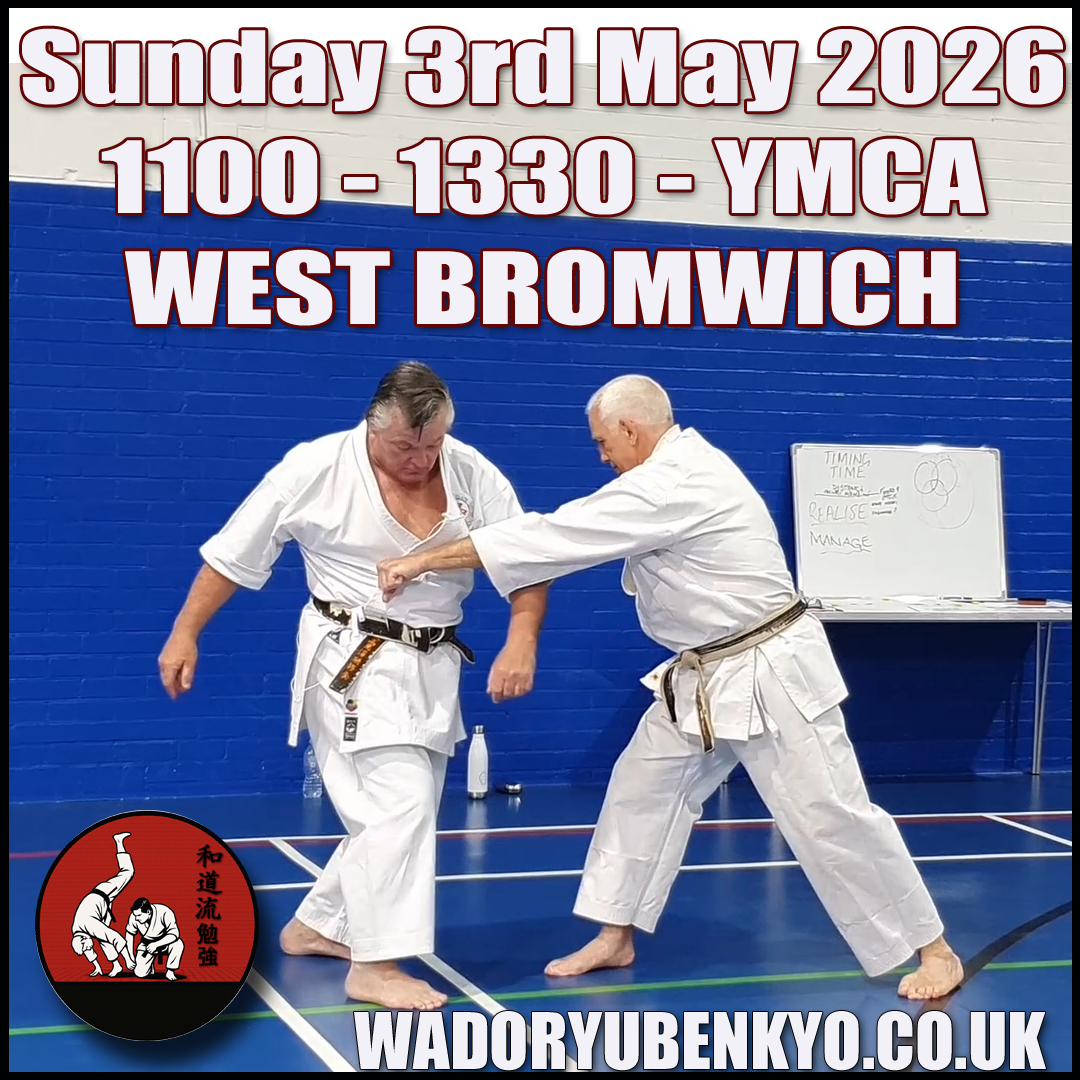
- The May 2026 course dates and location has been confirmed, you can see all the details and book on here.
🧠 5. Wado Ryu Principle of the Week
Dōjini (同時に) — Simultaneous Action in Wadō-Ryū
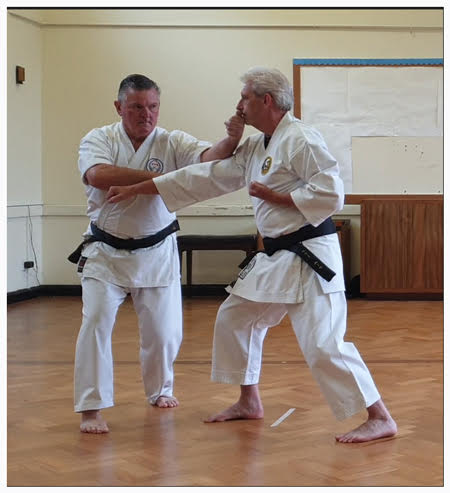
Dōjini: defence and attack occurring together, expressed through timing, positioning, and unified movement.
Dōjini (同時に) is commonly translated as “simultaneously” or “at the same time”. In Wadō-Ryū Karate, it describes the ability to perform defensive and offensive actions as a single, unified movement rather than as separate steps.
At a basic level, this may appear to mean blocking and countering together. However, in Wadō, the idea runs deeper. Defence and attack are not two distinct actions performed quickly one after the other — they are part of the same movement, occurring within the same moment.
In this way, Dōjini reflects a more refined understanding of timing, efficiency, and structure.
Understanding the Meaning of Dōjini
The phrase is composed of three elements:
- Dō (同) — same
- Ji (時) — time
- Ni (に) — indicating manner
Together they describe actions occurring within the same moment.
In everyday Japanese, this simply means doing two things at once. In Wadō-Ryū, however, it becomes a principle of movement — ensuring that no action is wasted and no gap exists between defence and response.
Why Wadō-Ryū Emphasises Dōjini
Wadō-Ryū places strong emphasis on efficiency and natural movement. Techniques are not intended to rely on strength or excessive speed, but on correct timing and positioning.
If defence and attack are separated, even by a fraction of time, several problems arise:
- the opponent may recover or adjust
- the practitioner may become fixed or rigid
- the flow of movement is broken
- opportunity is lost
Dōjini avoids these issues by ensuring that the moment of defence is also the moment of control.
Rather than thinking in terms of “block, then counter”, Wadō encourages the practitioner to act in a way where the defensive movement itself creates the attack.
Timing Rather Than Sequence
A common misunderstanding is to treat technique as a sequence of steps.
Step 1: defend
Step 2: counter
In practice, this often leads to hesitation or delay.
Dōjini removes this separation. The correct approach is not to move faster between steps, but to eliminate the steps altogether.
The action becomes:
One movement, one moment, one intention.
This is why effective Wadō technique often appears effortless. There is no visible transition between defence and attack — they are inseparable.
Dōjini in Wadō Movement
Dōjini is expressed through several key aspects of Wadō practice.
Taisabaki (Body Movement)
As the body moves off the line of attack, it simultaneously creates the position for counter-technique. The evasion is not separate from the response — it is the beginning of it.
Nagasu and Inasu (Flowing and Deflecting)
Rather than stopping the attack, the practitioner redirects it while applying technique. The redirection and the counter occur together, without interruption.
Irimi (Entering)
Entering movement often takes place at the same moment the attack is avoided. This creates immediate control of distance and position, leaving little opportunity for the opponent to continue.
Examples in Wadō Training
Dōjini appears throughout Wadō practice.
In Kihon Kumite, the defender does not block and then counter as two separate actions. Instead, the body movement, deflection, and counter-technique occur together as one integrated response.
In kata, many movements that are often interpreted as blocks can be understood as simultaneous defensive and offensive actions. The apparent “block” is frequently the moment of control.
In kumite, Dōjini becomes essential. If actions are separated, even slightly, the opponent can exploit the gap. When movement is unified, control is established immediately.
Dōjini and the Mind
To apply Dōjini effectively, the mind must also be unified.
If the practitioner thinks in stages, the body will move in stages.
If the mind is divided between defence and attack, the technique will also be divided.
The correct state is one of calm awareness, where action emerges naturally without conscious separation. This aligns closely with principles such as Mushin and Fudōshin.
Common Misunderstandings
Dōjini is sometimes misunderstood in practice.
- it is not performing two techniques quickly one after the other
- it is not rushing to counterattack
- it is not relying on speed alone
Instead, it is the removal of separation between actions. The technique becomes a single, continuous expression of movement.
In Simple Terms
Dōjini means that defence and attack occur together, within the same moment.
In Wadō-Ryū, this reflects a deeper principle — that effective technique does not come from doing more, but from doing less, with greater precision. When movement is unified, timing becomes natural, effort is reduced, and control is established immediately.
🙏 Thank You for Being Part of the Community
If you have any questions, video requests, or feedback, simply reply to this email — We read everything.
Wishing you a fantastic week of training,
Roger and The Team
Wado-Ryu Benkyo
https://wadoryubenkyo.co.uk/
If you no longer wish to receive these weekly updates, simply reply with “UNSUBSCRIBE” and we will remove you from the mailing list.