Traditional Karate
Weekly Newsletter • 26 April 2026
Weekly Update from Wadō-Ryū Benkyō
Hello,
Welcome to your 20th Weekly update from Wado-Ryu Benkyo, here is what you will find below:
- 🥋 Saturday Benkyō Class Review
- 🎥 This Week’s Long-Format Video
- 📝 Featured Article of the Week
- 📅 Upcoming Courses, Events, or Updates
- 🧠 Principle of the week
🥋 Saturday Benkyō Class Review – Posture Through Motion
Today’s session was, in many ways, a masterclass in posture through motion.
It is often assumed that posture is something fixed — how we stand before and after a technique. However, correct Wadō-Ryū technique demands something far more subtle: posture must be maintained throughout the entire movement. If posture breaks at any point, connection is lost — and with it timing, power, and ultimately impact.
This formed the focus of the first half of the session.
Working through kihon techniques, we explored posture at the start, middle, and end of each movement. The key question was not simply what moves, but what moves first — and how that connects to what follows.
How is the chain formed that allows the body to move as one? How does the centre carry the body through the technique, creating weight, balance, and correct ma-ai? And just as importantly — what requires tension, and what must remain relaxed for movement to flow?
This is a vast area of study, one that can only be touched on in a single session, but enough to prompt reflection and guide future training.
We also examined the difference between moving on the heel and the ball of the foot, and how this affects posture, timing, and distance. Understanding when to apply or release tension — and how the foot interacts with the ground — has a direct influence on speed, structure, and effectiveness.
These ideas were then carried into Pinan Godan, where the opening sequence provided an excellent example of how rotation on the heel can drive the body forward into the technique. Rather than retreating, the movement becomes both defensive and offensive, establishing correct distance for the counter while adding depth and power through controlled balance.
We spent some time working this sequence in detail, allowing those training to explore the nuances for themselves and develop a clearer understanding of the underlying principles.
From there, we moved on to Jion, applying the same concepts to the transition into a strong Neko Ashi Dachi. This offered a useful shift in perspective, showing how what is often considered a basic stance can, when used correctly, open up a wide range of possibilities — defensive, offensive, or both simultaneously.
We also examined the principle of Meotode, particularly in the crossing of the hands before the uke. The initial crossing hand can act as a subtle slip against the incoming attack, allowing the following hand to take full control. The contrast between using one hand and two was significant, and became clear through partner work.
To reinforce this, we worked through selected keisetsu from the opening of Jion, exploring jujutsu-based applications — including a grab release followed by deflection and control of a second attack. Here, timing, posture, and connection were very much in focus.
The session concluded with a discussion and demonstration of elements from Chintō Kata, highlighting the balance between relaxation and structure. The body must remain free enough to flow, yet organised enough to arrive in the correct position at exactly the right moment.
After a powerful demonstration of relaxed movement and some thoroughly engaged (and slightly overheated) minds, the session came to an end all too quickly. As always, the overriding feeling was how soon we could return to the dojo and continue the work.
Finally, thank you to everyone who travelled considerable distances to attend — it is always appreciated, and a reflection of the commitment within the Wadō community.
Saturday Benkyo sessions will run throughout May 2026 (no training Saturday 23rd May).
🎥 This Week’s Long-Format Video
Part 28 - Kihon Fundamentals - Technical Breakdown Part 3
📝 Featured Article of the Week
Ippon Kumite No.6 – Ropponme: Controlling the Centre Through Continuous Movement
A study in direction, balance, and the manipulation of the opponent’s centre
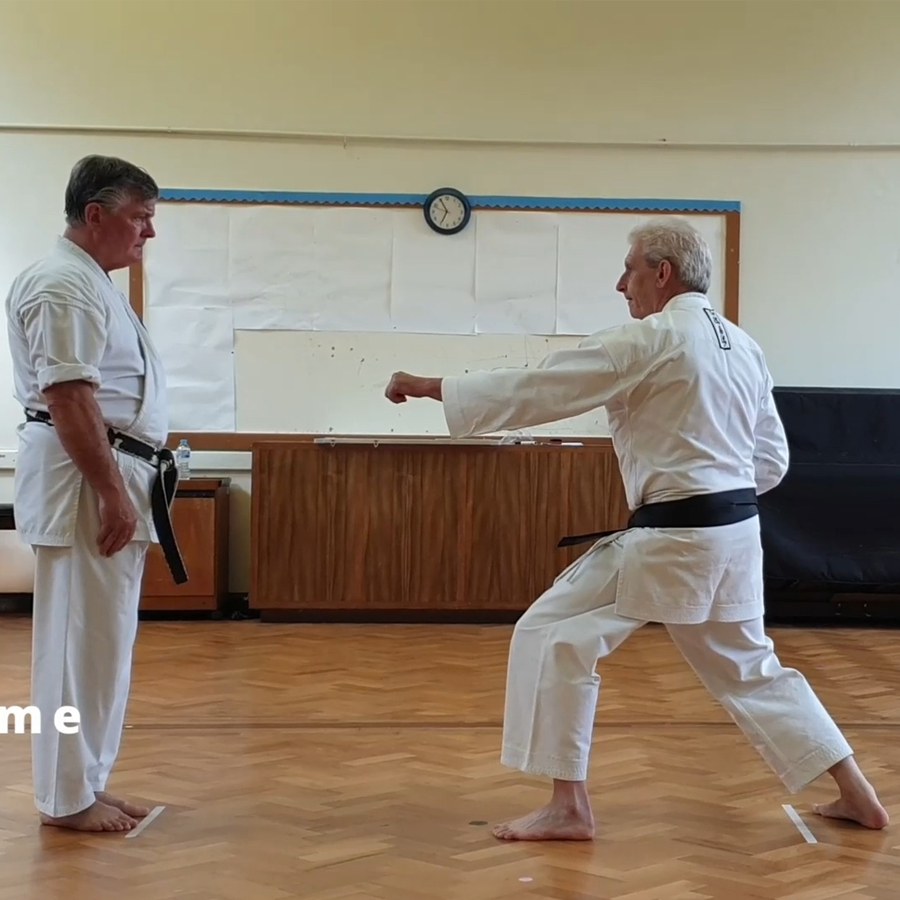
Ippon Kumite No.6 – Ropponme represents a significant step forward in the Wadō-Ryū syllabus. While earlier forms establish timing, angle, and structure, this waza introduces a more advanced concept — the continuous manipulation of the opponent’s centre of gravity.
As Sensei often remarks:
“This is the first one where you can really start to play with the body — where you put them, how they move, and the direction they’re going.”
Rather than a simple exchange of techniques, Ropponme becomes a study in how the body can influence, guide, and ultimately control an opponent through movement.
Initial Contact – Creating Backward Movement
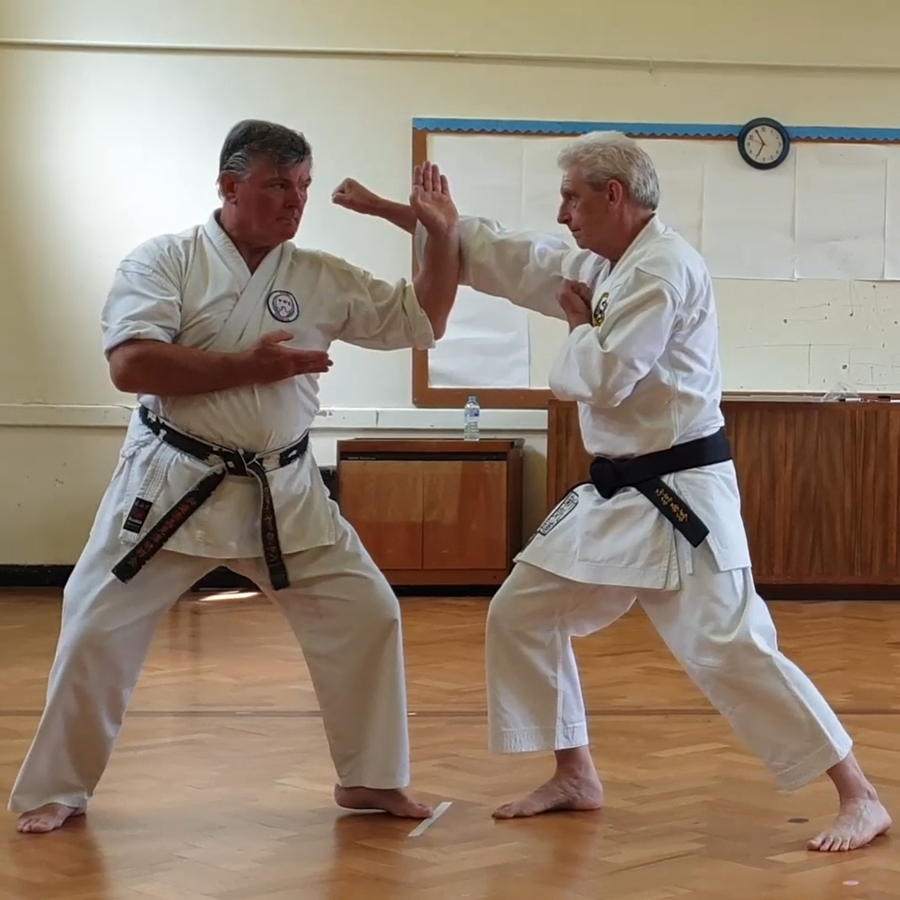
The sequence begins with Ayumi Ashi Jōdan Junzuki, met by a step back into Hidari Shutō Uke. This first action is critical — not simply as a block, but as a means of creating immediate disruption.
The emphasis is on using the body, not the arm alone. The Shutō action should encourage the attacker to move backwards, subtly shifting their centre and breaking their forward momentum.
“You’re already starting to move them — before anything else happens, you’ve taken their centre away.”
Pulling Forward – Changing Direction
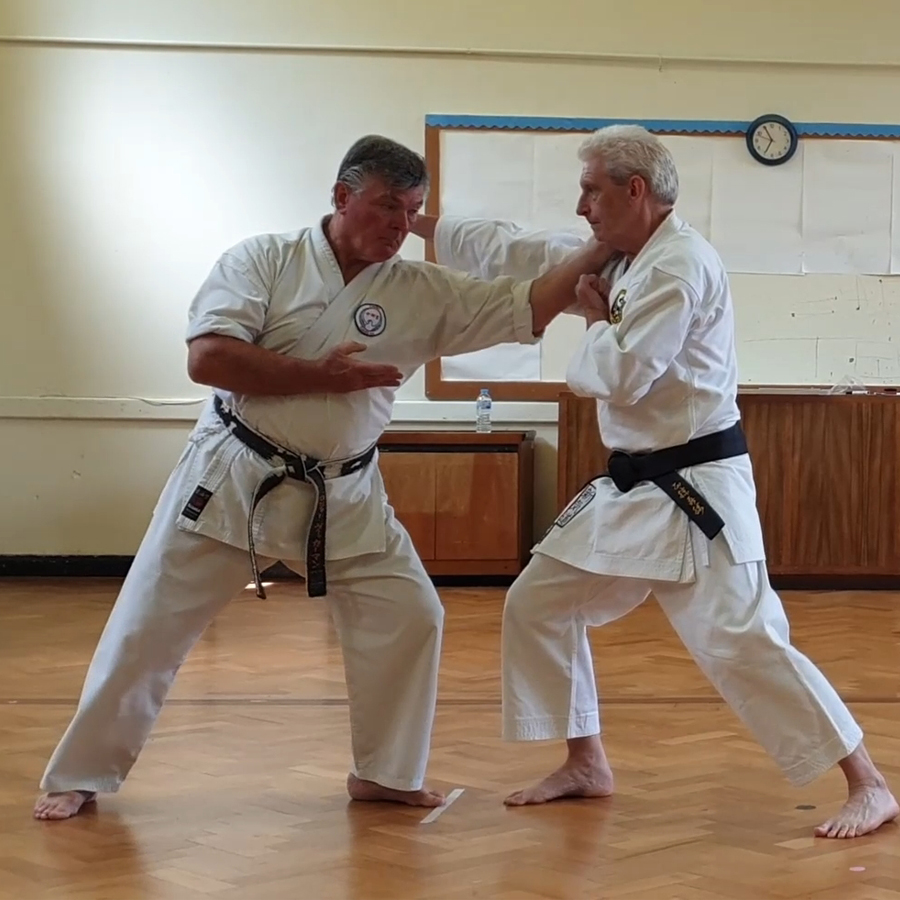
From this initial disruption, the movement changes direction. The arm is drawn down and back, pulling the opponent forward into the next phase.
This is a defining feature of Ropponme — the opponent is never static. They are continuously being moved, first backwards, then forwards, never able to regain balance.
As highlighted in training:
“You take them back… then you bring them forward… they never get their bearings.”
Mae Geri – Using Their Movement
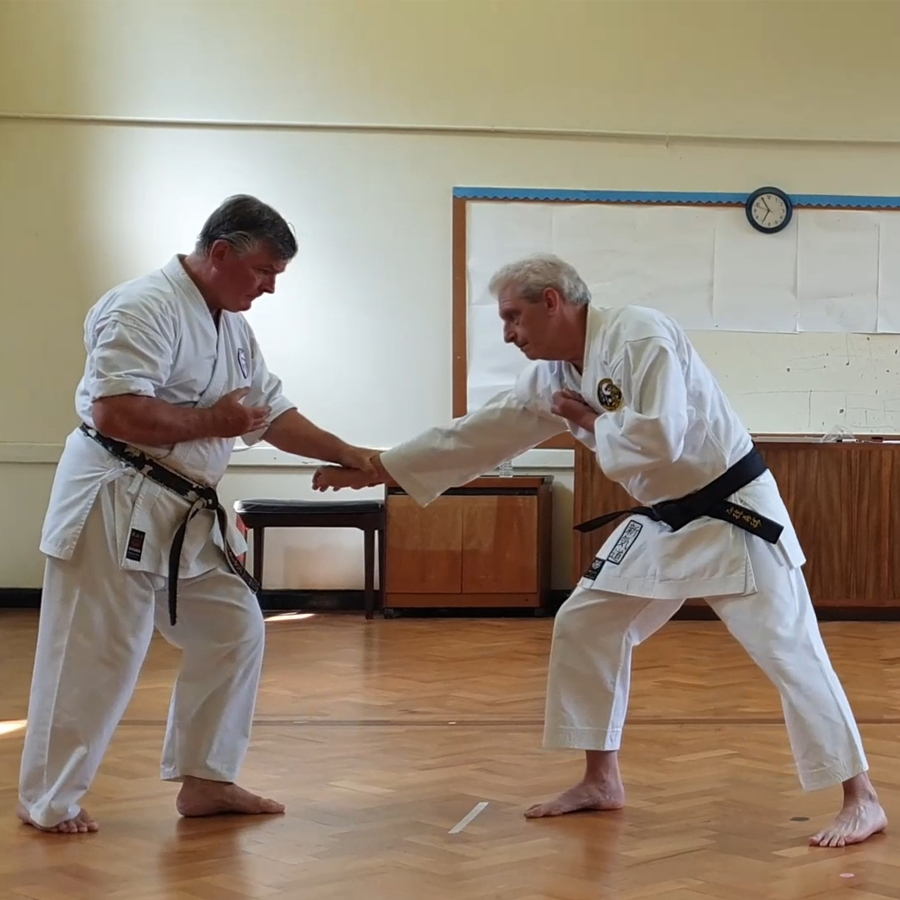
The Mae Geri Chūdan is delivered as a natural continuation of the pulling action. It is not an isolated technique, but a direct result of the opponent being drawn into position.
Timing is essential. The kick should arrive as the opponent is recovering forward — catching them at the moment where their balance is weakest.
Rotation and Control – Breaking Structure
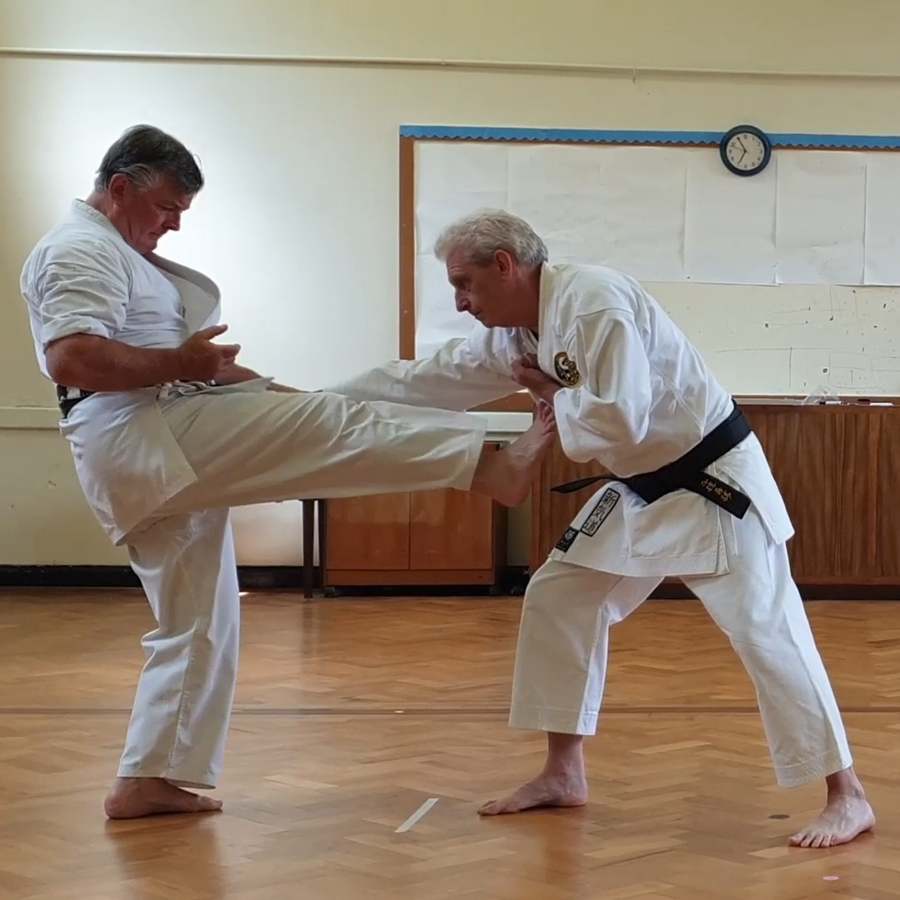
From here, the movement becomes more circular. The arms guide the opponent through a turning action, introducing rotation into their structure.
This rotational element creates a spiralling effect through the body:
- the spine begins to twist
- balance shifts laterally
- structure becomes increasingly unstable
“Now you take them back and around… then you take them the other way… you can really play with their centre.”
This is where the technique moves beyond simple karate and into a deeper understanding of body mechanics.
Final Control – Collapse of the Centre
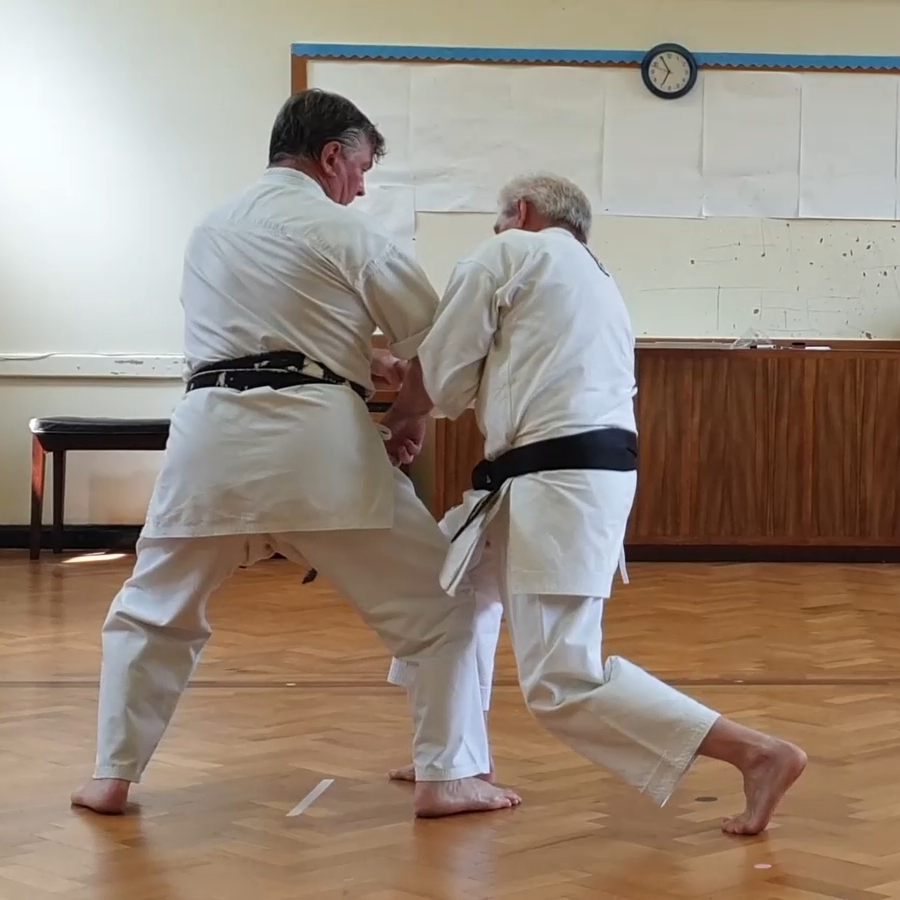
The final phase brings the arm under control, combining Empi with wrist manipulation to collapse the opponent’s structure completely.
At this stage:
- balance is fully compromised
- structure is broken
- resistance becomes impossible
The technique finishes not with impact alone, but with complete control.
What Uke Should Experience
When performed correctly, Uke should feel:
- initial backward displacement from the Shutō
- forward pull into the kick
- rotational imbalance through the arms
- progressive loss of centre
- final structural collapse
“There’s no point where they can get back into their centre — they’re being pushed, pulled, and twisted all the time.”
Key Principles
- Continuous control of the opponent’s centre
- Movement in multiple directions (back, forward, rotational)
- Connection between hands, body, and centre
- Using movement rather than force
- Flow between phases of the technique
Final Thoughts
Ropponme is more than a sequence — it is a study in how movement influences structure. It demonstrates how subtle changes in direction, timing, and connection can completely dominate an opponent without the need for excessive force.
As Sensei advises:
“Break it down… practice the parts… then bring it back together.”
With careful study, this Ippon Kumite becomes one of the most enlightening in the series — revealing how Wadō-Ryū uses movement to control, rather than collide.
📺 Full Breakdown Video
Watch the full breakdown of Ippon Kumite No.6 (Ropponme), including detailed explanation of body movement, timing, and control of the opponent’s centre.
📅 Upcoming Courses & Events
Course and events are live on the website events calendar — please bookmark and check regularly.
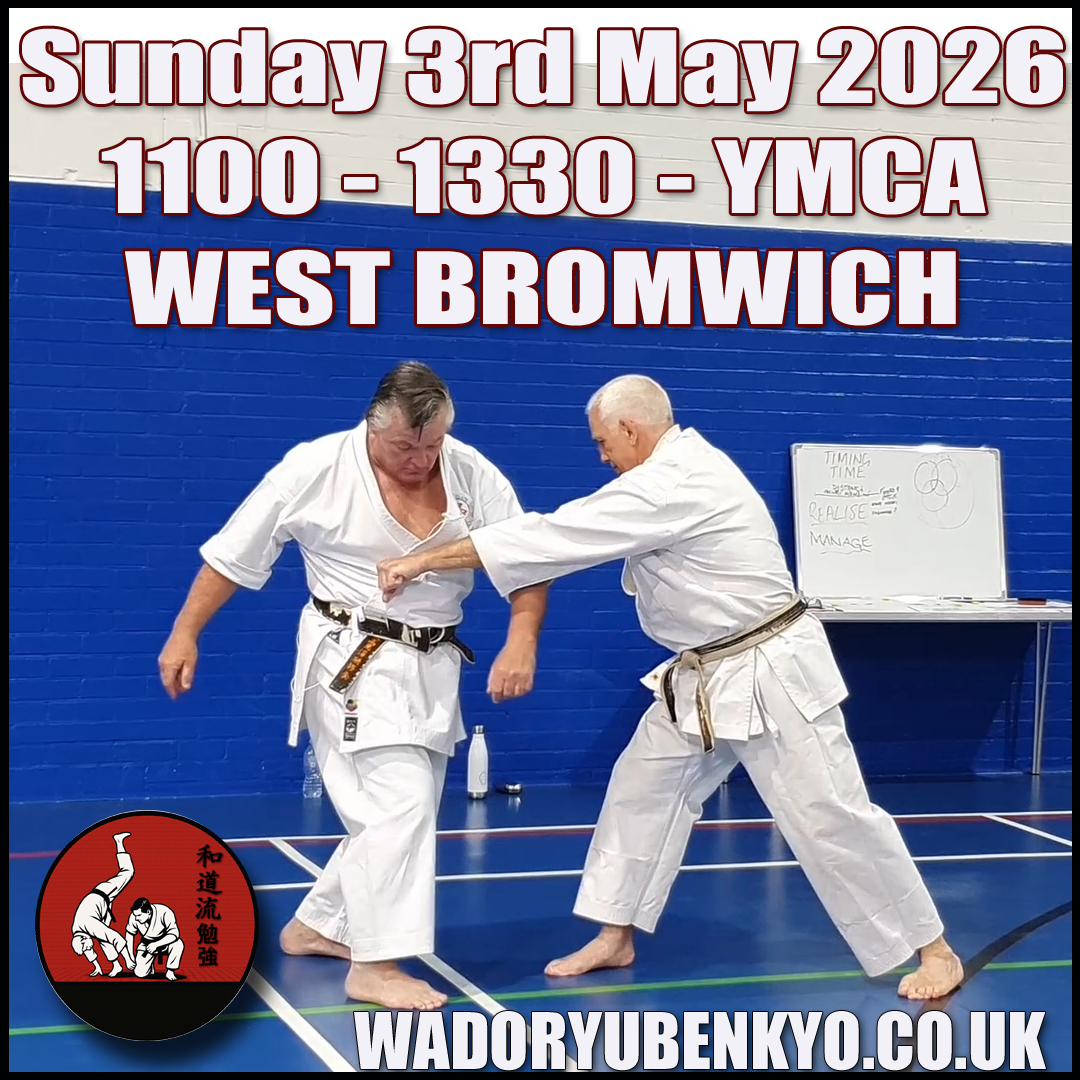
The May 2026 course dates and location have been confirmed:
🧠 Principle of the Week
Nagasu / Nagashi (流す / 流し) — Guiding and Redirecting in Wadō-Ryū
By Roger Vickerman Renshi · Principles
Nagasu (to let flow) and Nagashi (flowing redirection) represent one of the most important and defining ideas in Wadō-Ryū. Rather than stopping an attack, colliding with it, or retreating away from it, the practitioner allows the force to pass while subtly guiding it away from their centre.
This approach sits at the heart of Wadō’s non-collision philosophy. Instead of meeting strength with strength, we remove the need for force entirely by changing the relationship between the bodies at the moment of contact.
Understanding Nagasu and Nagashi
Although often used interchangeably, the two terms have slightly different meanings:
- Nagasu — the action of allowing something to flow or pass
- Nagashi — the expression of that action through movement and technique
In practice, nagasu is the principle, and nagashi is how we see that principle in motion. Together, they describe how we interact with incoming force in a way that avoids impact while maintaining control.
Not Blocking — Not Avoiding — But Guiding
A useful way to understand this principle is by clarifying what it is not:
- It is not a hard block that stops the attack
- It is not simply stepping away to avoid contact
- It is not passive or soft in a weak sense
Instead, nagasu/nagashi allows the attack to continue — but not in the direction or with the effect the attacker intended. The force is guided, slightly altered, and redirected so that it no longer threatens the defender while at the same time creating opportunity.
Why It Matters in Wadō-Ryū
Wadō is built on the idea of non-collision. If we try to stop force directly, we are already losing efficiency and relying on strength. Nagasu removes this problem at its source.
When applied correctly:
- The body does not need to brace or tense
- The movement remains continuous and connected
- The opponent’s balance begins to break naturally
- The transition from defence to control or attack becomes seamless
This is why high-level Wadō often appears effortless — the practitioner is not resisting force, but reshaping it.
The Role of Timing and Contact
Nagasu is not something that happens after the attack has arrived. It must occur at the moment of contact, or even slightly before. If the timing is late, the body is forced to absorb impact. If the timing is correct, very little force needs to be handled at all.
The contact itself should also be light, connected, and responsive — not rigid or pushing. This allows the practitioner to feel the direction of the attack and guide it accordingly.
Relationship to Other Wadō Principles
Nagasu / Nagashi does not exist in isolation. It is deeply connected to many other principles:
- Taisabaki — body movement creates the space for redirection
- Ma-ai — correct distance makes guiding possible
- Ryūsui — flow ensures the movement does not stop
- Kuzushi — balance is broken as force is redirected
- Datsuryoku — relaxation allows sensitivity and adaptability
Without these connections, nagasu becomes mechanical or ineffective. With them, it becomes natural and highly efficient.
Where It Appears in Training
Nagasu and nagashi can be seen throughout Wadō practice:
- Kihon — where receiving actions begin to show redirection rather than blocking
- Kihon Kumite — where guiding the attack off line is essential
- Kumite Kata — where subtle control and connection become more refined
- Kata — where movements that appear as blocks are often expressions of redirection
As understanding develops, practitioners begin to recognise that many techniques are not separate defensive actions, but part of a continuous process of guiding and controlling.
Common Training Errors
- Trying to push or force the attack away
- Moving too far and losing connection
- Using the arms independently of the body
- Applying the movement too late
These errors usually come from misunderstanding the principle. Nagasu is not about doing more — it is about doing less, at the right moment, with the right structure.
Nagasu and Control
One of the most important aspects of this principle is that it does not end with avoidance. By maintaining connection while guiding the attack, the practitioner remains in control of the situation.
This is where nagasu naturally leads into kuzushi and further technique. The opponent’s movement has already been compromised, making the next action simpler and more effective.
Closing Thoughts
Nagasu and nagashi represent a fundamental shift in how we approach conflict. Instead of opposing force, we allow it to pass. Instead of stopping movement, we continue it. Instead of reacting after impact, we change the outcome before it fully develops.
In this sense, nagasu is not just a technical idea — it is a way of thinking about movement, interaction, and control. When understood correctly, it removes the need for struggle and replaces it with timing, sensitivity, and precision.
🙏 Thank You for Being Part of the Community
If you have any questions, video requests, or feedback, simply Contact us here — we read everything.
Roger and The Team
Wado-Ryu Benkyo