Traditional Karate
Weekly Newsletter • 10 May 2026
Weekly Update from Wadō-Ryū Benkyō
Hello,
Welcome to your 22nd Weekly update from Wado-Ryu Benkyō.
🥋 1. Sunday Benkyō Course Review
No Saturday Session this week, but back to normal next week for anybody wishing to train.
Saturday Benkyō sessions will run throughout May 2026, but there will be no training on Saturday 23rd May. If you would like to attend a Saturday session for the first time, please reply to the email or check the events calendar for future session dates.
🎥 2. This Week’s Long-Format Video
Kihon Fundamentals — Tying the Obi — Three Methods
In this video, we take a practical look at three effective methods of tying your obi, demonstrated by Roger Vickerman Renshi (7th Dan), Kerry Moore Sensei (4th Dan), and Kash Bansal (2nd Dan).
Each method offers a slightly different approach, reflecting personal preference, experience, and the demands of modern training.
We begin with the traditional method, focusing on correct placement, symmetry, and attention to detail — ensuring the belt is secure, balanced, and worn with respect.
We then explore a more secure variation, including the “Superlock” knot, designed to stay firmly in place during grappling, throwing, and more dynamic practice.
Finally, we look at an alternative method often used by experienced practitioners and competitors, offering both improved durability and a clean, aesthetic finish.
Throughout the session, emphasis is placed on:
- keeping the belt flat and correctly aligned
- ensuring even length on both ends
- practical considerations for modern training
- the importance of care, presentation, and detail
As Roger Sensei highlights, tying your belt is not just functional — it reflects your approach to training and your attention to the fundamentals.
📝 3. Featured Article of the Week
Ippon Kumite No.8 – Hachihonme
A study in connection, elbow control, body dropping, and the collapse of posture through continuous pressure
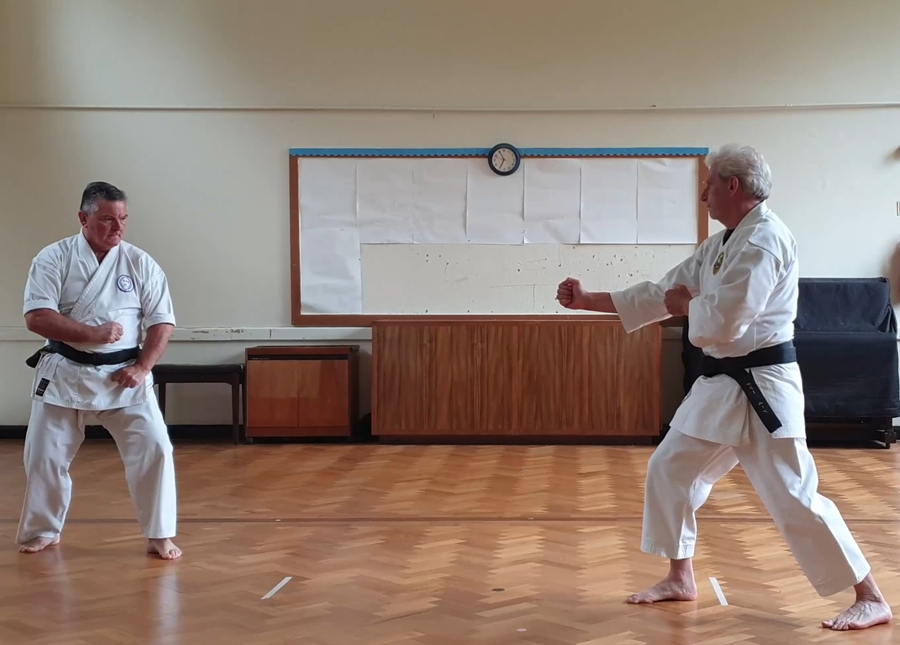
Ippon Kumite No.8 – Hachihonme develops several of the deeper principles found throughout advanced Wadō-Ryū practice.
Rather than relying on strength or collision, the technique focuses on controlling the attacking arm through connection, manipulating structure through the elbow and shoulder, and breaking balance by dropping body weight into weak areas of Uke’s posture.
The movement appears soft and relaxed, but underneath is a highly sophisticated use of positioning, timing, and directional force.
Initial Kamae and Pressure
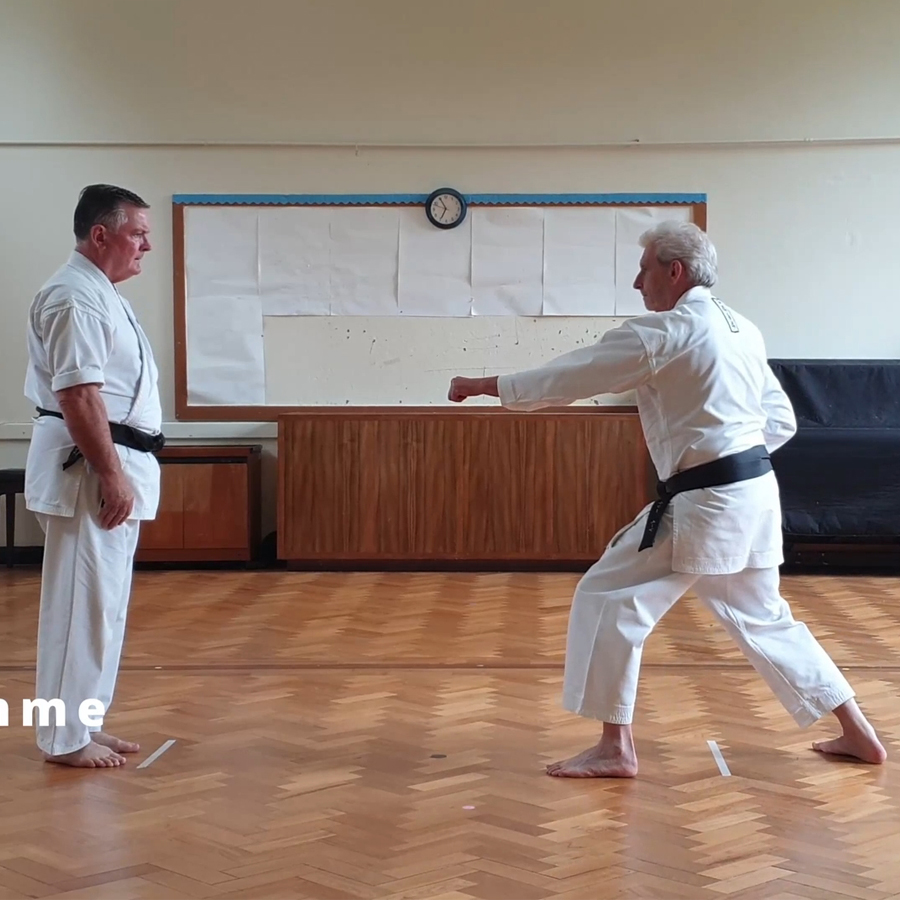
Uke attacks from Hidari Junzuki Dachi with Iyumi Ashi Chudan Junzuki. Tori does not meet force with force, but instead receives and connects to the attacking arm.
The initial movement is subtle. The body shifts slightly off line while maintaining the relationship with Uke’s centre.
“The important thing is not to clash. Connect first… then control the structure.”
Receiving and Establishing Control
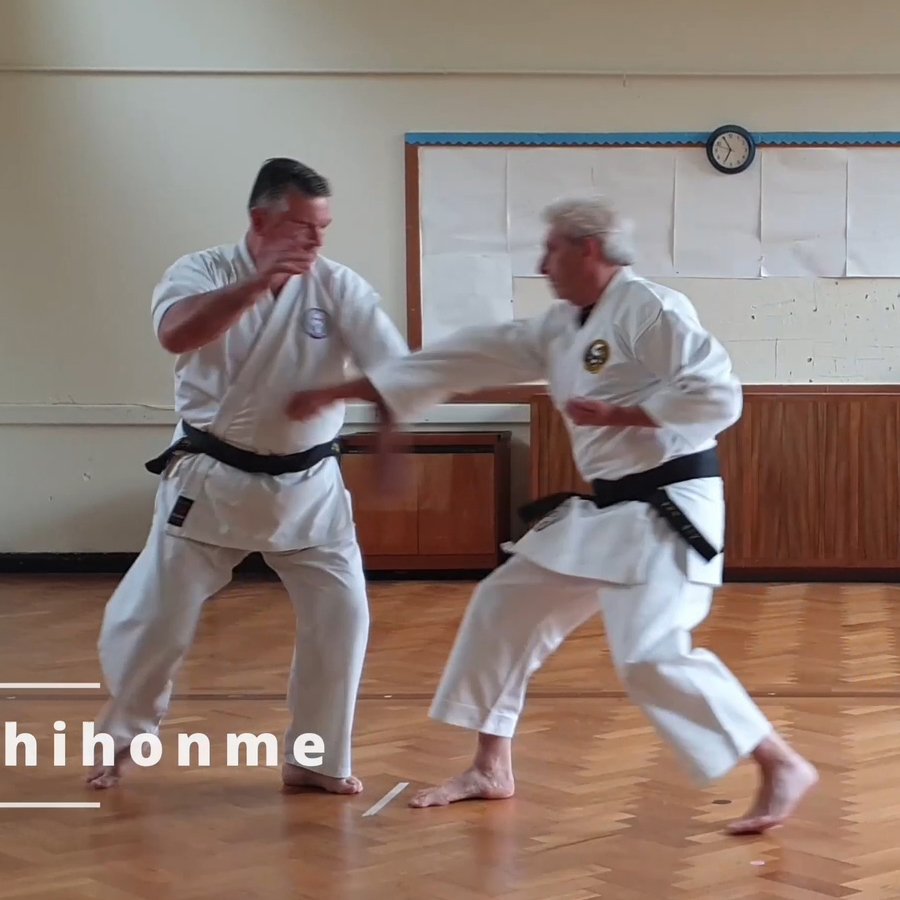
As the punch extends, Tori establishes control through the attacking arm rather than attempting to stop the strike directly.
The rear hand secures the arm while the body begins to rotate and position itself safely outside the line of attack.
The key is that the control comes from body positioning and angle rather than gripping strength.
Pulling and Creating Kuzushi
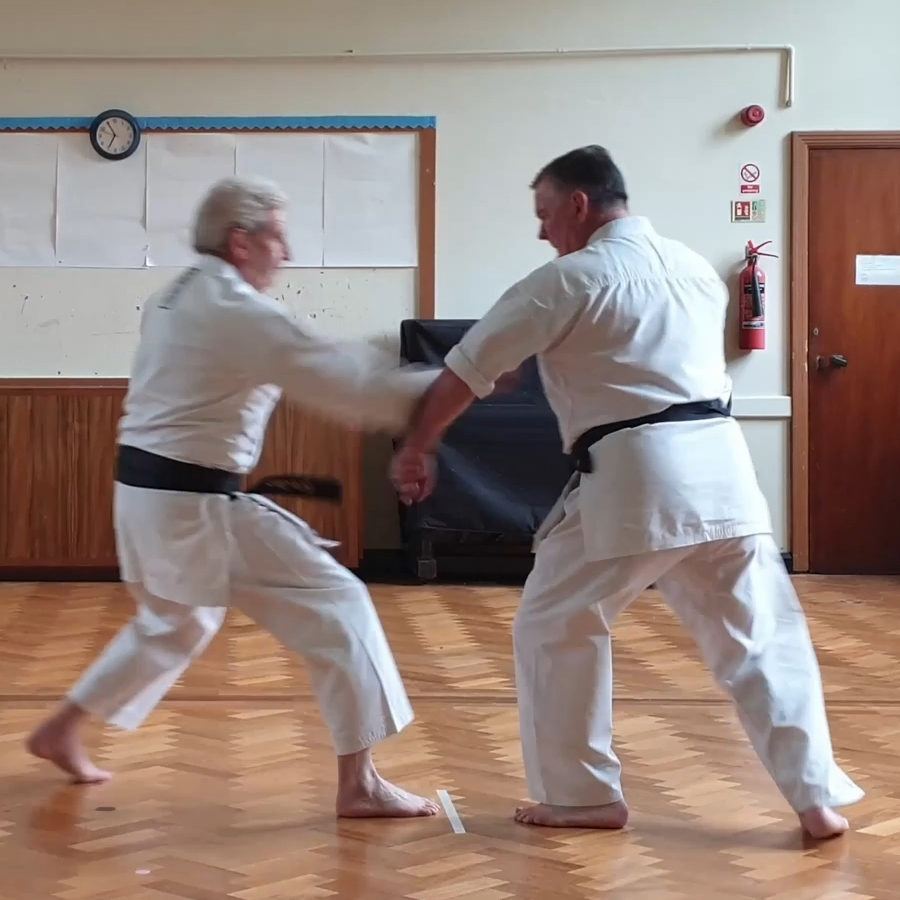
Tori’s rear hand pulls Uke’s arm while the body shifts and drops.
This begins the process of kuzushi — breaking balance and disturbing posture.
The pulling action is not large or exaggerated. Instead, it redirects the shoulder and elbow relationship, creating instability through the spine and hips.
Otoshi Uchi and Body Drop
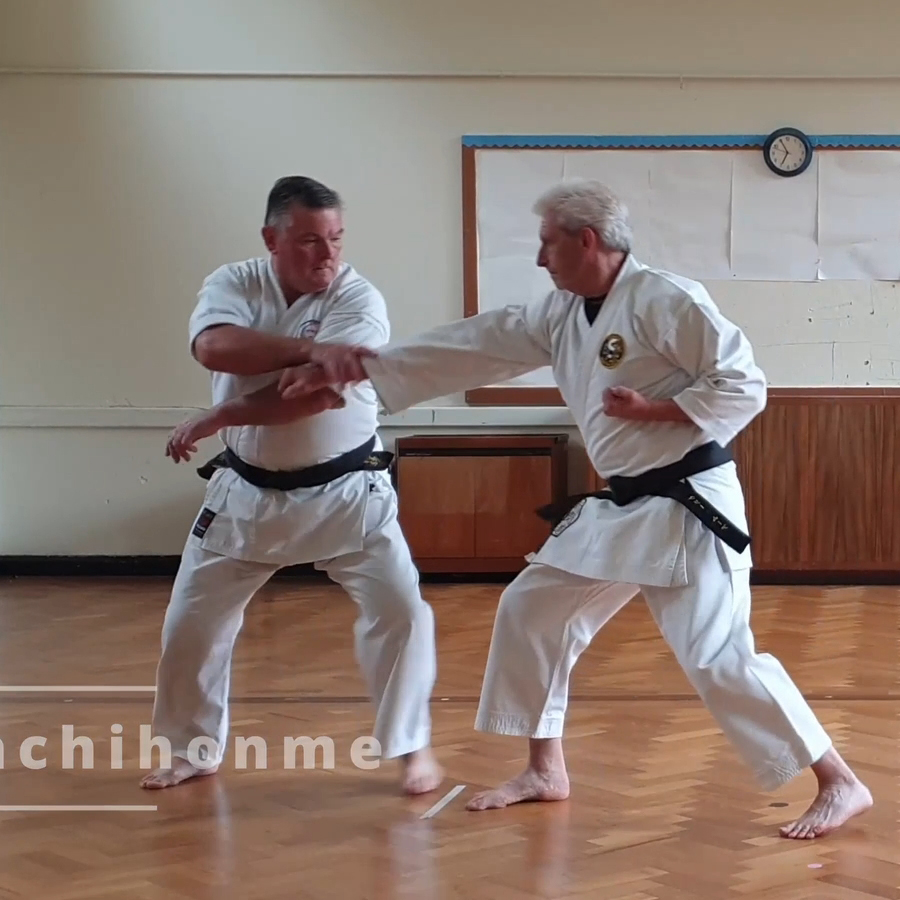
The left hand applies Chudan Otoshi Uchi while the body weight drops.
This dropping action is crucial. The technique does not rely purely on the arm strike itself, but on the lowering of the centre through the body.
“Drop your weight through the technique — don’t hit with the arm alone.”
As the weight drops, Uke’s posture becomes increasingly difficult to maintain.
Turning the Wrist and Controlling the Elbow
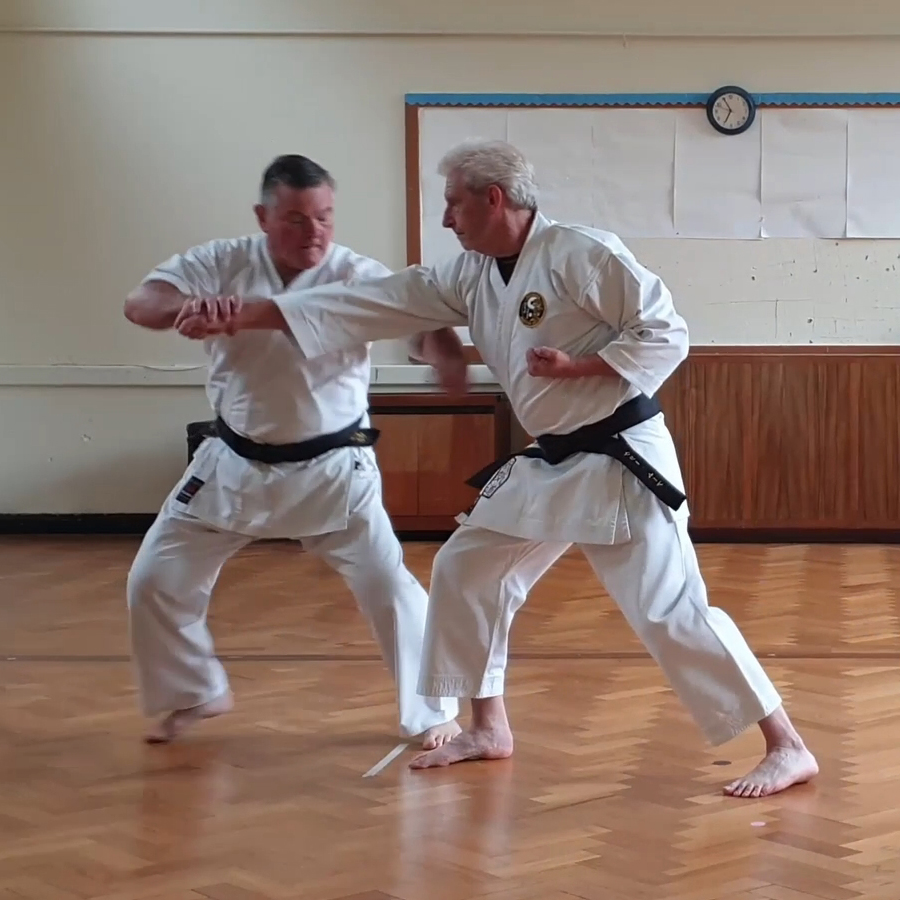
Tori rotates the wrist away and downward while maintaining pressure through the elbow line.
This creates a spiralling effect through Uke’s arm and shoulder structure.
Rather than forcing the arm, the technique follows the natural weakness in the elbow and shoulder alignment.
Rising Through the Elbow
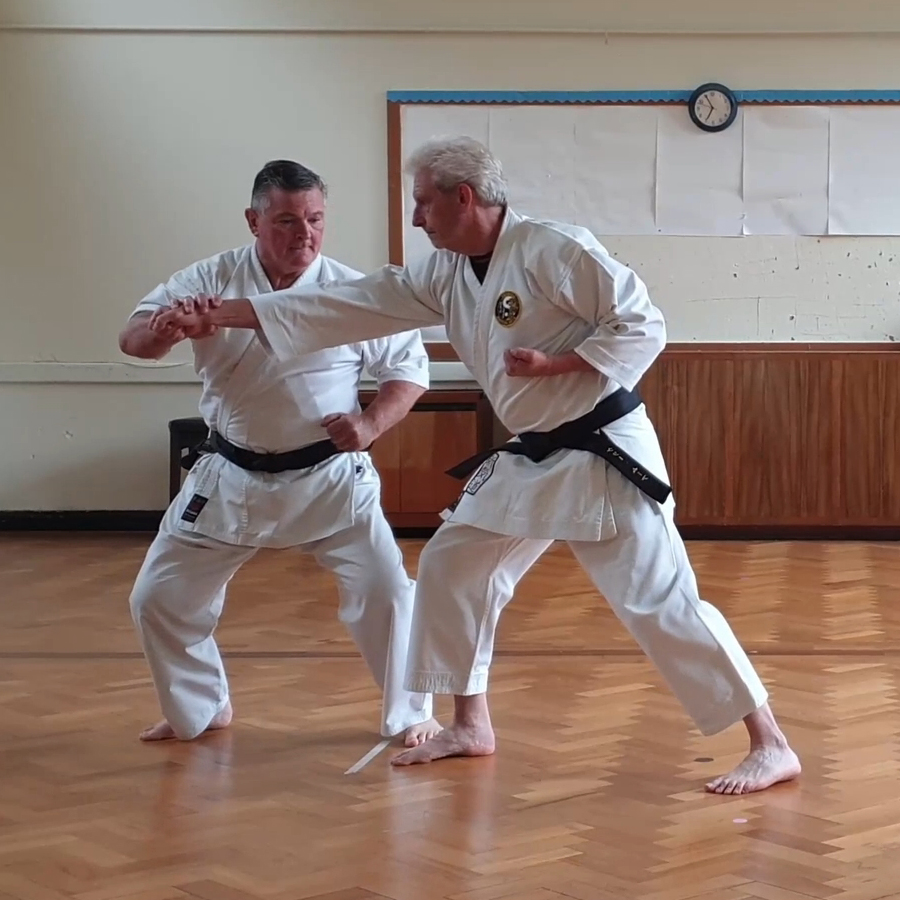
As the body rises slightly, the left hand rolls over Uke’s elbow.
This creates a continuous pressure through the joint and further destroys structure.
The motion should feel smooth and connected rather than segmented into separate techniques.
“It’s one movement all the way through.”
Continuous Connection
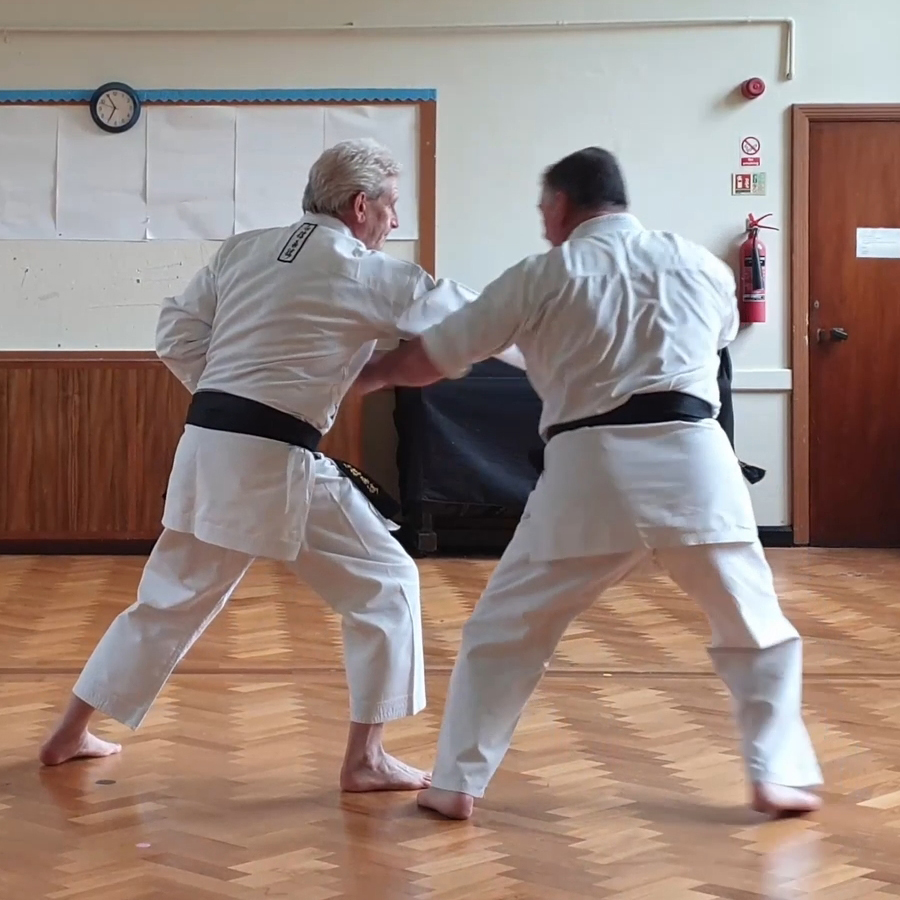
At this stage, Tori maintains constant connection with Uke’s arm and shoulder.
There is no release of pressure. Each movement feeds naturally into the next.
This continuity is central to Wadō-Ryū paired practice.
Rear View – Structural Collapse
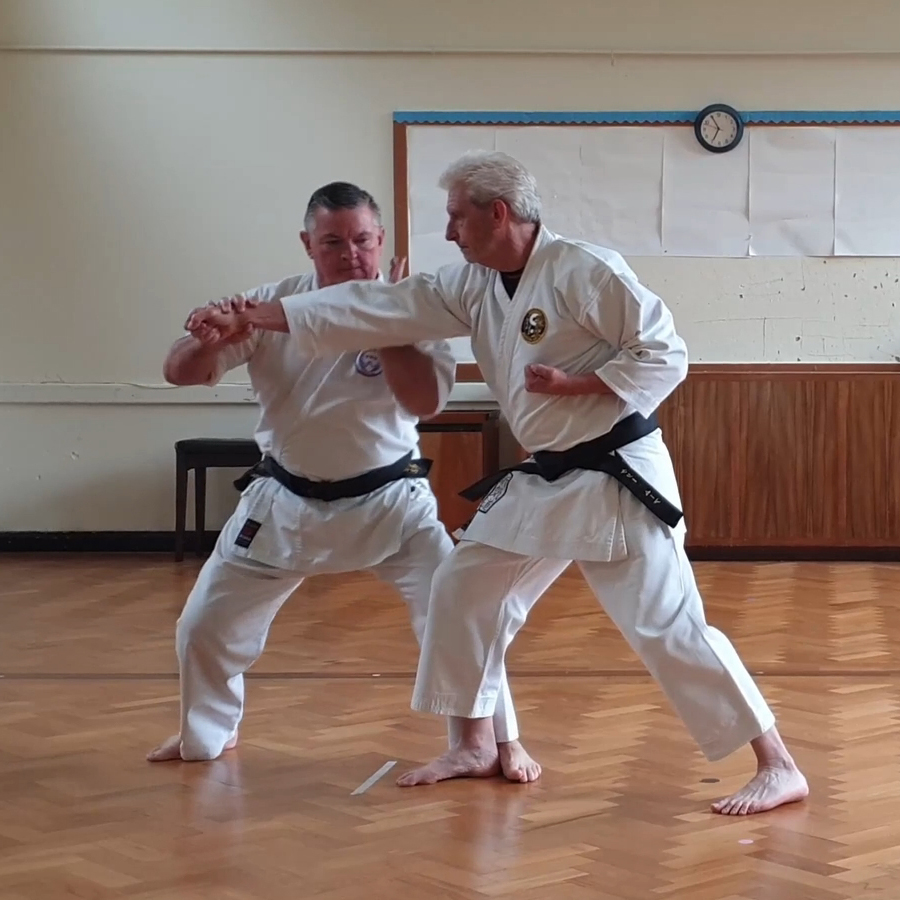
From the rear angle, the structural collapse becomes more visible.
Uke’s spine begins to bend forward while the shoulder and elbow are rotated away from their natural alignment.
This creates a position where balance recovery becomes increasingly difficult.
Knee Pressure and Shoulder Control
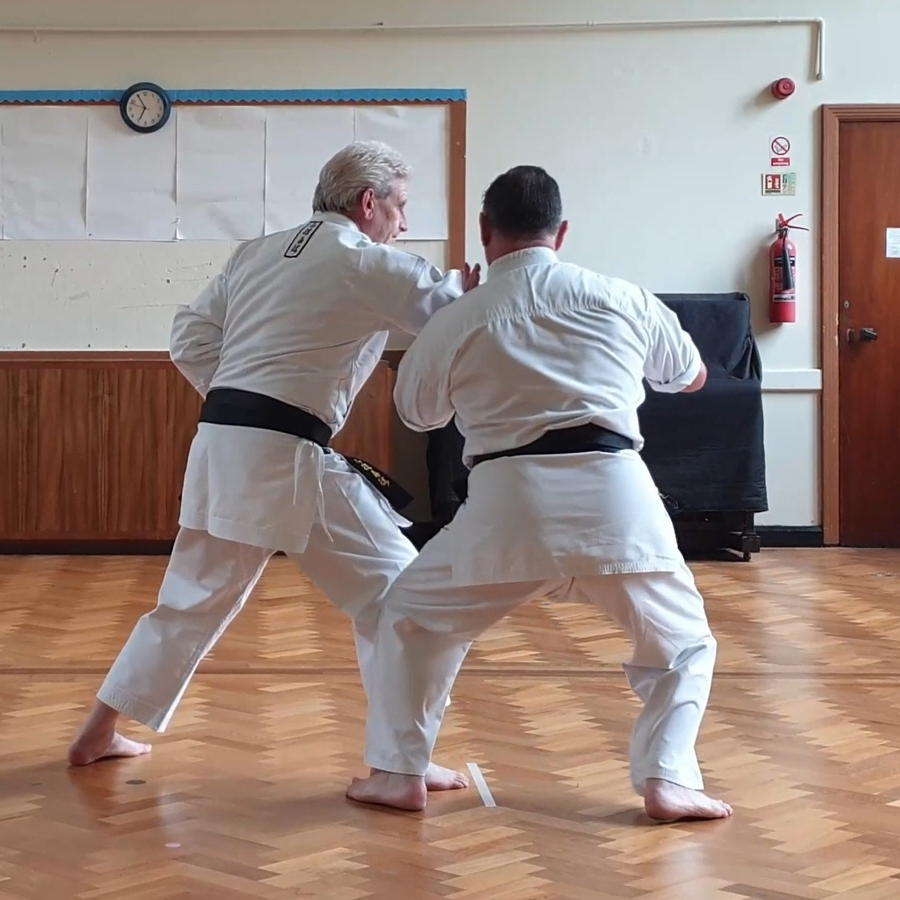
Tori’s knee drops into the back of Uke’s knee while the shuto hand controls the shoulder joint.
This is a classic Wadō principle — controlling the upper and lower body simultaneously.
The collapse does not come from force alone, but from attacking the integrity of the stance itself.
“If the structure goes… the body follows.”
Breaking the Stance
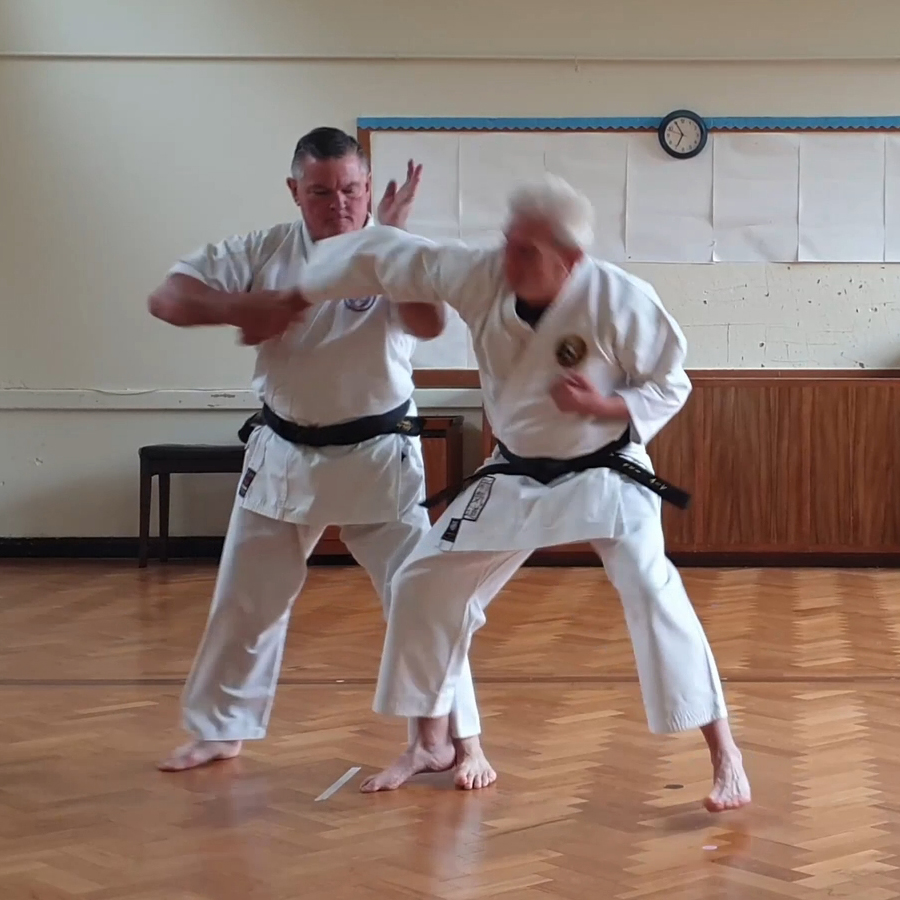
As pressure continues through the shoulder and knee, Uke’s stance begins to collapse.
The dropping of body weight through the technique amplifies the effect without requiring excessive muscular effort.
Final Control Position
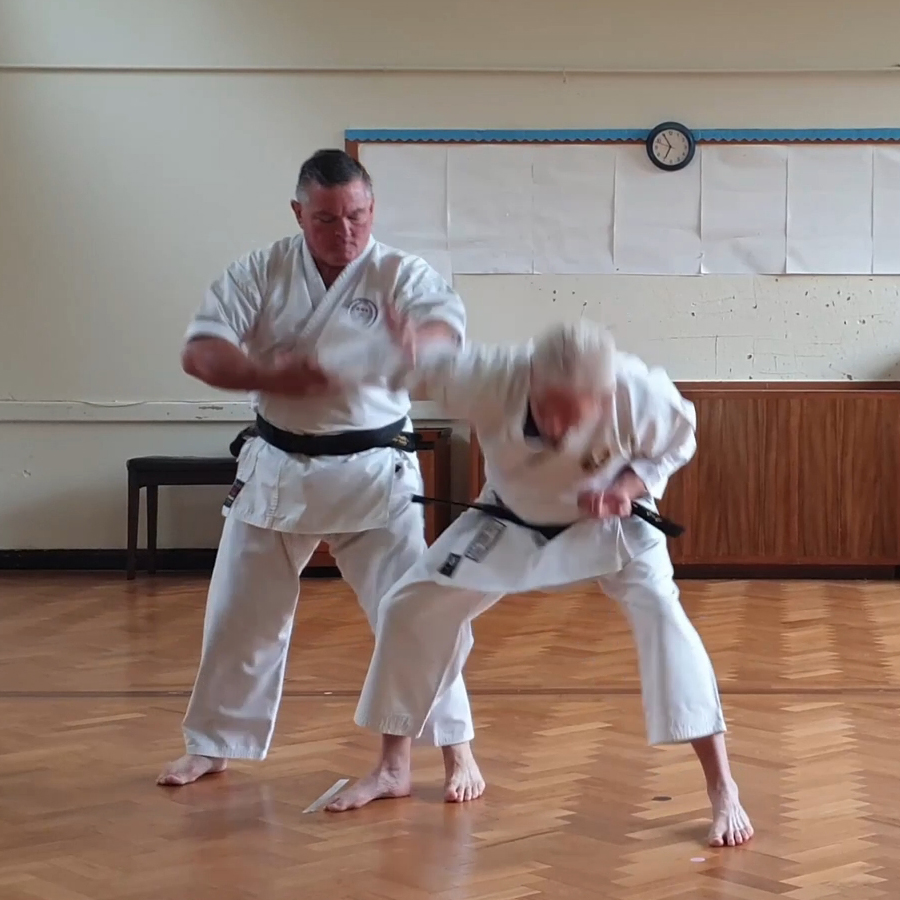
The final position demonstrates complete control through posture, angle, and connection.
Tori maintains pressure through the elbow and shoulder while directing Uke’s balance downward and away.
The technique concludes not with impact, but with total domination of structure.
What Uke Should Experience
- loss of posture through elbow and shoulder rotation
- continuous pressure without release
- disruption of stance through knee control
- collapse of balance through body weight dropping
- inability to recover structure once connection is established
Key Principles
- receiving without collision
- connection before control
- dropping body weight through technique
- controlling upper and lower body simultaneously
- breaking posture through spiralling movement
- continuous movement without pause
Extra Notes
The instructional emphasis throughout Hachihonme focuses heavily on:
- maintaining relaxation throughout the movement
- using body weight instead of arm strength
- controlling the elbow line rather than chasing the wrist
- dropping and rising naturally through the technique
- destroying structure progressively rather than suddenly
The lesson repeatedly returns to the principle that the body should remain connected from beginning to end, creating one uninterrupted action.
Final Thoughts
Hachihonme reveals many of the deeper principles hidden inside Wadō-Ryū paired kata.
At first glance, the movement appears simple. However, beneath the surface lies sophisticated use of timing, spiralling control, posture breaking, and body-weight manipulation.
The form teaches that effective control does not require forceful collision. Instead, by understanding alignment, balance, and connection, the opponent’s structure can be dismantled progressively and efficiently.
“Control the structure… and the rest becomes easy.”
With careful practice, Hachihonme becomes an excellent study in how Wadō-Ryū uses softness, positioning, and body movement to achieve decisive control.
📺 Full Breakdown Video
Watch the full breakdown of Ippon Kumite No.8 (Hachihonme)
📅 4. Upcoming Courses, Events, or Updates
Courses and events are live on the website events calendar and will be updated regularly, so please bookmark it and check it.
Videos from the 3rd May Course will start being released from the 16th May 2026.
🧠 5. Wado Ryu Principle of the Week
Kōbō-ittai (攻防一体) — Attack and Defence as One in Wadō-Ryū
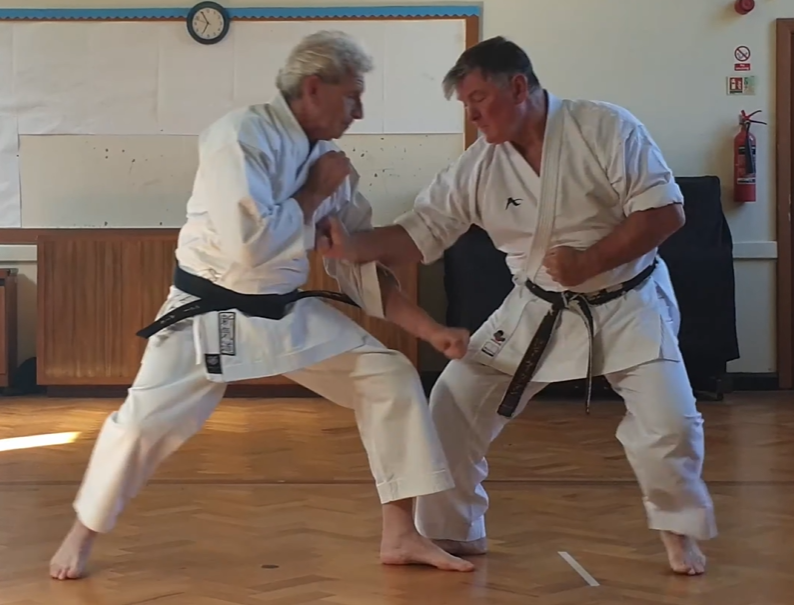
Kōbō-ittai is one of the most important strategic and philosophical principles in Wadō-Ryū. Translated as “attack and defence as one,” it describes a way of moving and thinking in which there is no separation between defending oneself and responding to the opponent.
Rather than blocking first and then attacking, or waiting to react after contact, Wadō-Ryū seeks to unify these actions into a single moment. Defence is not something that happens before attack — it is part of the same movement.
What Kōbō-ittai Means
The term itself is made up of three parts:
- Kō (攻) — attack
- Bō (防) — defence
- Ittai (一体) — one body / one unified action
Together, they express the idea that attack and defence should not be treated as separate phases, but as a single integrated process.
Beyond “Block then Counter”
A common approach in early training is to think in stages: first block, then counter.
While useful as a learning tool, this way of thinking creates delay. The body stops, resets, and then acts again. In a real exchange, this separation often leads to hesitation, collision, or missed opportunity.
Kōbō-ittai removes this gap. The same movement that avoids or redirects the attack also creates the opportunity to strike, control, or unbalance.
Why It Matters in Wadō-Ryū
Wadō-Ryū is built on efficiency, timing, and non-collision. If defence and attack are separated, movement becomes heavier and slower. By unifying them, the practitioner:
- reduces reaction time
- maintains continuous movement
- avoids unnecessary force
- creates natural openings
This is why advanced Wadō often appears effortless. The practitioner is not doing more — they are doing everything at once, in the correct moment.
The Role of Timing
Kōbō-ittai is closely linked to timing. It relies on acting at the moment when the opponent’s intention becomes movement, but before their attack has fully developed.
This connects directly to principles such as Dōjini — simultaneous action — and Sen-no-sen — initiative within the opponent’s initiative.
When the timing is correct, defence and attack naturally merge. When it is late, they separate again.
Relationship to Other Wadō Principles
- Taisabaki — body movement allows safe entry while creating attack
- Ma-ai — correct distance makes unified action possible
- Nagasu — guiding the attack removes the need for a separate defence
- Kuzushi — balance is often broken within the same movement
- Ryūsui — flow ensures continuity without interruption
Without these supporting principles, kōbō-ittai becomes mechanical. With them, it becomes natural.
Where It Appears in Training
- Kihon Kumite — many forms demonstrate entering while receiving
- Kumite Kata — defence and control often occur simultaneously
- Kata — movements often contain both defensive and offensive meaning
- Jiyū Kumite — successful exchanges rarely involve separate phases
As understanding develops, students begin to see that techniques are not isolated actions, but part of a continuous interaction.
Common Misunderstandings
- trying to force attack during defence
- rushing and losing structure
- separating actions mentally even if they appear simultaneous
- overcomplicating what should be natural movement
Kōbō-ittai is not about doing two things at once. It is about doing one thing correctly, so that both effects are present.
Kōbō-ittai and Control
One of the most important outcomes of this principle is control. When defence and attack are unified, the opponent is immediately placed under pressure. There is no opportunity for them to reset or continue freely.
This is where kōbō-ittai leads naturally into kuzushi, control, and finishing technique.
Closing Thoughts
Kōbō-ittai represents a fundamental shift in how we understand technique. Instead of separating defence and attack into stages, we bring them together into a single moment of action.
When this principle is understood, movement becomes simpler, faster, and more effective. There is less hesitation, less force, and less conflict. The practitioner is no longer reacting and then responding — they are moving in a way where both happen together.
In this sense, kōbō-ittai is not just a technical idea, but a way of thinking about karate itself.
🙏 Thank You for Being Part of the Community
If you have any questions, video requests, or feedback, simply contact us here — we read everything.
Wishing you a fantastic week of training,
Roger and The Team
Wado-Ryu Benkyō
https://wadoryubenkyo.co.uk/