Traditional Karate
Weekly Newsletter • 31 May 2026
Weekly Update from Wadō-Ryū Benkyō
Hello,
Welcome to your 23rd Weekly update from Wado-Ryu Benkyō.
A correction from our last newsletter, 10th May 2026, issue 22: we incorrectly referred to Kash in the featured video section as Kash Patel. Kash’s Last name is Kash Bansal. The YouTube video has been corrected, but please accept our apologies for the error.
Thank you also for your patience while we were on our spring break. We are back now with no further planned breaks.
🥋 1. Benkyō Course Review
We recently had the honour and pleasure to train with Grandmaster Ohtsuka III Soke in Rome, and it was, as always, an amazing experience.
It was sadly one of those experiences that you had to be there to fully appreciate, and we would not do it justice by trying to give a full description or breakdown here in the newsletter. However, the Grandmaster will be back in the UK next year for the Winter Course in 2027, and if you have the opportunity to train there, we highly recommend you do.
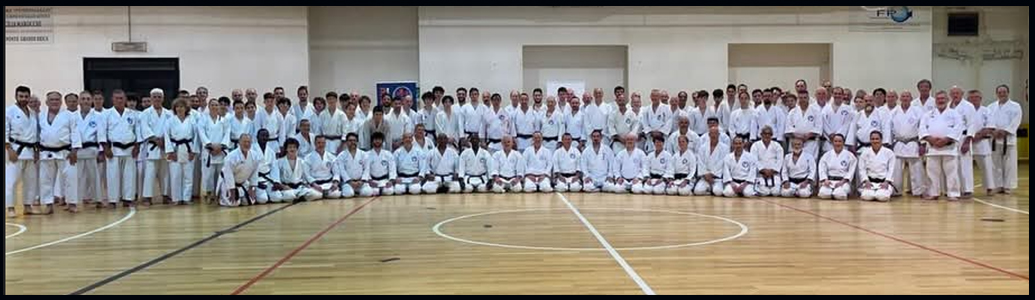
Saturday Benkyō sessions will run throughout June 2026, but please look out for weekly updates as to when classes may not be running. If you would like to attend a Saturday session for the first time, reply to the email and let us know, and check the events calendar for future session dates.
🎥 2. This Week’s Long-Format Video
Part 1 — May 2026 YMCA Course
The first part of our May 2026 Course at the YMCA in West Bromwich explores the importance of the mind in training and martial development. This is something often overlooked when the physical aspects of training are given priority, but the mind is equally important and also needs training and refinement. It was an excellent course, and we hope you enjoy following along with us over the next month of video releases.
📝 3. Featured Article of the Week
Ippon Kumite No.9 – Kyūhonme
A study in nagashi, forward pressure, simultaneous entry, and striking before Uke’s kicking foot lands
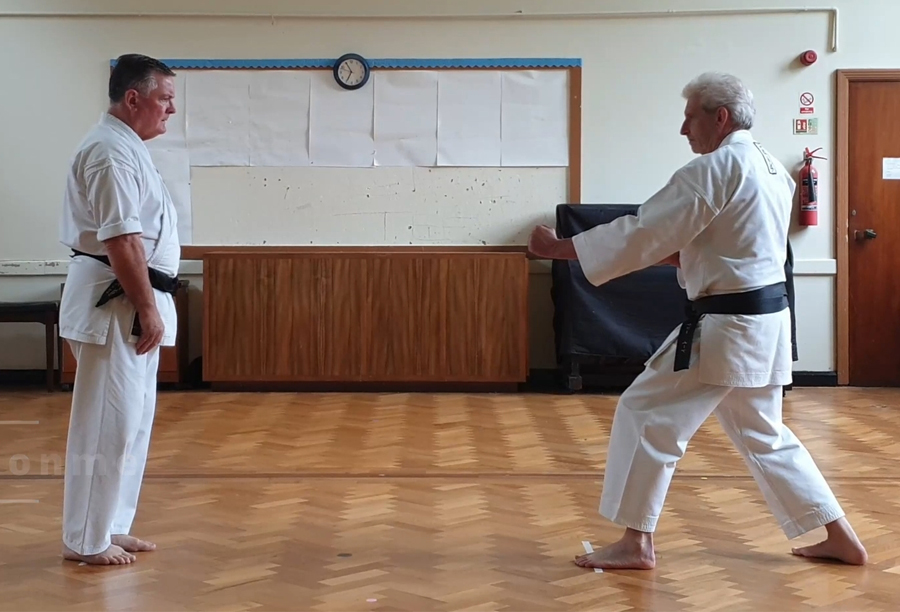
Ippon Kumite No.9 – Kyūhonme is one of the more direct-looking forms in the series, but its apparent simplicity hides several important Wadō-Ryū principles.
Unlike the earlier waza based primarily around hand attacks, Kyūhonme deals with a committed front kick. Tori must not merely step away or block the leg. The real lesson is to enter forward, use nagashi, take the space, and counter before Uke has had time to recover their posture.
The technique teaches forward pressure without collision. Tori does not retreat from the kick, nor does Tori smash the leg aside. Instead, the incoming energy of the kick is used to rotate the body and strengthen the counterattack.
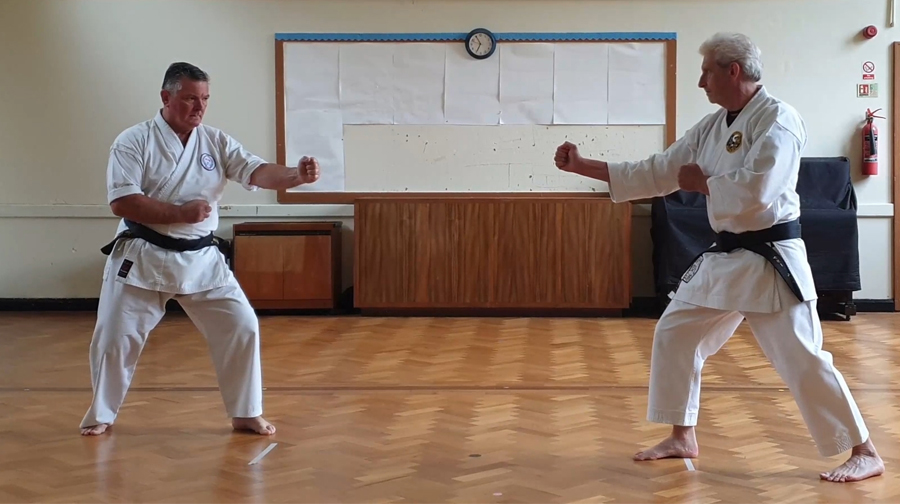
Initial Kamae – Reading the Kick
Uke begins in Hidari Tate Seishan Dachi. The attack is Okuri Ashi Migi Maegeri Chūdan.
This is important because the front kick creates a different problem from a punch. Uke is advancing with the body mass behind the leg, but for a brief moment their balance is also committed onto one supporting foot.
Tori must recognise that moment and take it. If the response is late, Uke lands, recovers structure, and can continue. If the timing is correct, Uke is crowded and struck before the kicking foot has returned to the floor.
Step Forward – Do Not Escape Sideways
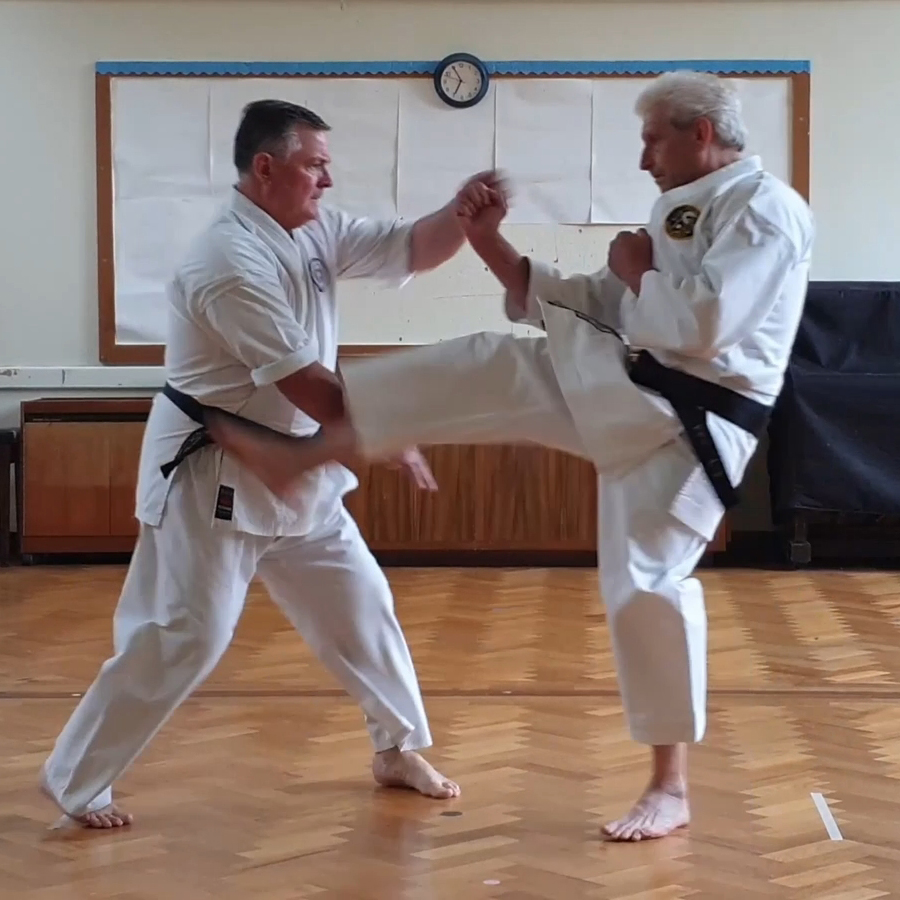
Tori steps forward with the left foot, applying Migi Gedan Barai and Hidari Jōdan Zuki.
One of the key teaching points is that Tori should not move out to the side in a way that loses pressure. The movement is nagashi, but it still goes forward. Tori takes Uke’s ground rather than simply escaping from the kick.
“Try not to go to the side to punch — try and take their ground.”
The forward movement creates pressure immediately. Uke should feel that their attack has not simply been avoided, but has been overtaken.
Using the Kick to Rotate the Body
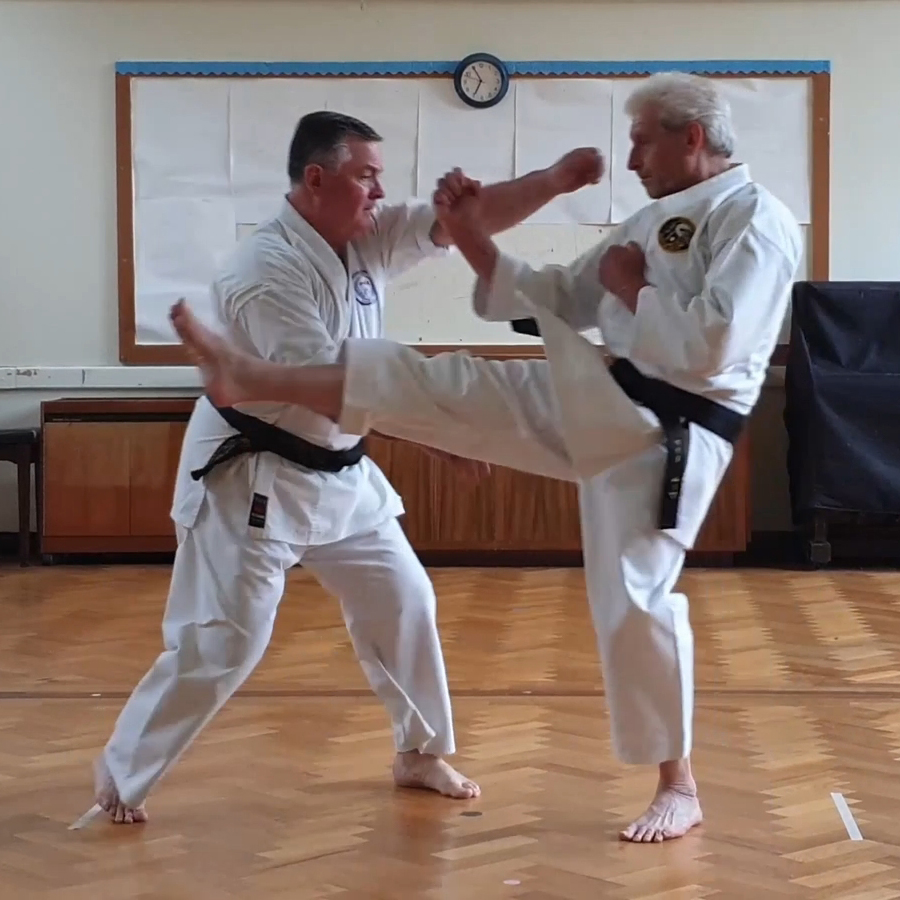
The contact with the kicking leg should not be a heavy, smashing gedan barai. There is contact, but the purpose is not to overpower the leg.
Instead, the energy of the kick helps rotate Tori’s body. That rotation then enhances the punch. In this way, the defensive action and the counterattack become linked rather than separated.
“Use their kick to move your body… their kick is rotating your body, and by doing so it will enhance your zuki.”
This is a very clear example of Wadō using the opponent’s action as part of the response.
The First Strike – Hidari Jōdan Zuki
As the body turns, HidariJōdan Zuki is delivered. The punch should not be treated as an isolated counter after the block. It is part of the same entering movement.
The timing must be early. Tori is not waiting until the kick is finished. The aim is to strike while Uke is still in the action of kicking.
The body should feel long and deep, almost as if reaching through Uke’s centre. This helps prevent Tori from becoming short, cramped, or defensive.
Rear View – Taking the Line
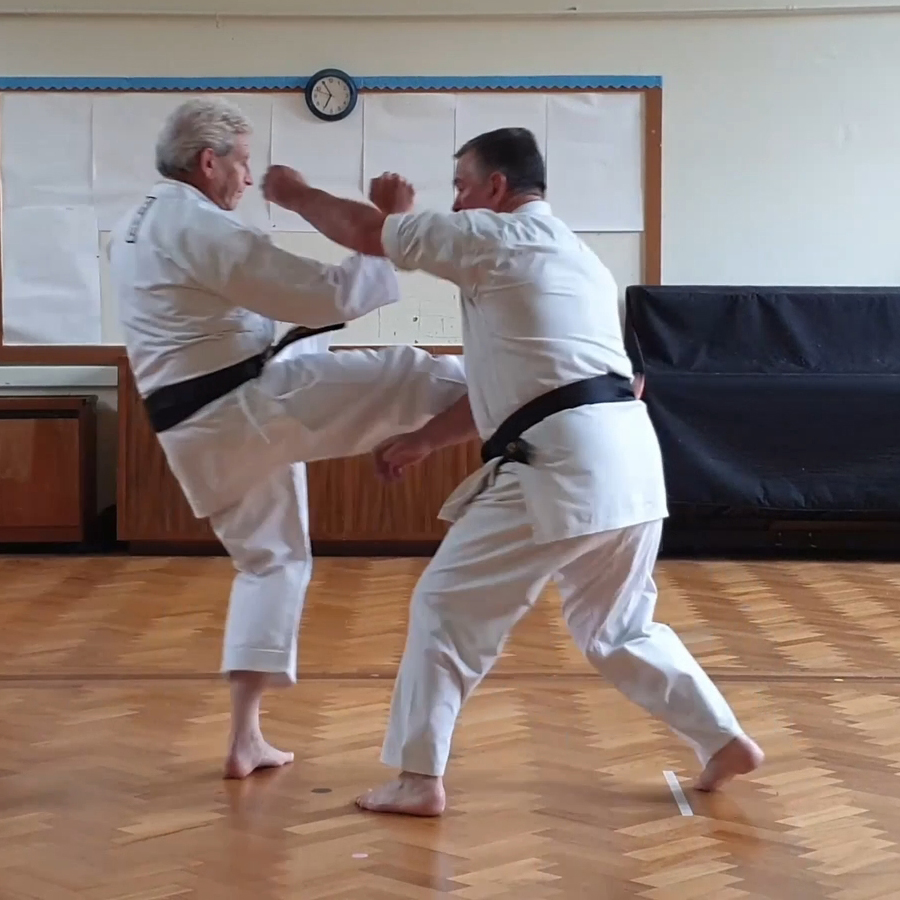
From the rear view, the principle becomes clearer. Tori is not outside and detached from the exchange. Tori is entering on a line that makes Uke feel crowded and unable to counter freely.
This angle also shows why moving too far to the side can weaken the technique. If Tori escapes sideways, the counterattack becomes separate. If Tori enters forward with the correct angle, the same movement receives, turns, and strikes.
Second Strike – Before the Foot Lands
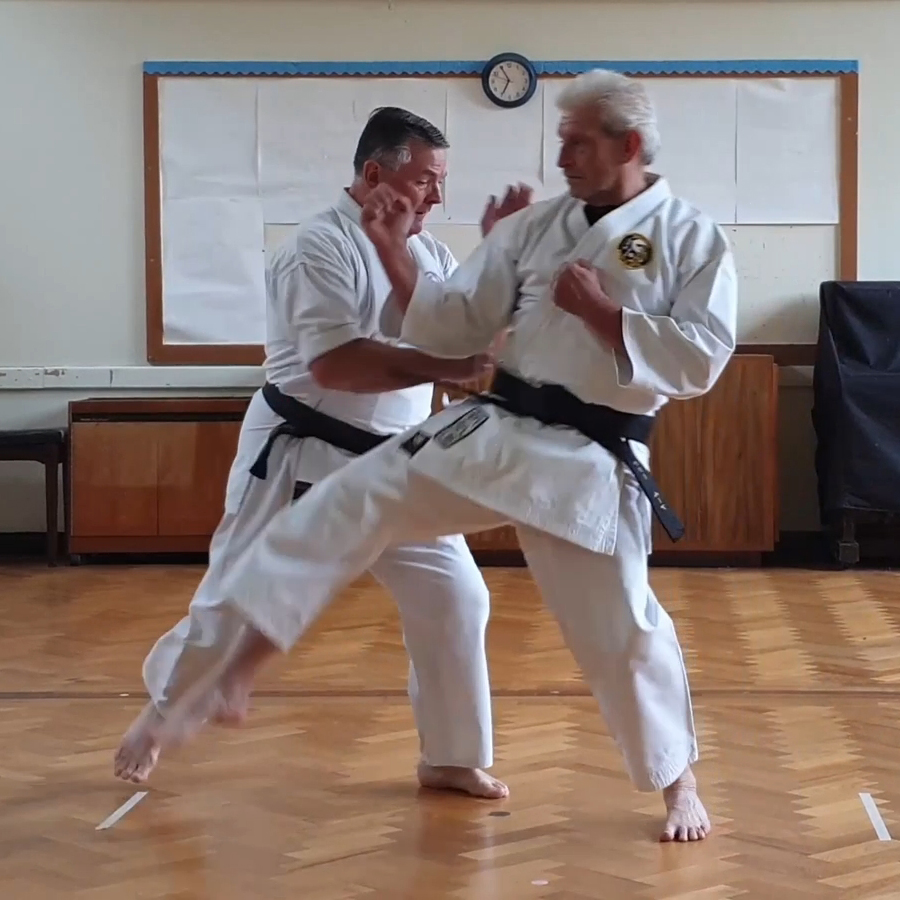
The next action is Chūdan Migi Gyakuzuki, delivered before Uke’s kicking foot has landed.
This is a central point of Kyūhonme. Tori should not wait for the kick to complete, then reset, then strike again. Both attacks must arrive while Uke is still unsettled.
“You want to get both zukis in before it’s actually hit the floor.”
In training terms, Sensei compares this to scoring two waza-ari for an ippon. The idea is not simply to perform two punches, but to overwhelm Uke with continuous forward pressure.
Long, Deep Movement
Kyūhonme should feel like natural walking extended into combative movement. The body moves in an organised, coordinated way rather than separating the upper and lower halves.
As the leg moves, the opposite arm connection is maintained. The action should feel natural, long, and deep. If Tori fails to step through properly, there is not enough room or rotation to affect Uke’s body.
A useful training image is to aim through Uke’s pelvis rather than merely touching the leg. This helps turn the whole body rather than only redirecting the lower limb.
“Try and hit their bottom… then you start to turn the pelvis rather than just the leg.”
Cover After the Punch
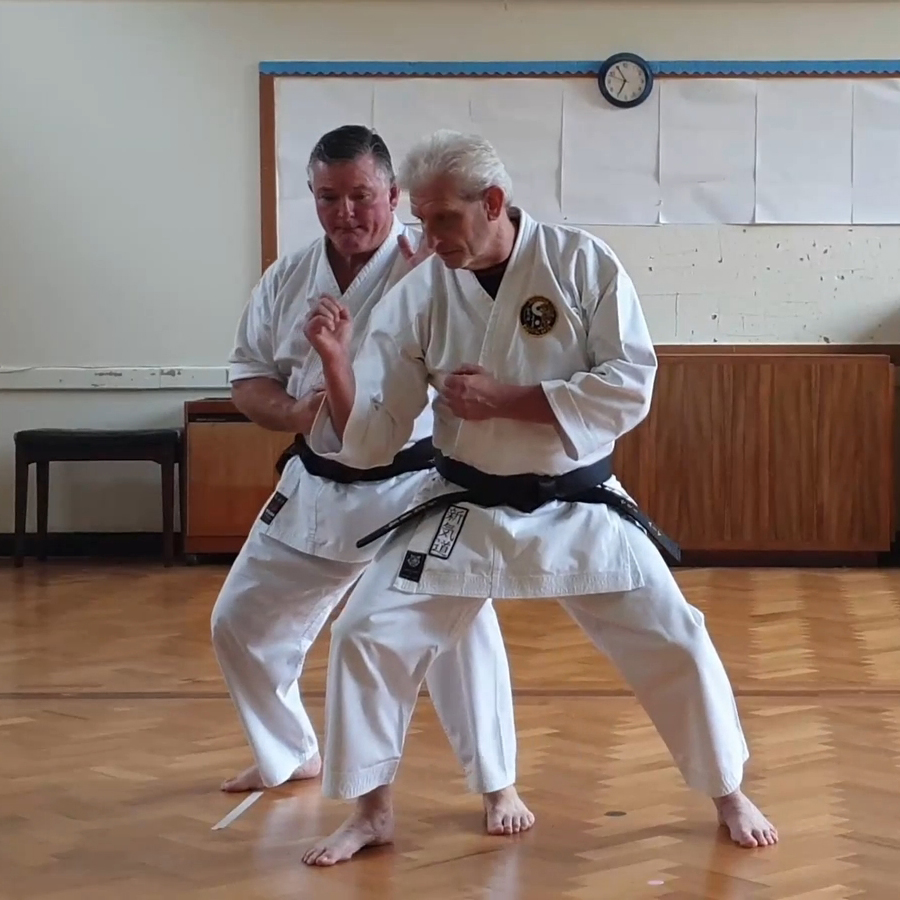
After the gyakuzuki, Tori must not stop in a dangerous position. Uke still has arms, balance, and potential to respond.
The next movement closes the gap and covers the remaining danger. Tori moves in to control the knee and shoulder, continuing the pressure created by the strikes.
This is one of the finer details. The striking phase may appear complete, but the waza is not finished until Uke is covered and controlled.
“After you’ve done the zuki, make sure you cover.”
Control of Knee and Shoulder
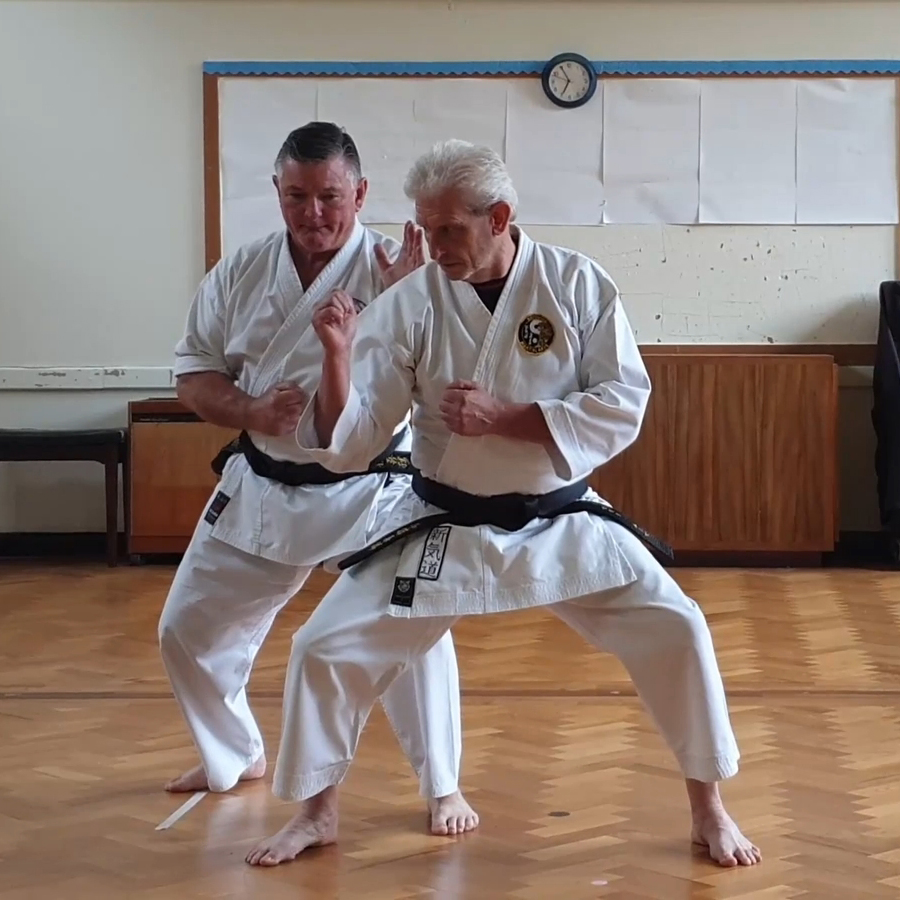
The control phase works through both the upper and lower body. Tori’s positioning affects Uke’s knee while the upper body is covered through the shoulder line.
By stepping forward into this control, Tori further breaks Uke’s balance. The forward entry that began the technique continues right through to the finishing position.
The effect on Uke should be one of pressure and crowding. There is no easy space to regain posture or launch a counterattack.
Final Push Away
The final action applies control and pushes Uke away.
This ending should not be understood as a casual release. It is the final expression of the control already established through entry, timing, cover, and pressure.
Tori has taken the line, struck before Uke could recover, covered the danger, and then controlled the body sufficiently to create a safe separation.
What Uke Should Experience
- the feeling that their kick has been received without a heavy collision
- immediate forward pressure from Tori
- being crowded while still in the act of kicking
- two strikes arriving before the kicking foot lands
- the pelvis and body being turned rather than only the leg being moved
- loss of balance through Tori’s continued entry and cover
Key Principles
- Nagashi — receiving and flowing without escaping the exchange
- Forward pressure — taking Uke’s ground rather than retreating
- Kōbō-ittai — defence and attack expressed as one movement
- Timing — striking before Uke’s foot lands
- Body rotation — using the kick to enhance the punch
- Cover and control — not stopping after the strike
Common Errors
- moving too far sideways and losing forward pressure
- using a heavy gedan barai against the leg
- waiting for Uke’s foot to land before striking again
- stopping after the punch without covering the remaining danger
- only moving the leg rather than affecting Uke’s pelvis and body
- making the movement short instead of long and deep
Final Thoughts
Kyūhonme may contain fewer visible movements than some of the earlier Ippon Kumite, but it is rich in detail.
The lesson is not simply how to block a front kick. The deeper study is how to enter against a kick without collision, use the opponent’s energy to rotate the body, and overwhelm Uke before they can regain structure.
This makes Kyūhonme an excellent study in Wadō-Ryū’s preference for timing, flow, and intelligent pressure over hard resistance.
“Try and overwhelm your Uke with this forward pressure of the attack. They should feel very crowded performing this technique.”
With correct practice, Kyūhonme teaches that even against a strong kicking attack, Tori can move forward, avoid collision, and take control through precise timing and connected body movement.
📺 Full Breakdown Video
Watch the full breakdown of Ippon Kumite No.9 (Kyūhonme), including detailed explanation of nagashi, forward pressure, timing against mae geri, and control after the strike.
📅 4. Upcoming Courses, Events, or Updates
Courses and events are live on the website events calendar and will be updated regularly, so please bookmark it and check it.
Videos from the 3rd May Course started to be released from the 30th May 2026.
🧠 5. Wado Ryu Principle of the Week
Meotode (夫婦手) — Paired Hands in Wadō-Ryū

Meotode (夫婦手) is often translated as “husband-and-wife hands”. It describes the coordinated use of both hands working together, where one hand supports, controls, or creates opportunity, while the other delivers the decisive action.
In Wadō-Ryū Karate, this is not simply a matter of using two hands at once. It is a principle of cooperation, timing, and structure — ensuring that each hand has a clear role within the same movement.
Understanding the Meaning of Meotode
- Meoto (夫婦) — husband and wife
- Te (手) — hand
The term suggests a relationship rather than two independent actions. Just as a partnership requires harmony and mutual support, Meotode reflects the idea that both hands must function together with purpose.
One hand does not act in isolation. Each movement is part of a unified whole.
Why Wadō-Ryū Emphasises Meotode
In many beginner approaches to karate, techniques are often practised with a single focus — a block followed by a punch, or a strike delivered with one hand while the other remains passive.
In Wadō-Ryū, this is considered incomplete.
Effective technique requires:
- control of the opponent
- creation of openings
- maintenance of balance and structure
- continuous connection
Meotode allows these elements to occur together. One hand may guide, deflect, or control, while the other completes the technique.
This creates efficiency and removes unnecessary separation between actions.
Support and Decisive Action
Within Meotode, the hands take on complementary roles.
One hand:
- controls or redirects
- establishes contact
- creates opportunity
The other hand:
- applies the technique
- delivers the decisive action
These roles are not fixed. They may change within the same exchange, but they must always remain connected.
The key point is that both hands are active and purposeful.
Meotode in Wadō Movement
Connection Rather Than Separation
Both hands move in coordination with the body. If one hand acts without the support of the other, the technique becomes weaker and less stable.
Continuous Contact
Where contact is made, it is often maintained and used. One hand may remain in contact to control or monitor, while the other completes the technique.
Natural Flow
Movements are not forced or exaggerated. The hands work together naturally, reflecting the overall Wadō principle of efficiency.
Examples in Wadō Training
Meotode is present throughout Wadō practice.
In Kihon Kumite, one hand frequently controls or redirects the attack while the other applies technique. The effectiveness of the movement depends on how well these roles are coordinated.
In kata, many techniques that appear to involve a single action actually rely on both hands working together. One hand often prepares or supports the technique, even if this is subtle.
In kumite, failure to use both hands effectively often results in loss of control. When Meotode is applied correctly, the opponent is managed and controlled throughout the exchange.
Meotode and the Mind
As with other Wadō principles, Meotode depends on the correct mental approach.
If the practitioner focuses only on the striking hand, the supporting role is lost. If attention is divided or unclear, the movement becomes disconnected.
The aim is a unified intention, where both hands act as part of the same movement, without conscious separation.
Common Misunderstandings
- it is not simply using two hands at once
- it is not performing two separate techniques together
- it is not relying on strength or force
Meotode is about relationship and coordination. Each hand has a role, and both contribute to the effectiveness of the technique.
In Simple Terms
Meotode means that both hands work together, one supporting and one completing the technique.
In Wadō-Ryū, this reflects the broader principle that effective movement is unified, efficient, and connected. When both hands are used correctly, control is established more easily, and technique becomes both simpler and more effective.
🙏 Thank You for Being Part of the Community
If you have any questions, video requests, or feedback, simply contact us here — we read everything.
Wishing you a fantastic week of training,
Roger and The Team
Wado-Ryu Benkyō
https://wadoryubenkyo.co.uk/