Ippon Kumite No.1 – Ippon Me: Structure, Timing and Centre Control in Wadō-Ryū
· by Roger Vickerman Renshi (7th Dan) · Paired Practice
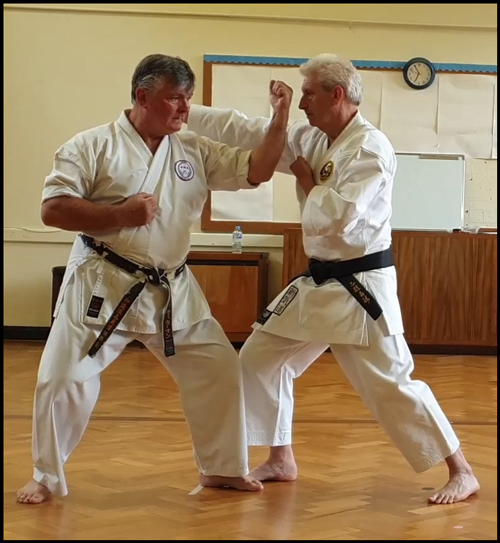
Ippon Kumite No.1 – Ippon Me offers an excellent introduction to the deeper mechanics of Wadō-Ryū paired work. Although it can appear straightforward when first demonstrated, this sequence contains a rich study of posture, body movement, weight transfer, centre-line control, and the relationship between kata and application.
In the accompanying video, we look not only at how the movements are performed, but also at where they come from, how they are linked to Kihon Kata, and what the uke should be feeling during the exchange. That last point is particularly important. Wadō-Ryū technique is not merely about reproducing shapes. It is about creating precise effects within the opponent’s balance and structure.
From Kihon Kata to Ippon Kumite
The first two Ippon Kumite in our association are drawn from movements found in Kihon Kata, a fundamental form which develops essential coordination and body organisation. In this case, the two principal actions are:
- Jōdan Uke
- Gedan Barai
At first glance these may seem basic, but in Wadō nothing is truly basic. These movements teach the body to coordinate opposite sides effectively: for example, the right leg moving while the left arm rises, or the left leg moving while the right arm descends. This cross-body action trains control, balance, and what many teachers describe informally as learning to use both sides of the brain.
In that sense, Ippon Kumite is not separate from kata. It is one of the ways kata begins to reveal its practical logic through interaction with a partner.
The Formal Sequence
The video breakdown sets the sequence out clearly. Uke begins in hidari junzuki dachi, then attacks with iyumi ashi migi junzuki jōdan. Tori responds by stepping back with the right leg into hidari jōdan age uke, then advances with okuri ashi hidari jōdan uraken, followed by migi chūdan gyaku zuki. The sequence then concludes with pressure applied to the knee, shoulder, and covering hand to disrupt uke’s centre, before withdrawing with sugi ashi kotai into gyaku hanmi gamae.
Moving Back – But Not Straight Back
One of the first lessons in this Ippon Kumite is that retreating is not simply a matter of stepping backwards. As the punch comes, tori steps back with the right leg, but also moves off centre. This is crucial.
If we remain directly in front of the line of attack, then even a strong block can leave us absorbing force head-on. By shifting slightly off the line, the body becomes harder to hit and gains a better angle from which to work. The age uke is therefore not just a defensive arm movement. It is part of an integrated change in position, posture, and angle.
A useful image here is to imagine the opponent’s face divided into four quarters. Rather than staying fixed in front of the centre, we shift so that our position begins to take us outside the direct line of attack whilst still keeping us close enough to act immediately.
Posture, Head Position, and Distance
As the movement develops, posture becomes critical. The head should not rise excessively, nor should the body collapse downward. Instead, the body remains aligned and connected. The chin and head stay controlled, the eyes forward, and the structure stable.
This is important both for efficiency and for protection. Dropping too low or bowing the body forward can create vulnerability, including the possibility of running into a head-butt or losing the integrity of one’s own centre. Wadō-Ryū consistently teaches us to stay composed, connected, and properly aligned even in the midst of movement.
Uraken and the Transition to Control
After the initial jōdan age uke, tori moves in with okuri ashi and delivers hidari jōdan uraken. This moment is significant because it marks the transition from surviving the attack to taking control of the exchange.
The movement is not simply a strike in isolation. It continues the body’s forward intention, maintains advantageous positioning, and prevents uke from recovering their balance and line. The body may also work with a slight redirection, almost in the spirit of nagashi, so that the exchange keeps flowing rather than becoming a collision.
Gyaku Zuki Over the Top
The next movement is migi chūdan gyaku zuki. A key detail here is that the punch should travel over the top rather than underneath.
This matters because punching underneath tends to encourage the body to dip, lower, or collapse. It can also create the bad habit of punching from a weaker, compromised line. By going over the top, tori keeps posture, controls the upper line, and preserves the dominant position.
Where possible, there may also be a light trapping or controlling action on uke’s arm, but that is not the only priority. The real principle is to maintain structural superiority while the gyaku zuki lands in a way that reinforces control rather than surrendering it.
What the Uke Should Feel
One of the most valuable features of this Ippon Kumite is that it teaches not only what tori does, but what uke experiences.
At a physical level, uke should feel a downward pressure through the arm and upper body which begins to collapse the centre. When this is done correctly, uke becomes less able to counter-attack because their balance and structure are no longer fully available to them.
There is also a more subtle action at work: two different directions of rotation. One line of control affects the shoulder and upper body, while another line of pressure creates an opposing rotational effect elsewhere in the structure. Together they create a kind of spiralling action through the body. This is one of the reasons the technique can feel surprisingly powerful even when performed without exaggerated force.
In addition, there may be pressure beneath the jaw or around the side of the neck. This area is sensitive and can further disturb balance, alignment, and composure. These details are often not obvious to an observer, but they make a great deal of difference to the partner receiving the technique.
Disrupting the Centre
The video highlights a particularly important teaching point: tori applies pressure through the knee, shoulder, and covering hand in order to disrupt uke’s centre. This is a very useful summary of what the exchange is really about.
Wadō-Ryū does not rely on brute force where structure will do. If we can disturb the opponent’s centre through angle, pressure, and coordination, then their ability to resist or counter diminishes rapidly. The technique becomes less about “hitting harder” and more about placing the body in such a way that the opponent is quietly but decisively compromised.
The Withdrawal
The final action is sugi ashi kotai into gyaku hanmi gamae. This matters just as much as the entry. Wadō does not end at the point of contact. We must also know how to leave the exchange with balance, readiness, and correct distance preserved.
Too often, practitioners focus solely on the impact moment and neglect the quality of the finish. In good paired practice, the ending position should show the same attention to posture, awareness, and ma-ai as the beginning.
More Than a Grading Exercise
Although these Ippon Kumite are used for formal training and grading within our association, they should never be reduced to mere syllabus items. Inside this short sequence we find many of the deeper themes of Wadō-Ryū:
- off-line movement
- cross-body coordination
- maintenance of posture
- spiral force and rotation
- control of centre
- structured entry and clean withdrawal
For that reason, Ippon Kumite No.1 is well worth sustained study. It provides a bridge between solo kata training and paired application, showing how seemingly simple kata motions can become highly functional methods of control.
Final Thoughts
Ippon Kumite No.1 – Ippon Me is a reminder that paired work in Wadō-Ryū is not separate from the deeper art. It is one of the places where the principles of kata, posture, timing, and centre control begin to be felt directly.
When practised carefully, it teaches both partners a great deal. Tori learns how to move with precision and structure. Uke learns how balance can be taken, how pressure can be applied, and how subtle body mechanics can shape the exchange.
That is why exercises like this deserve more than casual repetition. They deserve study.
Watch the video on YouTube or join the conversation on Facebook.
How do you teach or experience Ippon Kumite in your own Wadō-Ryū training? Share your thoughts and observations as we continue exploring the paired practices of the system.