Ippon Kumite No.2 – Nihon Me: Contact, Kuzushi and Taking the Centre in Wadō-Ryū
· by Roger Vickerman Renshi (7th Dan) · Paired Practice
Ippon Kumite No.2 – Nihon Me develops the ideas introduced in the first Ippon Kumite and takes them further into the realm of continuous contact, balance breaking, and centre taking. What appears at first to be a simple defensive and countering sequence is, in practice, an excellent lesson in how Wadō-Ryū uses posture, angle, and pressure rather than force alone.
In the accompanying video, the emphasis is not only on how to perform the formal sequence, but on how to move with the correct attitude. This is especially important here. Too often people think of the opening action as “going back to defend”. In reality, the movement should be much more neutral than that. It should preserve the possibility of both defence and attack at the same time.
From Junzuki Dachi to Tate Seishan
For students working at the earlier kyu levels, using a clear junzuki stance is perfectly acceptable. It helps establish line, direction, and a clean understanding of the formal movement.
However, as practitioners move through the grades and begin approaching more advanced practice, the movement should start to settle into a more neutral Tate Seishan stance. This matters because the body should not feel as though it has simply retreated. It should feel ready, connected, and able to continue immediately into the next phase.
That is one of the central lessons of this Ippon Kumite: the opening action is not a withdrawal in spirit. It is a controlled repositioning which neutralises the line of attack while preserving initiative.
The Formal Sequence
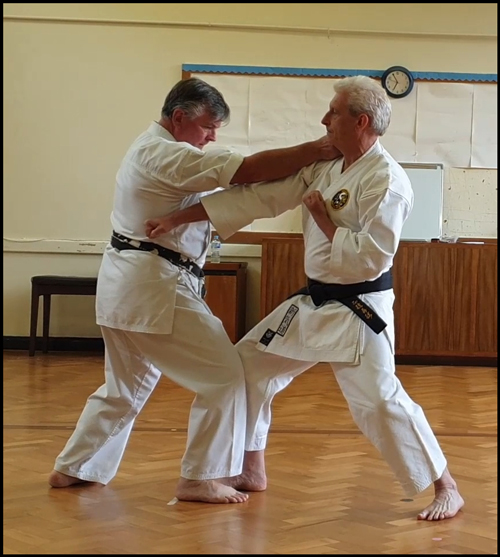
The video breakdown gives the sequence clearly. Uke begins in hidari junzuki dachi and attacks with ayumi ashi migi chūdan junzuki. Tori responds by stepping back with the left leg into gedan barai. From there, while keeping contact, tori leaves the elbow in place and moves the attacking arm onto uke’s arm, then advances with okuri ashi jōdan zuki, using the left hand to control uke’s elbow. The elbow is then moved to the outside of uke’s arm as tori sinks down, working foot-to-foot with the knee pressing into uke’s front knee to break balance. This is followed by hidari gyaku zuki, a drop in weight to complete the taking of uke’s centre, and finally sugi ashi kotai into hanmi gamae.
Do Not Go Too Far Back
One of the common mistakes in this technique is that the defender goes too far backwards in the opening movement. When that happens, the body adopts a purely defensive mentality and the technique loses its continuity.
Instead, the body should drop and settle rather than flee. The hip goes back slightly, the weight organises itself, and the arm comes up or across in a way that stays outside the line of attack. The movement is small, economical, and composed.
Mentally, this is important. We should not think only in terms of “I am defending”. We should think in terms of neutrality — ready to defend and attack in the same instant. This is much closer to Wadō-Ryū strategy.
Gedan Barai as More Than a Block
The opening gedan barai is not merely a downward sweeping action. In this context it is also a positioning tool. It brings the body off the line, controls the attacking limb, and establishes the tactile connection that the rest of the technique depends upon.
That connection is crucial. The PDF notes specifically that tori should leave the elbow in the same place and move the attacking arm onto uke’s arm, keeping contact. This tells us something important about the nature of the technique: once contact is made, we do not abandon it. We use it to guide, feel, and control.
Following the Arm In
As tori moves forward, there is a kind of sliding or following quality along uke’s arm. Rather than disconnecting and striking from outside, the body continues to work through the line already established.
This is where the next action begins to emerge. As you come in, the body is already starting to create kuzushi. The movement is not simply “block, then punch”. The entering motion itself is already breaking structure and taking away stability.
At this stage, care must also be taken with uke’s elbow. As you move in, you need to watch that line closely. This is why the other hand becomes so important.
Jōdan Zuki and Elbow Control
The next formal action is okuri ashi jōdan zuki, with the left hand controlling uke’s elbow. This is one of the most important details in the whole sequence.
The striking hand moves in, but the controlling hand ensures that uke’s arm cannot simply recover and counter. The elbow is not allowed to dominate the space. Instead, it is guided and managed as part of the entry.
The reverse-view images in the PDF make this particularly clear: the elbow is worked to the outside of uke’s arm as tori sinks down through the knees. That sinking action is not cosmetic. It is the beginning of real structural control.
Foot to Foot and the Start of Kuzushi
The photo notes emphasise that tori should be foot to foot with uke and that the knee should press into uke’s front knee in order to break balance. This is a very important Wadō detail.
Kuzushi here is not dramatic. It is subtle and precise. Through the alignment of the feet, the sinking of the body, the pressure on the knee line, and the control of the elbow and upper body, uke’s balance begins to dissolve.
This is why the technique should not be rushed. If the position is correct, the effect becomes obvious to the partner. Uke should feel that their ability to stabilise, step, or counter is being quietly removed.
Noko and Upper-Body Pressure
As the body comes in, there is also an upward and inward pressure through the upper line. In your explanation you refer to using noko into this upper area as the structure comes forward. This complements the elbow control and lower-body pressure beautifully.
What matters is that the whole body is coordinated. The lower body begins to take balance, the arm and elbow line are controlled, and the upper body receives pressure in a way that further prevents recovery. The punch is therefore not independent of the control. It emerges from it.
Hidari Gyaku Zuki and Taking the Centre
The next formal technique is hidari gyaku zuki. By this stage the intention is not merely to score a counter. It is to complete the process of taking uke’s centre.
The PDF makes this explicit by noting that tori should drop weight to complete the taking of uke’s centre. This is an excellent summary of the principle. The punch, the pressure, the knee relationship, and the dropping of weight all work together.
When done correctly, uke should feel not only struck, but structurally overwhelmed. Their posture shortens, their balance weakens, and their centre becomes unavailable to them.
What the Uke Should Feel
For uke, this technique should feel very different from a simple block-and-counter drill.
First, there is the sense that tori has not really “gone away”. Even in the opening movement, contact and pressure are being preserved. Then, as the body enters, uke should feel the arm being managed, the elbow controlled, and the lower body beginning to lose stability.
The pressure into the front knee, the sinking of tori’s body, and the dropping of weight through the final phase should combine to produce a clear sense of the centre being taken. Ideally, uke feels that their structure is being guided and collapsed rather than merely hit.
The Exit
The final movement is sugi ashi kotai into hanmi gamae. As with Ippon Kumite No.1, the exit matters enormously. It demonstrates that the exchange has been completed with awareness and control, not simply with impact.
Good Wadō movement does not fall into the technique and stop there. It enters correctly, controls correctly, and leaves correctly. The finishing kamae should show readiness, balance, and proper ma-ai.
More Than a Formal Drill
Although this Ippon Kumite is part of formal paired practice, it offers much more than a grading requirement. Inside it are many essential Wadō lessons:
- neutral rather than over-defensive movement
- progression from junzuki dachi towards Tate Seishan
- keeping contact rather than separating
- elbow control during entry
- kuzushi through knee pressure and sinking
- dropping weight to complete centre taking
For that reason, Ippon Kumite No.2 is a particularly valuable study. It shows how a simple-looking sequence contains quite advanced principles of body organisation and partner control.
Final Thoughts
Ippon Kumite No.2 – Nihon Me reminds us that Wadō-Ryū paired work is not a collection of isolated techniques. It is a method of learning how to move with precision, neutrality, connection, and structure.
When practised with care, this sequence teaches both partners a great deal. Tori learns how to preserve contact, control the elbow line, break balance, and take the centre. Uke learns how subtle pressure, correct positioning, and coordinated body movement can remove stability long before the final punch arrives.
That is why this practice deserves close attention. It is not just a drill. It is a lesson in Wadō-Ryū itself.
Watch the video on YouTube or join the conversation on Facebook.
How do you practise or interpret Ippon Kumite No.2 in your own Wadō-Ryū training? Share your thoughts and observations as we continue exploring the paired practices of the system.