Ippon Kumite No.3 – Sanbon Me: Pinan Nidan, Slicing Entry and Taking the Angle in Wadō-Ryū
· by Roger Vickerman Renshi (7th Dan) · Paired Practice
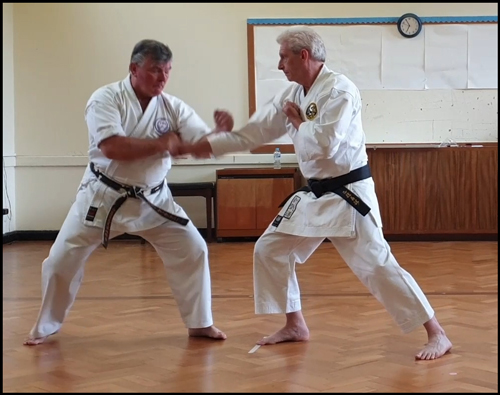
Ippon Kumite No.3 – Sanbon Me begins the next pair of Ippon Kumite linked to Pinan Nidan. If Ippon Kumite One and Two grow out of Kihon Kata, then Three and Four take us into a different kind of movement vocabulary: one that uses turning, pivoting, circular arm action, and the ability to let the attack pass before taking the angle.
In the accompanying video, the key image is very clear: open the door, let the attack through, then turn. That single idea captures much of what makes this technique so distinctly Wadō. The body does not clash with the line of attack. It opens, pivots, and then works through the opponent from a superior angle.
From Pinan Nidan into Ippon Kumite
The origin of this technique is identified directly in the teaching: number three comes from the opening of Pinan Nidan. The photo sheet supports this by noting that after the initial movement the arm travels in a full circle (Pinan Nidan kata).
This is important because it helps us understand that the partner work is not invented separately from kata. The Ippon Kumite allows the solo movement to be explored against a real line of attack. The same turning body, the same circular path, and the same slicing quality become practical when applied to uke’s arm and balance.
The Formal Sequence
The sequence begins with uke in hidari junzuki dachi attacking with ayumi ashi migi chūdan junzuki. Tori responds with ura gedan barai, followed by a full circular arm movement taken from Pinan Nidan kata. The same hand then continues into otoshi uchi, after which tori advances with okuri ashi hidari jōdan zuki, using the right hand to control uke’s arm. The punching hand then covers the shoulder ready for the strike, followed by chūdan hidari gyaku zuki. The finish uses the knee and covering hand to sink into uke before withdrawing with kotai tsugi ashi into gyaku hanmi gamae.
Open the Door, Then Turn
The body movement for both Numbers Three and Four is described through a very useful image: a hinged door. You do not turn too early. You do not swing away before the attack arrives. Instead, you allow the attack to come, then you open the door and turn.
This is critical. If the defender turns too soon, the movement loses its timing and realism. The correct feeling is to move back just enough, then pivot. The body should remind us of a pendulum or grandfather clock: measured, controlled, and natural.
This gives the technique its proper timing and ensures that the turn is not decorative. It is a response to a committed line of attack.
Ura Gedan Barai and the Start of the Circle
The opening action is ura gedan barai. As with many Wadō movements, this is much more than a simple block. It begins the process of opening the line, controlling the attacking arm, and positioning the body to work from outside.
From there, the arm travels in a full circle, directly reflecting the opening of Pinan Nidan. This circularity is not just for show. It builds the route by which the arm can guide, draw, and influence uke’s structure without becoming stiff or linear.
Drop the Weight, Do Not Hit
A major teaching point in your explanation is that this action should not feel like striking down with force. Instead, the body should drop its weight. The partner should feel body weight and structure, not a crude blow.
This is an important distinction. When the body drops correctly, the pressure becomes much more difficult to resist. It is not simply impact. It is the feeling of the defender’s whole structure entering the exchange.
The next movement, identified in the photo sheet as otoshi uchi, continues this idea. Rather than treating it as a separate, disconnected motion, it should arise naturally out of the previous hand position and the body’s dropping action.
Ryūsui – Flowing Through
You describe the next phase beautifully as ryūsui — flow. This captures the feeling very well. The hands work together, almost like breaststroke or moving through long grass. One hand is never abandoned while the other acts. Each hand prepares the next role.
This is also visible in the photo breakdown. On page 2, after the otoshi uchi, the same hand continues from the previous position, and the next advance is made with okuri ashi hidari jōdan zuki, while the right hand controls uke’s arm. The hands therefore operate cooperatively rather than in isolation.
Slicing Rather Than Smashing
Another key detail is the angle of the dropping action. You emphasise that it should not come in as a square 90-degree hit. Instead, it should travel through at an angle — more of a slicing or cutting action, reflecting the movement of Pinan Nidan.
This matters enormously. When the action slices through, it affects the arm and body differently. It does not just stop the movement. It redirects it while simultaneously undermining balance and structure.
You also note that if the action comes toward the centre, the connected structure of the arm naturally carries the fist outward. This makes the movement efficient and organic rather than forced.
Hooking with the Wrist
For uke, one of the clearest sensations in this waza comes from the curvature of the wrist. As Kerry explains, that curvature has a significant effect on the arm. It becomes a hooking action, helping the movement to bite and control rather than simply brush past.
This is a very characteristic Wadō feeling. Small adjustments in the hand and wrist can dramatically change how the partner experiences the technique. The motion is subtle, but the structural effect is considerable.
Jōdan Zuki, Shoulder Cover, and Gyaku Zuki
After the entry and circular control, tori advances with okuri ashi hidari jōdan zuki, while the right hand controls uke’s arm. The photo sheet then makes another excellent point: the punching hand covers the shoulder ready for the strike.
This is an important Wadō habit. The hand that has just been active does not disappear. It takes over the covering role so that the next action can be delivered from a protected and structurally sound position.
From there comes chūdan hidari gyaku zuki. As you explain, this should not be a linear push straight backwards. The real pressure is through a 45-degree angle, through the line that has already been created by the body movement and control.
What the Uke Should Feel
For uke, this technique should feel very different from a simple block-and-punch combination. First there is the sense that the defender has opened and turned rather than collided. Then there is the circular arm action, the drop of body weight, and the slicing quality of the control.
As the waza develops, uke should feel the hooking effect through the arm, then the cover and strike building pressure along an angled line rather than a direct shove backwards. This is one of the reasons the technique can be so effective. The balance is not challenged in a way uke easily expects. It is taken through angle, coordination, and structure.
Sinking into the Uke
The photo sequence finishes by noting that tori should use the knee and the covering hand to sink into the uke. This is a very strong summary of the final principle.
Again, the emphasis is not on striking harder. It is on dropping body weight and structure through the partner in a way that compromises the centre. When done correctly, uke should feel pressure through the body as a whole, not just at the point of contact.
The Exit
The final movement is kotai tsugi ashi into gyaku hanmi gamae. As always in Wadō, the withdrawal matters. It shows that the defender has not overcommitted, and that posture, readiness, and ma-ai have all been preserved.
The technique therefore begins well, controls well, and finishes well. That is part of what gives these Ippon Kumite such value as training methods.
More Than a Formal Drill
Ippon Kumite No.3 contains several important Wadō lessons:
- linking partner work directly to Pinan Nidan
- opening like a hinged door rather than turning early
- using full circular arm motion
- dropping weight instead of striking crudely
- working with slicing rather than smashing action
- using cover intelligently between punches
- creating pressure through a 45-degree angle
For that reason, this technique is far more than a grading sequence. It is a compact lesson in Wadō-Ryū timing, angle, flow, and body organisation.
Final Thoughts
Ippon Kumite No.3 – Sanbon Me helps show how kata movement becomes living partnered technique. Through Pinan Nidan, the body learns how to open, turn, circle, slice, cover, and take the angle. In partner work, those same ideas begin to be felt directly.
Practised carefully, this waza teaches both sides. Tori learns to move with flow, angle, and weight. Uke learns how subtle changes in wrist shape, line of pressure, and body dropping can have a profound effect on structure and balance.
That is why this practice deserves study. It is not only formal. It is deeply instructional.
Watch the video on YouTube or join the conversation on Facebook.
How do you practise or interpret Ippon Kumite No.3 in your own Wadō-Ryū training? Share your thoughts and observations as we continue exploring the paired practices of the system.