Traditional Karate
Weekly Newsletter • 31 January 2026
Weekly Update from Wadō-Ryū Benkyō
Hello, welcome to your 8th weekly update from Wadō-Ryū Benkyō. Below you’ll find this Saturday’s training notes, the latest long-format video, a featured article, course updates, and this week’s principle.
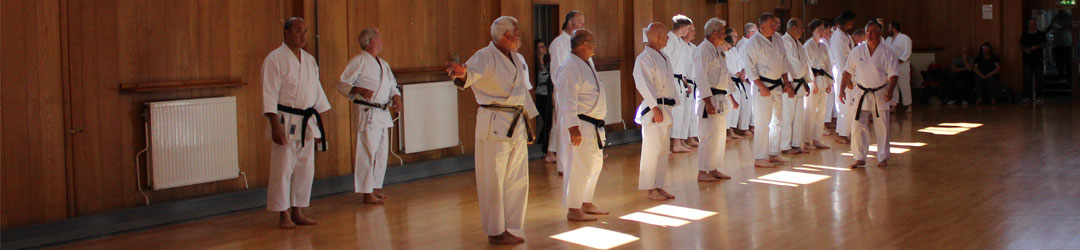
🥋 Saturday Benkyō Class Review – Today’s Training
We began with a thorough warm-up designed to get both the body and mind ready for the session. Alongside loosening and mobilising the body, there was a strong focus on body twisting for avoidance techniques (think Kihon Kumite No. 4), as well as the triangular footwork needed throughout the kihon. Emphasis was placed on gliding movement — almost like moving on ice — with the centre of the body travelling smoothly above the feet. This helped warm up the grey cells as much as the muscles.
A good portion of time was then spent on the Dan Grade Renraku Waza, not just to rehearse them, but to really let them settle. The aim was to give enough space to think about each technique, each transition, and the progression through the series, using the material as a tool for self-improvement rather than simple repetition.
With a healthy sweat on and the windows wide open to let in the freezing air, we moved on to jun-zuki — but not in the way you might expect from a standard class. This became a 20-minute masterclass on how to get the most out of jun-zuki by using the whole body before, during, and at the completion of the technique. We explored how to move from yoi-dachi into jun-zuki, generating speed and force without tension, allowing the technique to “ring out” cleanly, with every body movement contributing to its effectiveness.
Using the same principles, we then applied this approach to gyaku-zuki, kette jun-zuki, kette gyaku-zuki, jun-zuki notsukomi, gyaku-zuki notsukomi, kette jun-zuki notsukomi, and kette gyaku-zuki notsukomi. Particular attention was paid to the fact that kette itself is a complete technique and must be performed as such, rather than treated as a mere transition. We also looked closely at how the hips drive the body, how the head must be allowed to move back to “release the brakes” for effective mae-geri, and how the body then resets naturally for gyaku-zuki — all while remaining within the notsukomi framework, avoiding unnecessary up-and-down movement and giving each technique the space and time it needs to be effective.
To place this work into a more practical context, we then practised Nihon Kumite with a partner. This highlighted exactly where the elements studied earlier — posture, timing, body use, and structure — need attention. It proved to be a thought-provoking section, with plenty to take away and work on in future practice.
The second hour of the session was dedicated to Seishan Kata. After running through the kata, we broke it down section by section, focusing on timing and reinforcing the first hour’s lesson: each technique must be distinct, practical, and correctly executed before moving on. We also examined the importance of each transition within the kata — why we move in certain ways, what each movement is designed to achieve, and which parts of the body are being used at any given moment to get the most out of the kata.
Partner work then allowed us to explore practical aspects of Seishan, including meotode — how the hands support and complement one another — and the often-overlooked role of the elbows within the kata. We also looked at how material from an advanced kata like Seishan can be fed back into kihon, such as gaiwan-uke and naiwan-uke, reinforcing the idea that everything is connected.
Finally, we used partner work to examine the transitions within Seishan, helping to clarify position, balance, timing, and weight shifting, and grounding the kata firmly in practical experience. By the end of the session, it was clear that everyone had made improvements in one or more areas, moving with greater understanding and technical ability. A great lesson — definitely a “get sweaty” session, but also a challenging and thought-provoking two hours of training.
🎥 2. This Week’s Long-Format Video
PART 17 – TECHNICAL BREAKDOWN – KERI WAZA | KIHON FUNDAMENTALS
Kihon Fundamentals – Keri Waza (Conclusion) brings the kicking syllabus together with a clear, principle-focused review of what makes Wadō-Ryū kicking functional and reliable. Rather than adding new material, Roger Vickerman Renshi and Kerry Moore Sensei clarify how structure, balance, timing, recovery, and continuity underpin effective keri waza — with particular emphasis on the supporting leg, posture, and avoiding over-commitment.
Watch on YouTube📝 3. Featured Article of the Week
Article: Wadō-Ryū Benkyō — Seishan by Roger Vickerman Renshi
Unveiling the Foundations of Seishan Kata in Wadō-Ryū Karate
Seishan (征捨安) is one of Wadō-Ryū’s most historically rich and internally demanding kata, emphasising breath, structure, and controlled power over visible speed or force. With its compressive stances, measured rhythm, and calm intensity, Seishan challenges practitioners to unite posture, internal pressure, and intention, drawing strongly on principles first explored in Naihanchi. This study explores Seishan’s origins, stance mechanics, arm structure, and practical applications, highlighting how subtle footwork, breath control, and internal readiness create stability, efficiency, and decisive effect. Often understated on first encounter, Seishan reveals increasing depth over time, rewarding patient study with profound insight into the internal and philosophical heart of Wadō-Ryū practice.
📅 4. Upcoming Courses, Events, or Updates
Things you may want to know about:
- The course and events calendar is now live on the website and will be updated regularly — please bookmark it and check it: Courses & Events.
- The May 2026 course dates and location have been confirmed — details and booking: May 2026 Course.
- The August 2026 course is now available for booking — details: August 2026 Course.
- The October 2026 course is now available for booking — details: October 2026 Course.
- Saturday sessions will be running throughout January 2026 — except the 17th January. If you would like to attend a Saturday session for the first time, please get in touch.
🧠 5. Wadō-Ryū Principle of the Week
Kuzushi (崩し)
Kuzushi is often translated as “breaking balance,” but in Wadō-Ryū it is better understood as breaking the opponent’s ability to maintain structure, timing, and intent — so technique becomes inevitable rather than forced.
Kuzushi can be physical, structural, rhythmic, or psychological — and in Wadō it is rarely dramatic. Instead, it is quiet destabilisation created through angle change, timing, subtle redirection, and body settling (shizumu). This is why kuzushi appears throughout Wadō practice: in taisabaki and entry, in kihon kumite, and embedded within kata such as Naihanchi, Seishan, and Wanshū.
Wadō’s strong jujutsu heritage makes kuzushi central: it allows control and decisiveness without force-on-force exchange, and it enhances other principles such as datsuryoku, ryūsui, hadō, omomi, and yowasa. Read the full Kuzushi article.
🙏 Thank You for Being Part of the Community
If you have any questions, video requests, or feedback, simply reply or get in touch — we read everything.
Wishing you a fantastic week of training,
Roger and The Team
Wadō-Ryū Benkyō
https://wadoryubenkyo.co.uk/