Traditional Karate
Weekly Newsletter • 7 March 2026
Weekly Update from Wadō-Ryū Benkyō
Hello, welcome to your 13th weekly update from Wadō-Ryū Benkyō. Below you’ll find this week’s class review, the latest long-format video, a featured article, course updates, and this week’s principle.
🥋 1. Saturday Benkyō Class Review – Today’s Training
Training with Roger Vickerman Renshi (7th Dan)
This week’s Saturday Benkyō session was very much a lesson in removing the hiding places from our technique. The focus throughout the class was simple but demanding: slow everything down, move smoothly, and allow the body to reveal how each movement truly works.
We began by exploring Junzuki, not as a fast stepping punch but as a coordinated movement of the whole body. Rather than pushing the technique with the arms, the motion started from the forward movement of the body’s weight. This forward intent naturally drew the back foot into motion, while the arms travelled with the body rather than moving independently. Particular attention was paid to allowing the front knee to settle correctly at the moment of impact, helping the body connect from the ground through the hips and into the technique.
From there we moved into Gyakuzuki, examining the subtle mechanics that make the punch effective. Roger emphasised the controlled “collapse” of the hip which allows the body to rotate around its centre and establish a new centre point as the technique develops. In this process we briefly pass through a shiko-dachi-like transitional moment, before the body resets from the foot through the hips, creating the forward energy that drives the punch.
The same principles were then applied to Sonobade Ippon Toru, with an emphasis on maintaining forward intention. Rather than rising up or retreating in order to generate power, the body subtly adjusts while still projecting forward. The aim is penetration through position and structure rather than force or speed. Partner work allowed everyone to explore these ideas in practice.
The class also examined how Gyakuzuki can naturally link into Maegeri, requiring a shift of weight to the new supporting leg while allowing the hips to open and continue the forward momentum. The key theme remained consistent throughout: the body may turn, but it must remain centred, balanced, and structurally aligned.
In the latter part of the session we explored Shuto Uke, Morote Uke, and Kaku Uke, using Hiraki Ashi and Sansoku footwork to understand how movement develops through the entire body chain. Partner drills focused on timing, positioning, and the coordination of hips, shoulders, and arms. The emphasis was on allowing movement to flow naturally — rolling onto the foot, releasing the back leg, and letting the technique emerge from the body as one connected action.
To bring everything together, we looked at Pinan Yondan, where many of these principles can be seen in action. By slowing the kata down and maintaining continuous movement, it becomes possible to see how posture, balance, distance, and timing all combine to produce efficient technique.
The message throughout the session was clear: slow the movement down, finish each technique fully, but never kill the flow. Smooth, continuous movement allows posture, timing, and structure to work together.
It was a demanding but rewarding session — a real masterclass in the physiology of movement and the deeper thinking behind true kihon, where the foundations of posture, timing, balance, and coordination are constantly refined.
Saturday sessions will run through 2026 - we will be training all Saturdays in March and April, if you would like to attend a Saturday session for the first time reply to this email and let us know.
🎥 2. This Week’s Long-Format Video
Part 21 - Kette Junzuki Notsukomi - Kihon Fundamentals
Kihon Fundamentals – Kette Junzuki Notsukomi continues the exploration of Wadō-Ryū’s integrated movement principles, with Roger Vickerman Renshi and Kash Bansal examining how the addition of the kette phase transforms Junzuki Notsukomi into a more complex but highly functional technique. The session focuses on maintaining posture, centre line, and balance while coordinating hips, supporting leg, and body movement so the kick and punch remain one continuous action. By keeping the body low, connected, and correctly aligned, the technique naturally develops into applications such as Maegeri Nagashi Zuki, showing how kihon mechanics evolve into practical movement for kumite.
📝 3. Featured Article of the Week
Bassai – Storming the Fortress in Wadō-Ryū Karate
Article: Read the full article here
Bassai (抜塞), often translated as “to storm a fortress,” is one of the most powerful and strategically rich kata in the Wadō-Ryū syllabus. In this detailed exploration with Roger Vickerman Renshi, the kata is examined beyond its strong outward structure to reveal its deeper principles of kuzushi, angular entry, centreline control, and overwhelming intent. Through historical context, Kaisetu discussion, and practical examples, the article explores how Bassai’s movements shift between striking, controlling, and unbalancing while maintaining tactical awareness. More than a sequence of techniques, Bassai emerges as a study in timing, strategy, and adaptability — a kata that continues to reveal new insights every time it is revisited.
📅 4. Upcoming Courses, Events, or Updates
Things you may want to know about:
- Course and events calendar is now live on the website and will be updated regularly so please bookmark it and check it
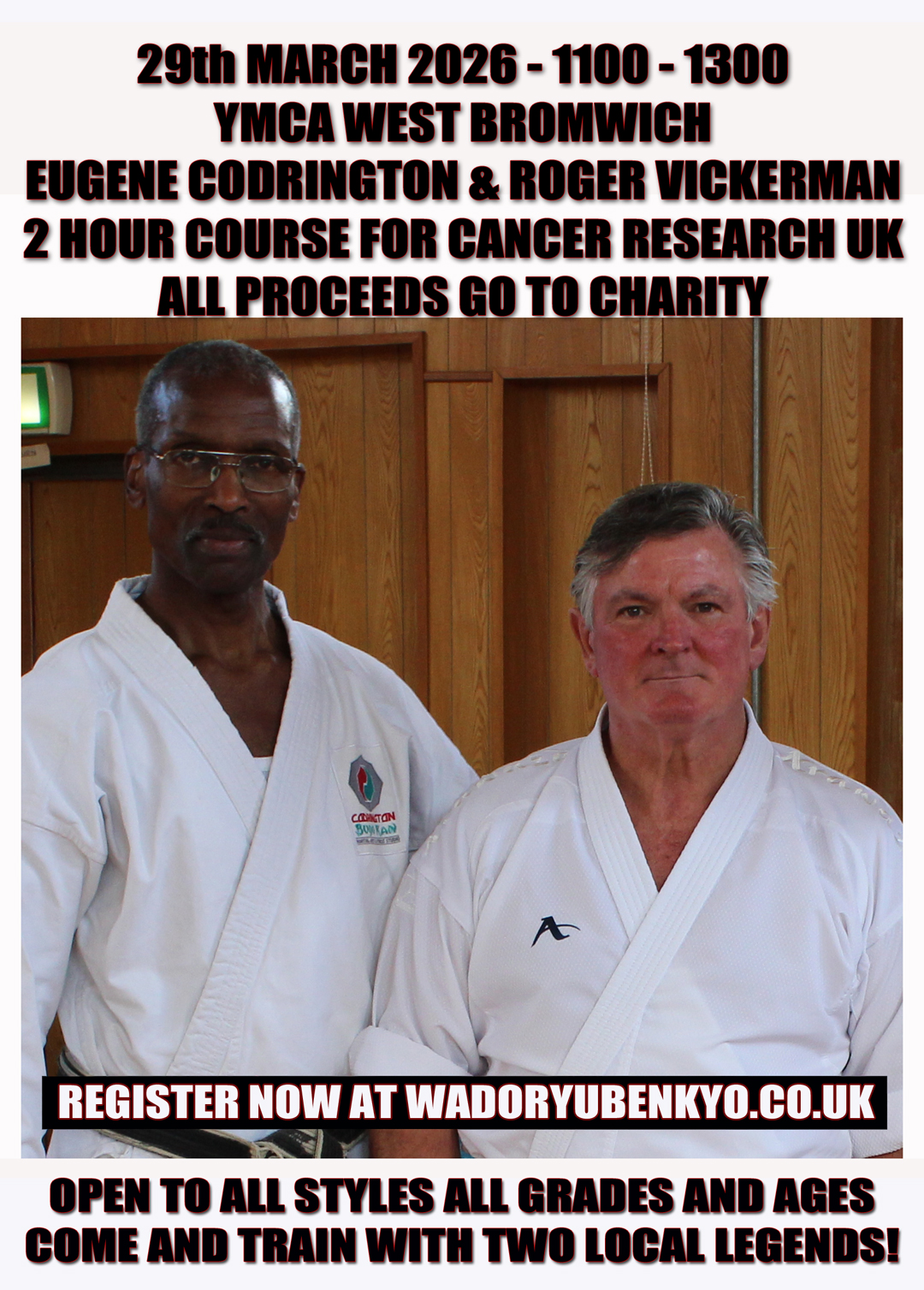
- 29th March 2026 Joint Charity Course with Eugene Codrington full details and booking here
- The May 2026 course dates and location has been confirmed, you can see all the details and book on here
- Website updates: Wadō-Ryū Benkyō is now fully live, but more content is being added all the time, so keep checking back for new articles, videos and announcements
- Saturday sessions to run through until 2026 - we will be training all Saturdays in December and January except the 17th January, if you would like to attend a Saturday session for the first time reply to this email and let us know
🧠 5. Wadō-Ryū Principle of the Week
San Mi Tai (三位体)
San Mi Tai is often translated as “three-body posture,” but in Wadō-Ryū it is better understood as the relationship between three elements: oneself, the opponent, and the space that exists between them.
Among the many principles that shape Wadō-Ryū movement, San Mi Tai describes the relationship between bodies in conflict. Rather than thinking only about technique, it encourages the practitioner to understand position, posture, and spatial advantage as a unified whole.
Literally, San (三) means three, Mi (位) refers to position or place, and Tai (体) means body. The phrase therefore points to the alignment and relationship of three “bodies”: your own body, your opponent’s body, and the positional space created between them.
In Wadō-Ryū this relationship is rarely static. It changes constantly as movement unfolds. Effective technique emerges not from forceful collision, but from maintaining a position in which the opponent cannot apply their strength effectively while you retain freedom to act.
Understanding the Three “Bodies”
When speaking about San Mi Tai, it is useful to consider the three elements individually, while remembering that in practice they always function together.
1) Your Own Body
Your posture, balance, and structural integrity determine whether you can respond effectively. If your own structure is compromised, even simple actions become difficult. San Mi Tai therefore begins with maintaining your own stability and alignment.
2) The Opponent’s Body
Just as your own posture matters, the opponent’s structure can also be influenced. Through timing, angle, and movement, their ability to organise their body may be subtly undermined. When this happens, their actions become slower, weaker, or poorly coordinated.
3) The Space Between
Perhaps the most important element is the relationship of space between the two bodies. Distance, angle, and relative position determine which person can act effectively. Wadō-Ryū places great emphasis on positioning that removes the opponent’s advantage while preserving your own.
When these three elements are understood together, movement becomes efficient and natural. Technique appears to arise effortlessly from correct positioning.
In Simple Terms
San Mi Tai is the management of the relationship between your body, the opponent’s body, and the space between you.
When this relationship is favourable, technique becomes easy. When it is unfavourable, even strong technique becomes difficult.
🙏 Thank You for Being Part of the Community
If you have any questions, video requests, or feedback, simply reply to this email — We read everything.
Wishing you a fantastic week of training,
Roger and The Team
Wado-Ryu Benkyo