Traditional Karate
Weekly Newsletter • 7 June 2026
Weekly Update from Wadō-Ryū Benkyō
Hello,
Welcome to your 24th Weekly update from Wado-Ryu Benkyō.
A correction from our last newsletter, 31 May 2026, issue 23: we incorrectly referred to the first zuki from Tori in Ippon Kumite No.9 as Migi Jōdan Zuki. It is in fact Hidari Jōdan Zuki; the right arm is being used for the gedan barai. Thank you to Richard for flagging this, and please accept our apologies for the error.
Now on to the newsletter.
🥋 1. Saturday Benkyō Review
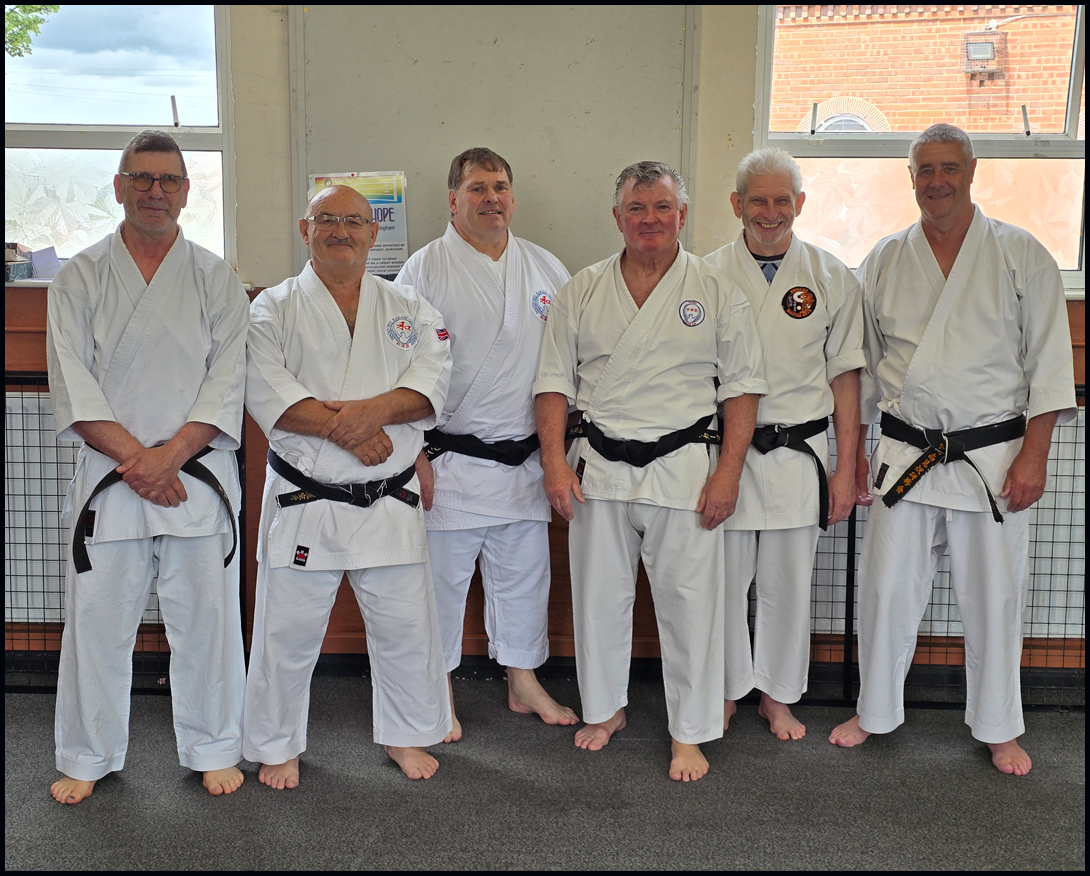
An excellent Saturday Benkyō class as always; a full-circle session that ended where it started, but in a completely different place. That may be difficult to explain, but I will try.
We began by practising the Renraku Waza. Although working solo, we focused on recognising the movements as they appear elsewhere within Wadō-Ryū, such as in Kata and paired practice. The aim was to visualise those applications within the Renraku Waza itself, giving the movements form, context, and meaning.
After running through the current Dan Grade combinations, we moved on to breaking down individual sections to better understand what was happening within each sequence. We examined body position, timing, and movement flow, seeking to mirror the reality of an attack-and-defence situation. By understanding how each action connects to the next, the Waza becomes far more than a series of memorised movements.
Having spent some time analysing the combinations, we moved into paired practice and explored Kihon Kumite that contain similar movements. One example was Ropponme, where body shifting is used to avoid a Sokutō Geri. This provided an opportunity to develop a deeper understanding of how the body should move, where it should move to, and how correct positioning creates freedom of movement for whatever follows, whether attack or defence.
From there, we stepped back and looked at some paired exercises that are not widely practised today but remain valuable for understanding the principles involved in receiving a Mae Geri head-on. We explored how Taisabaki and weight shifting can move the body off the line of attack without surrendering distance, allowing an immediate response at the correct ma-ai. We also examined different ways of using the defending arm to influence the uke, and how Ryūsui plays such a vital role in maintaining the flow of energy throughout a technique, making movement both more effective and more natural.
Moving away from paired work, we returned to group training and focused specifically on Shuto Waza (Uke and Uchi), examining how the whole body contributes to the technique rather than simply the arms. As with many Wadō-Ryū techniques, it is easy to focus on the final or most visible movement and assume that this is the technique itself. In reality, that final movement is usually the result of everything that has happened before it.
This is certainly true of Shuto Waza, where the body, from the feet upwards, creates the movement, momentum, and direction that allow the arms to complete the technique. The feet and hands finish together, enabling force to be transferred efficiently into the action.
We spent considerable time exploring Hiraki Ashi with Sansoku, even leaving the arms relaxed at our sides so that we could feel the body being drawn forward into the movement. As the practice continued, it became noticeable that the whole room was moving differently. When the arms were reintroduced, they were no longer the focus of the technique but simply the final expression of the body's movement.
To place this into a practical context, we partnered up once again and practised defending against Gyaku Zuki using Hiraki Ashi to move off the attacking line before entering the uke's space and attacking the leg. It was an excellent way to add depth and understanding to what we had been working on during Kihon practice.
From there we moved into Nihon Kumite, where there is a particularly good example of this principle in action within Number 11. Once again, the paired practice added context and depth to the training.
To finish and bring the session full circle, we returned to the Renraku Waza, but this time with uke and tori working together. We focused on understanding the relationship between both partners throughout the sequence: where each person is positioned, where the attacking line exists, why particular angles are used to avoid incoming attacks, and how those angles create the best opportunities for our own counterattack.
We explored why precise body movement is essential—not only to avoid danger but also to remain close enough to respond effectively. We looked at the importance of covering while attacking, allowing us to apply Dōjini and, in some cases, Kōbō Ittai. One example was using Noru to stop an attack while simultaneously driving forward with the same arm to counterattack.
As always, the time passed far too quickly, and we could easily have continued for several more hours. Nevertheless, there was a great deal to take away, reflect upon, and unpack. We look forward to picking up these themes again next time as we continue the Benkyō journey together with friends and the wider Benkyō family.
There will be no Saturday Benkyō session next week (13th June). However, classes will continue throughout June 2026. Please keep an eye on the weekly updates, as occasional changes to the schedule may occur. If you would like to attend a Saturday session for the first time, simply reply to this email and let us know. You can also check the Events Calendar for future session dates and further details.
🎥 2. This Week’s Long-Format Video
The Importance of the Mind in Japanese Martial Arts – Part 2
In Part 2 of this thought-provoking seminar, Roger Vickerman Renshi (7th Dan) continues his exploration of the mental dimensions of traditional martial arts, demonstrating how physical technique and mental awareness must work together to create effective karate.
Building upon the concepts introduced in Part 1, Roger explains how advancing age and experience should encourage practitioners to rely less on muscular strength and more on efficient body mechanics, relaxation, timing, and intelligent movement.
Through practical demonstrations and training exercises, he examines:
- How relaxation improves speed, power, and efficiency
- The role of body movement and hip positioning in effective technique
- Using natural body mechanics instead of excessive muscular tension
- Developing awareness through movement and partner training
- Understanding connection and sensitivity in martial arts practice
- How touch can often provide faster information than sight
A major focus of this session is the concept of connection — the ability to establish and maintain awareness through contact with an opponent. Roger explores how connection develops from simple self-preservation into a deeper understanding of an opponent's intentions, movements, and opportunities.
The seminar also introduces important budo concepts including:
- Ma-ai — far more than physical distance, encompassing timing, positioning, and relationship between opponents
- Mushin — the open, uncluttered mind that allows natural response without hesitation
- The relationship between mental awareness and physical interaction
- Recognising territorial space and understanding how distance affects human behaviour and reactions
This session provides valuable insights for karateka of all grades, helping practitioners move beyond simply performing techniques and towards understanding the deeper principles that underpin traditional Japanese martial arts.
📝 3. Featured Article of the Week
Read the standalone article page
Ippon Kumite No.10 – Jūponme
A study in dropping, sliding, vector pressure, elbow control, short kicking, and maintaining pressure through the finish
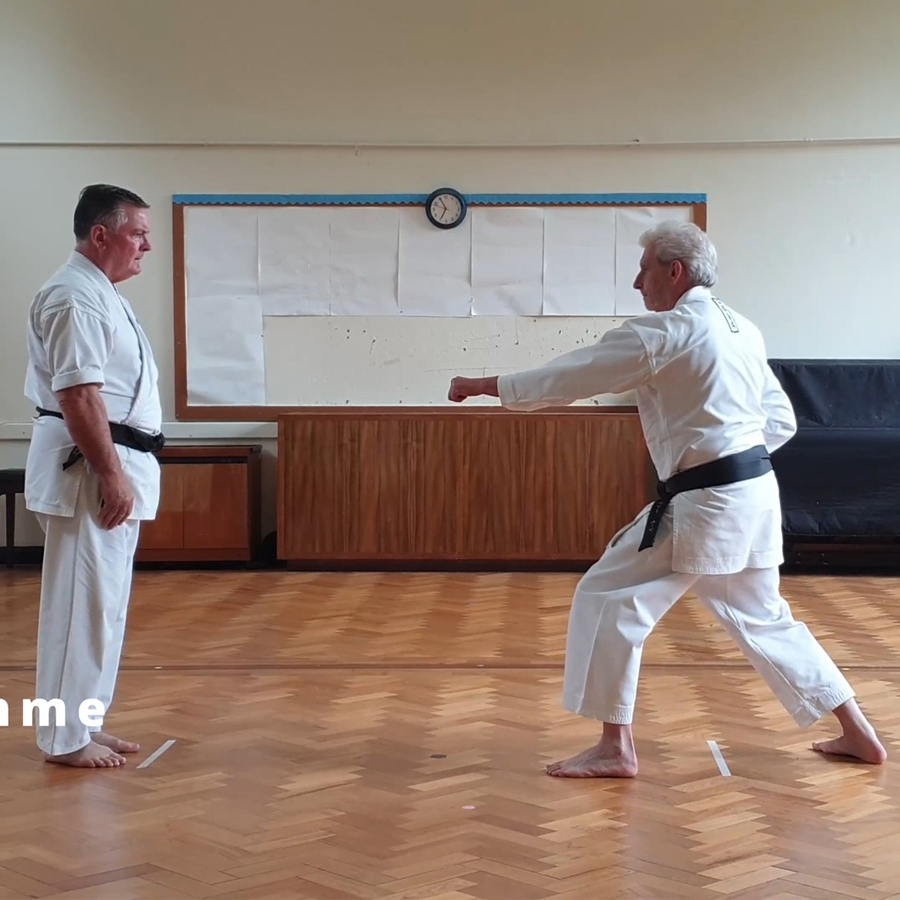
Ippon Kumite No.10 – Jūponme concludes the Ippon Kumite series with a sophisticated study of body movement, direction, pressure, and control.
Where some earlier waza focus on clear striking or direct structural collapse, Jūponme asks the practitioner to manage two lines of force at the same time. Tori must drop and slide to move the centre, turn the body out of danger, apply pressure through the arm, and then maintain that pressure while delivering a short, efficient kick.
The result is compact, directional, and precise. Uke should feel drawn into a weak line, controlled through the elbow, and unable to recover or counter.
Opening Position – Hidari Junzuki Dachi
Uke begins in Hidari Junzuki Dachi. The initial shape gives Tori a clear attacking line to work with, but the response must not be static.
The first lesson is that Tori must move the centre. This is not simply stepping the feet or moving the hands. The body must drop, lift, slide, and turn as one connected action.
“Make sure you drop and you lift and slide, to move your centre.”
Initial Entry – Drop, Lift, Slide
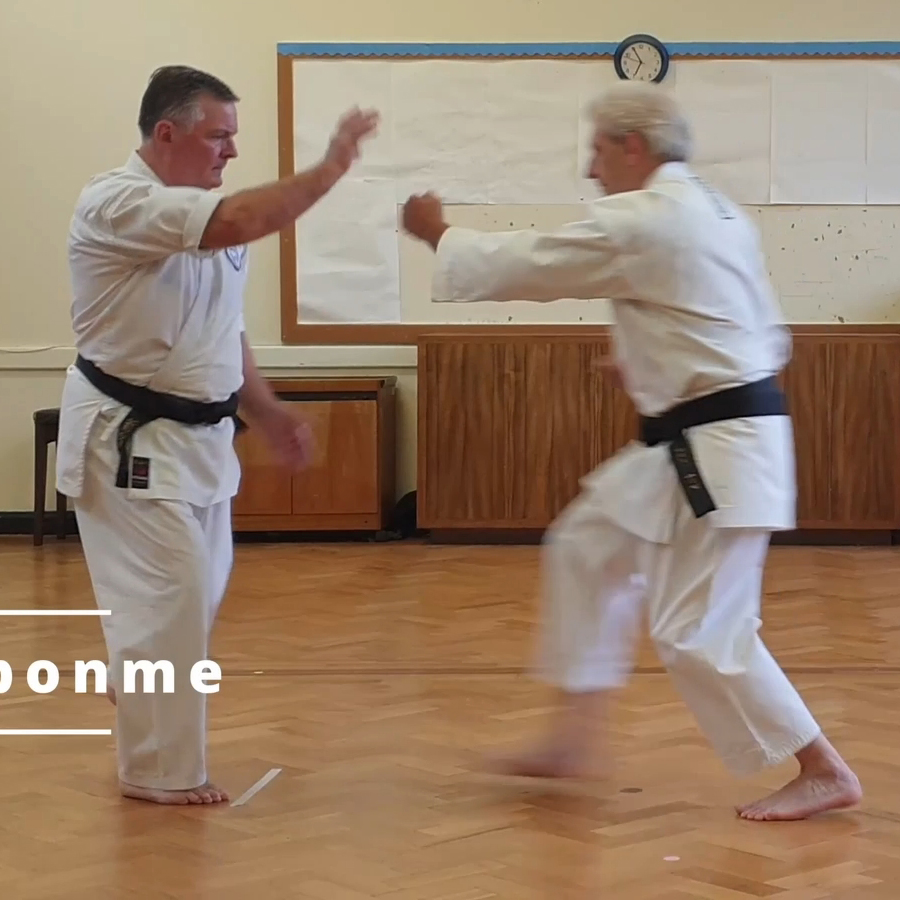
As Uke attacks, Tori begins by dropping and sliding the centre. This takes the body away from the direct line while keeping pressure available.
The turn is essential. Tori does not merely evade with the upper body. The whole body turns so that the rest of the body is removed from danger while the hands begin to apply control.
“Then you turn to get the rest of the body out of the way.”
This is Wadō movement: not escape first and technique second, but repositioning and application together.
One Movement, Two Applications
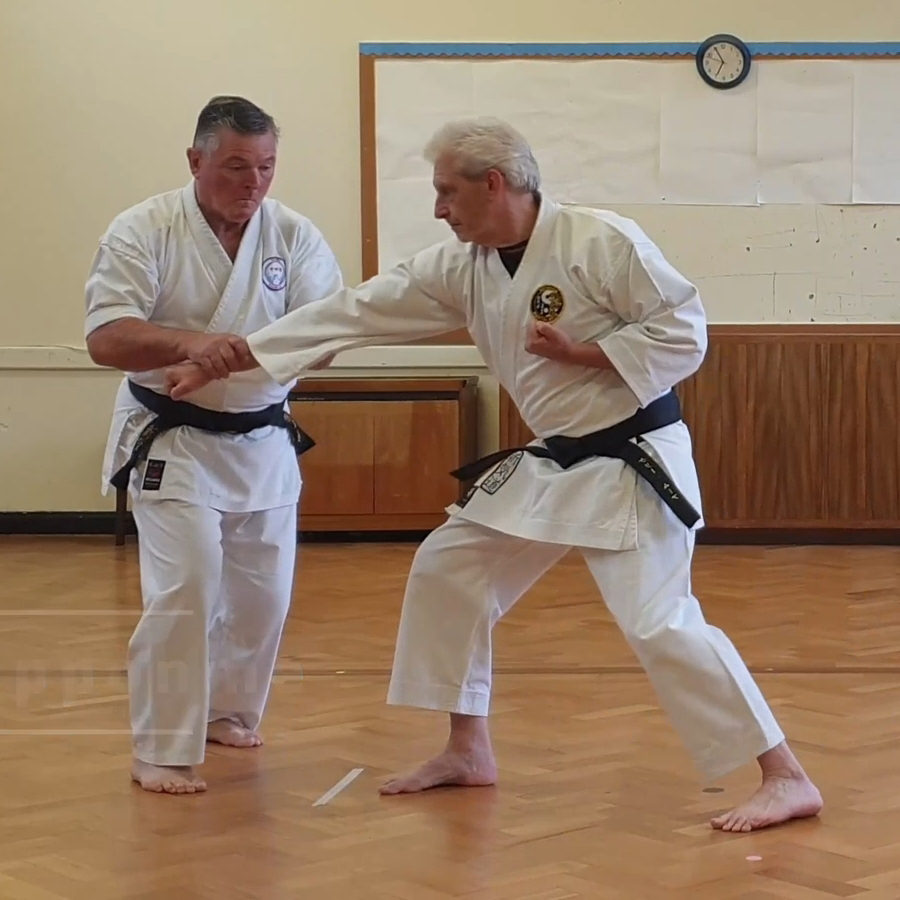
When Tori turns in, both hands have a job. One action redirects while the other applies pressure. The body rotation feeds both lines at the same time.
This creates a powerful but subtle effect. Uke is not simply pulled in one direction. Their structure is affected by two different forces, creating a combined angle of imbalance.
“When you turn in, you apply one move and you also apply the other move.”
The lesson is not to think of separate techniques. The whole action must be one coordinated body movement.
Vector Pressure – Two Directions Becoming One
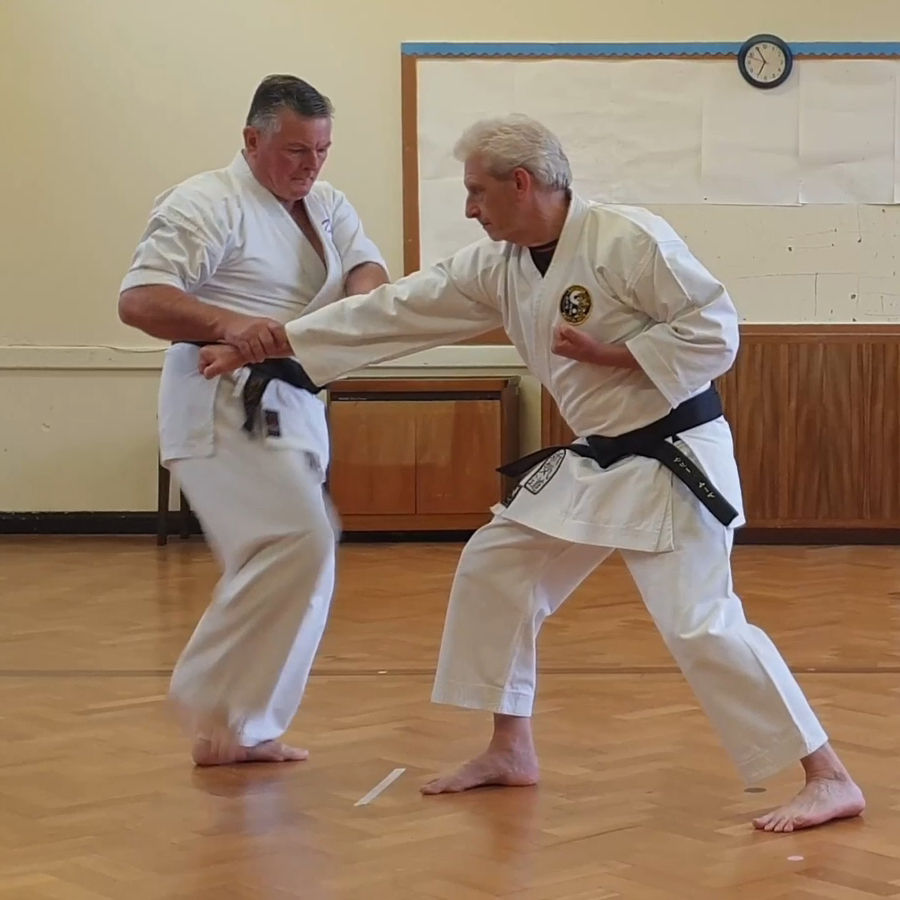
A major teaching point in Jūponme is the use of vector pressure. Tori uses one line of force through the hip and hand, and another through the knee and opposite hand. When these forces combine correctly, Uke is drawn off balance on a diagonal line.
It is not exclusively one direction or the other. The desired effect is a forty-five degree plane away from Uke’s attacking line.
“If we have the same force, can you see the vector? That’s the way that we want the force to go.”
This is a particularly important principle. The body does not overpower Uke by strength. It chooses the direction in which Uke’s structure cannot remain strong.
Hip, Hand, Knee – Connected Direction
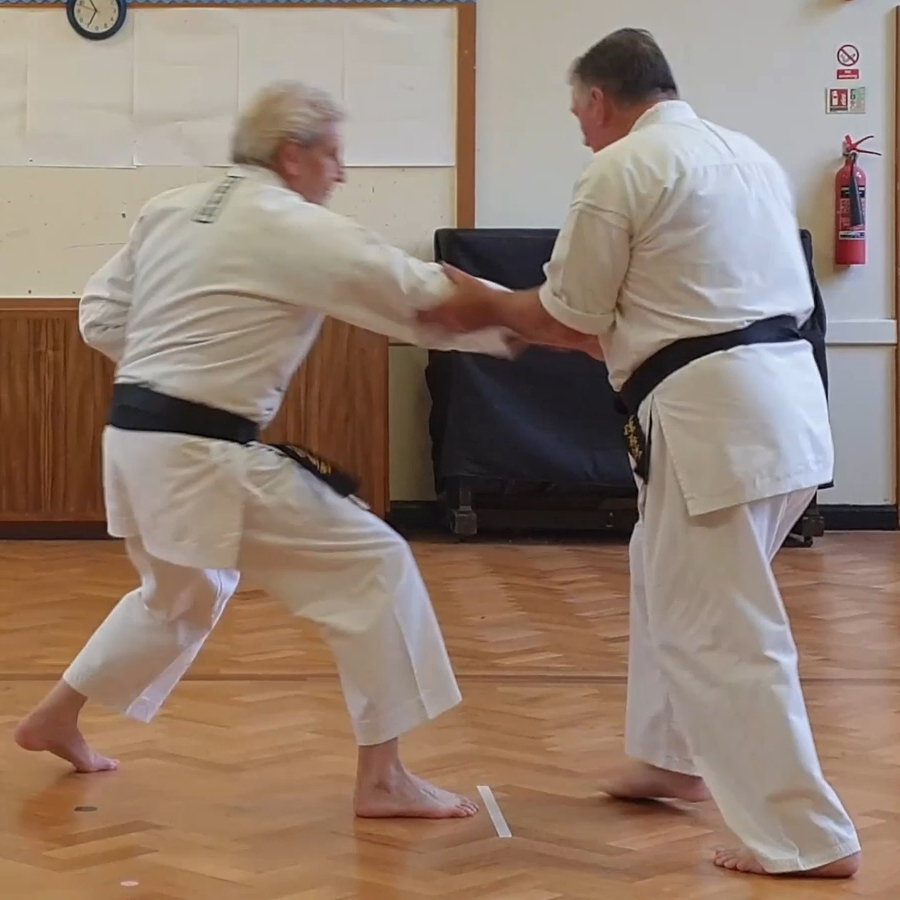
The two-directional pressure is created by the relationship between the hip, hand, and knee.
One hip and hand come back while the other side moves forward. This creates a connected line through the body rather than an isolated pull from the arms.
“I need this hip and this hand coming back; this hip and this hand going forward at the same time.”
The shape may look small, but the effect on Uke’s balance is significant.
Elbow Pressure and Safety in Practice
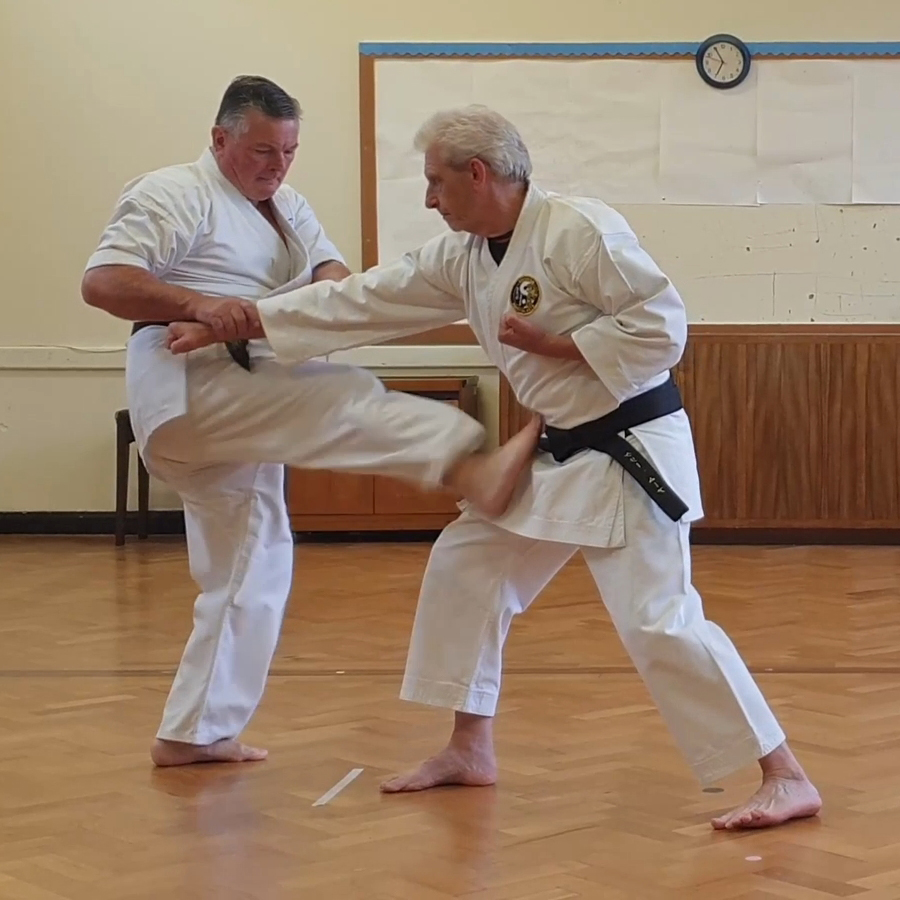
As the pressure develops, Tori applies a lock through Uke’s arm. This can be used to attack the elbow, but in training it must be practised carefully.
The aim is to apply enough pressure to teach the direction and control, without injuring the partner. The lock should be present, but the practice must remain safe and controlled.
“You need to apply just enough pressure.”
From Uke’s perspective, there should be a clear sense that the elbow is being controlled and that the body is being guided into a weak diagonal line.
Maintaining Pressure Before the Kick
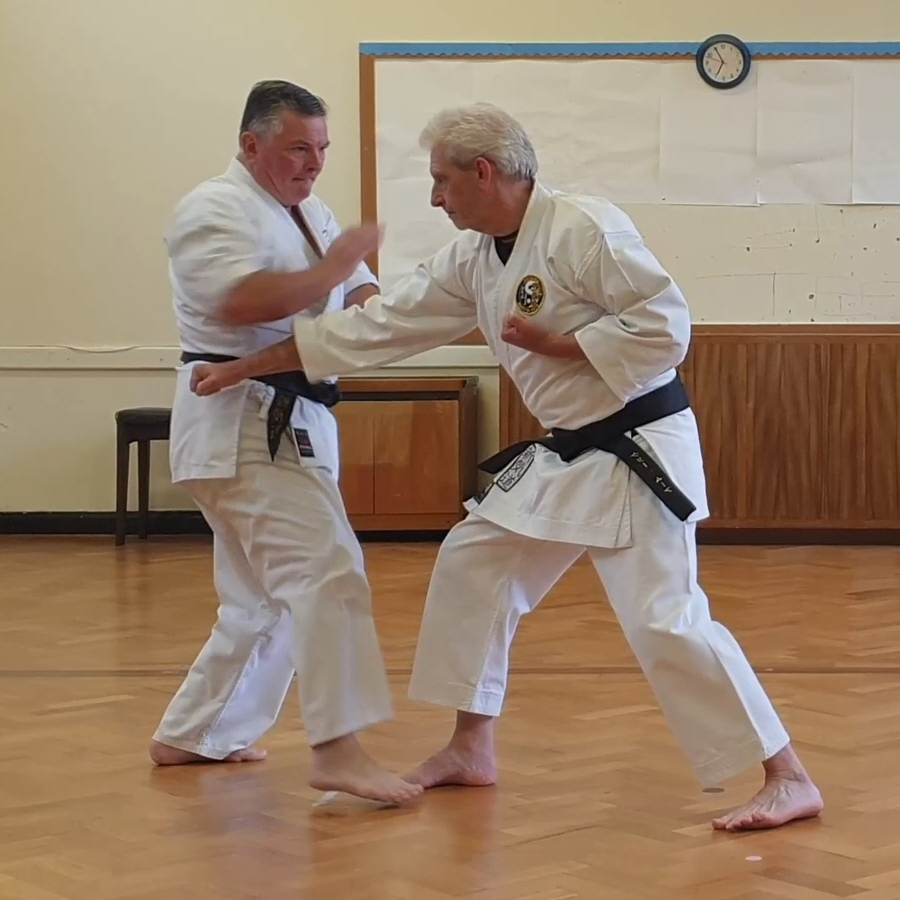
A common mistake is to release the pressure before kicking. In Jūponme, the pressure must continue while the hip comes back to prepare the kick.
If the elbow pressure is lost, Uke can begin to recover and may be able to counter. The control must stay active throughout the transition.
“Hold that pressure while you are bringing your hip back to kick.”
The Kick – Short, Direct, and Off-Line
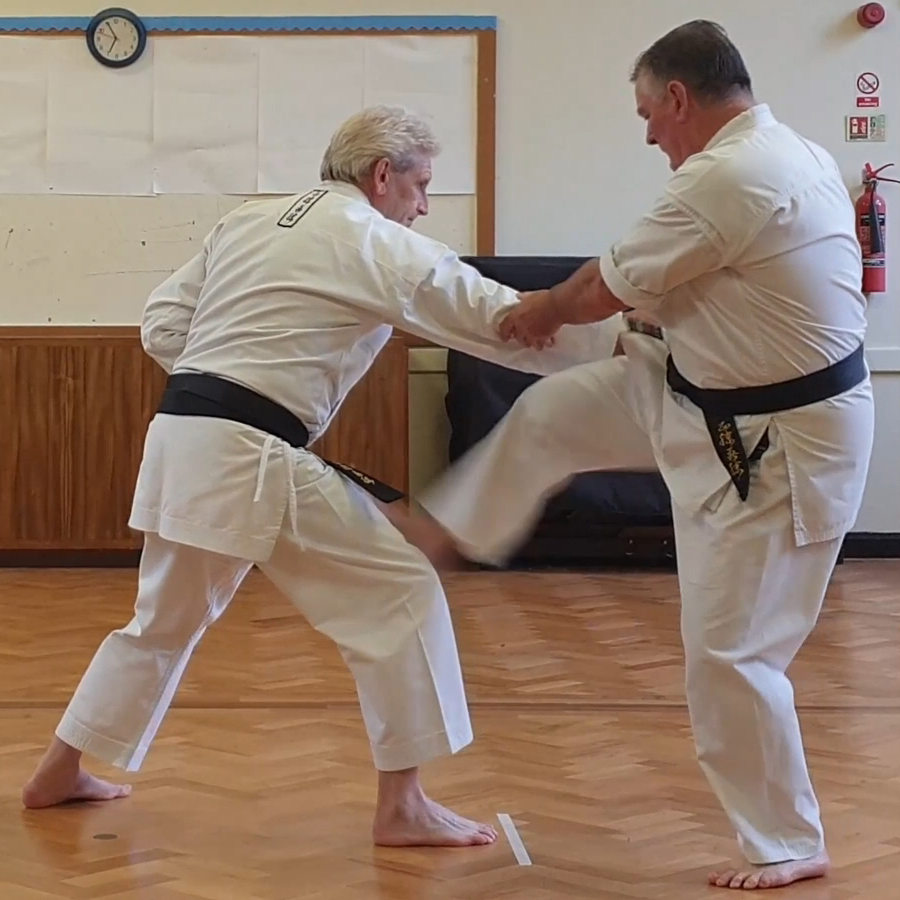
The kick is not a large sweeping mawashi geri, nor is it a simple straight mae geri. It sits just off the mae geri line and follows the shortest route to the target.
The movement should be compact. A big kick gives Uke time and space. A short kick maintains pressure and keeps the body connected.
“Not a big mawashi geri, not a mae geri, but short.”
Rear View – Direction and Control
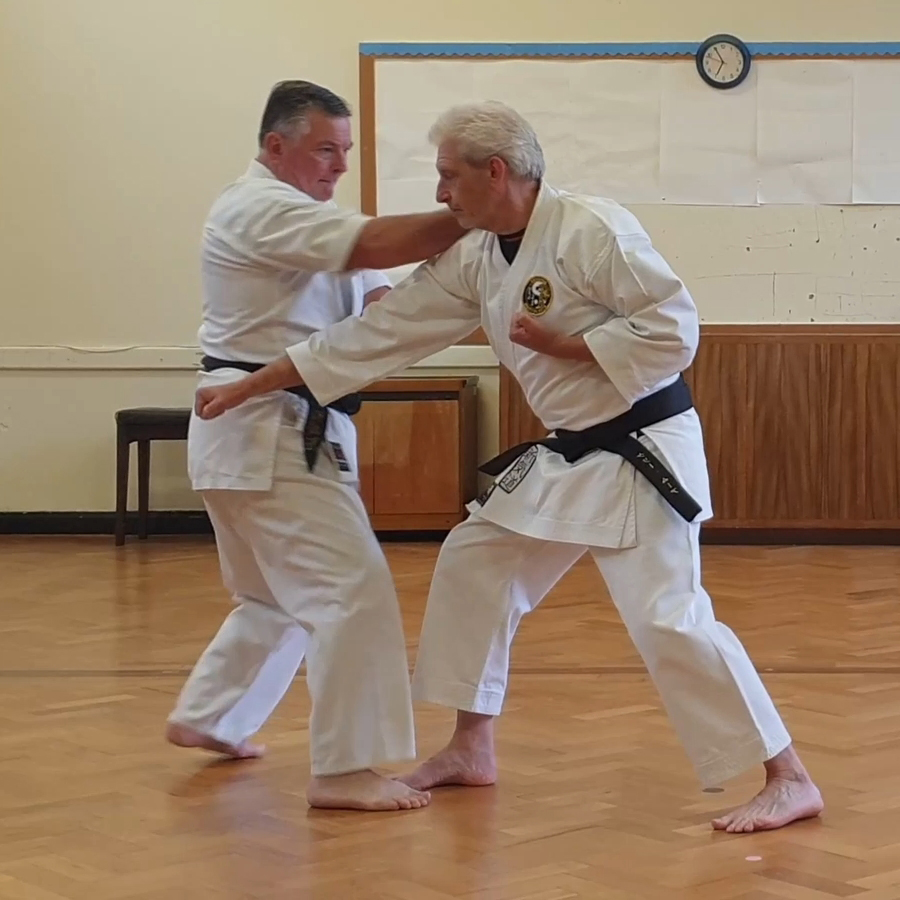
The rear view makes the directional pressure easier to see. Uke is being moved neither straight backwards nor purely sideways, but into a diagonal line that weakens posture.
This angle also shows how Tori’s body stays close enough to control, but not so square that it becomes vulnerable.
The body has turned, the elbow remains controlled, and the kick lands without losing the original pressure.
Moving Forward After the Kick
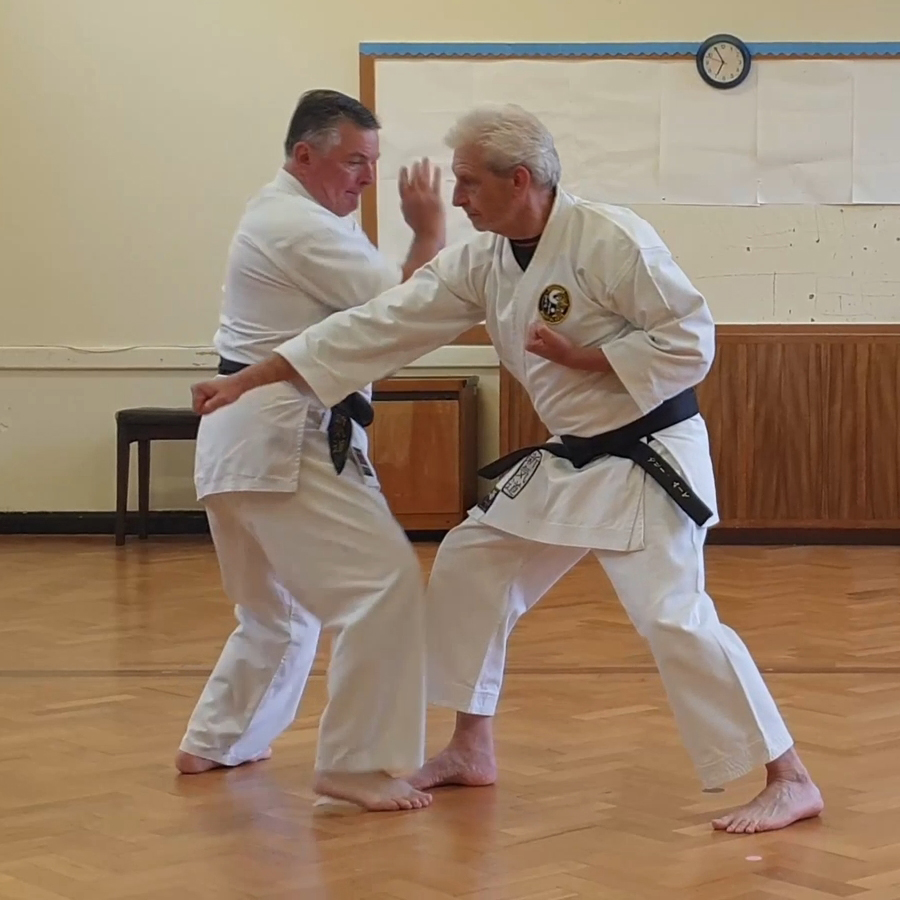
After the kick, Tori must continue to move forward. This is not the point at which the technique relaxes.
The arm continues to move and press, helping bring Uke down and stopping them from returning to a strong position.
“When you move forward, you need to move this arm as well.”
This continuation is what makes the technique complete. The strike has meaning because the pressure remains.
Pressure Downward After the Kick
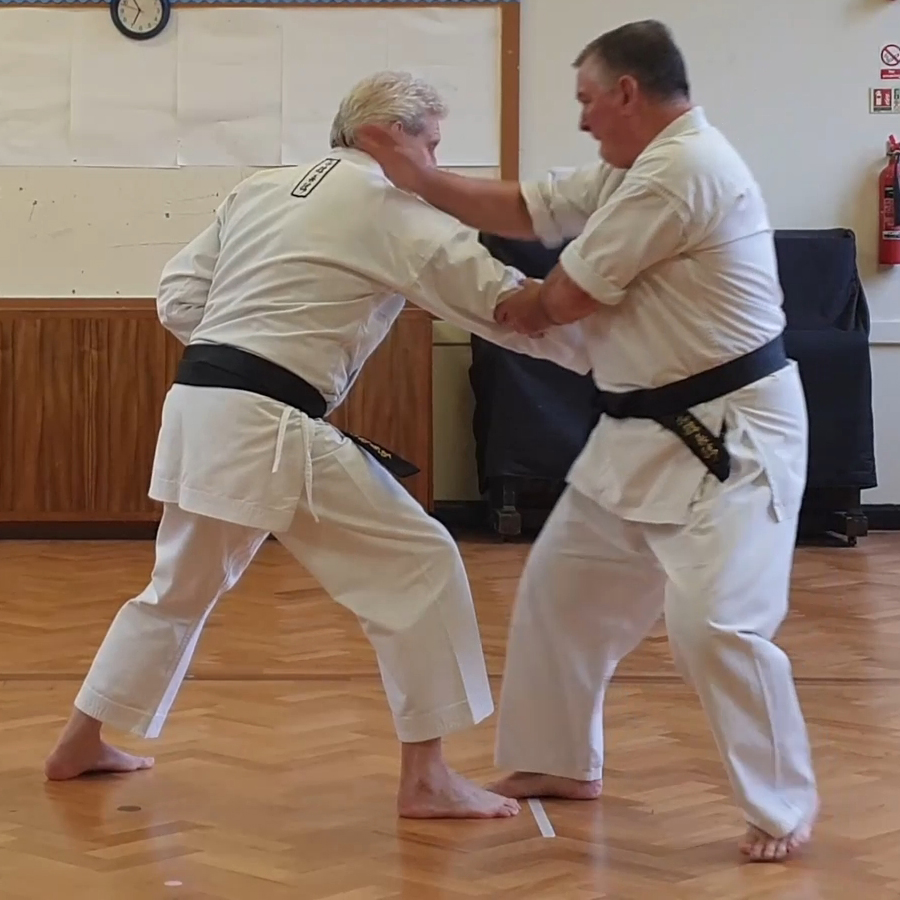
After the kick, the pressure moves downward through the arm. This prevents Uke from standing up, re-establishing posture, or launching a counterattack.
The important point is that the elbow pressure has not disappeared. It continues through the transition and only releases when the final control is established.
Done strongly, this type of pressure could damage the elbow, so the practice must be measured and respectful.
Final Control and Close Pressure
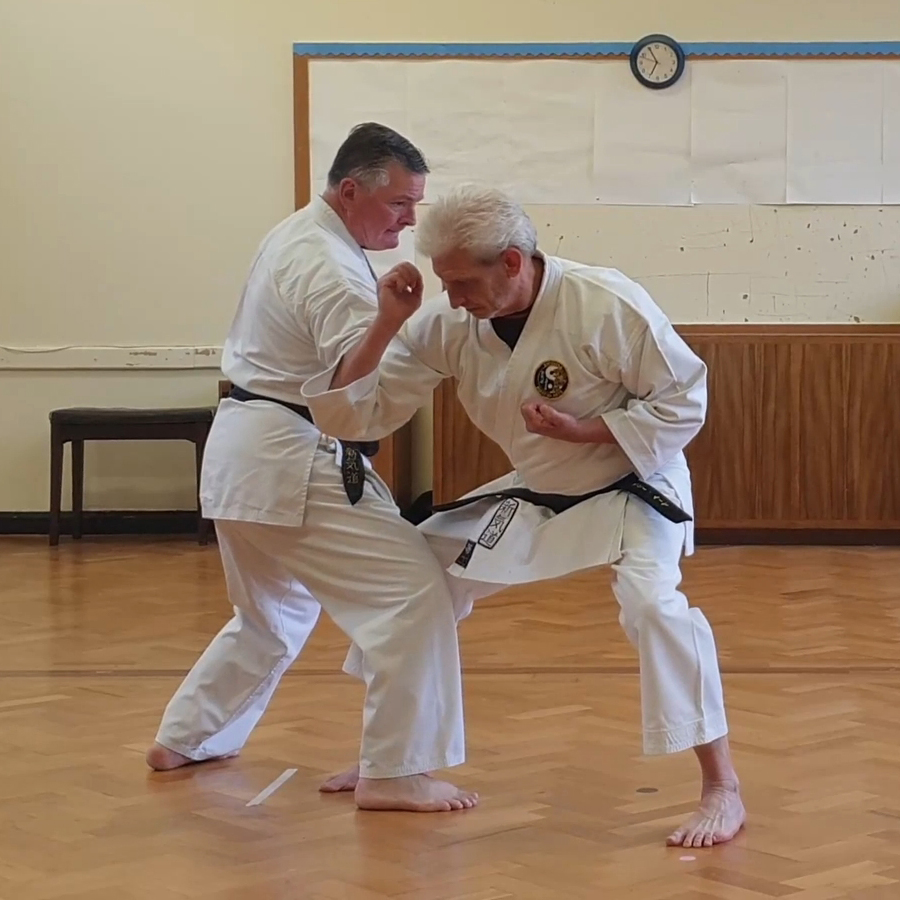
The final control position shows Uke crowded, bent, and unable to stand freely. Tori’s body remains close, the elbow line is still controlled, and the posture has been taken.
This is not simply an ending shape. It is the result of maintaining continuous pressure from the first movement through to the final control.
Alternative Angle – Final Structure
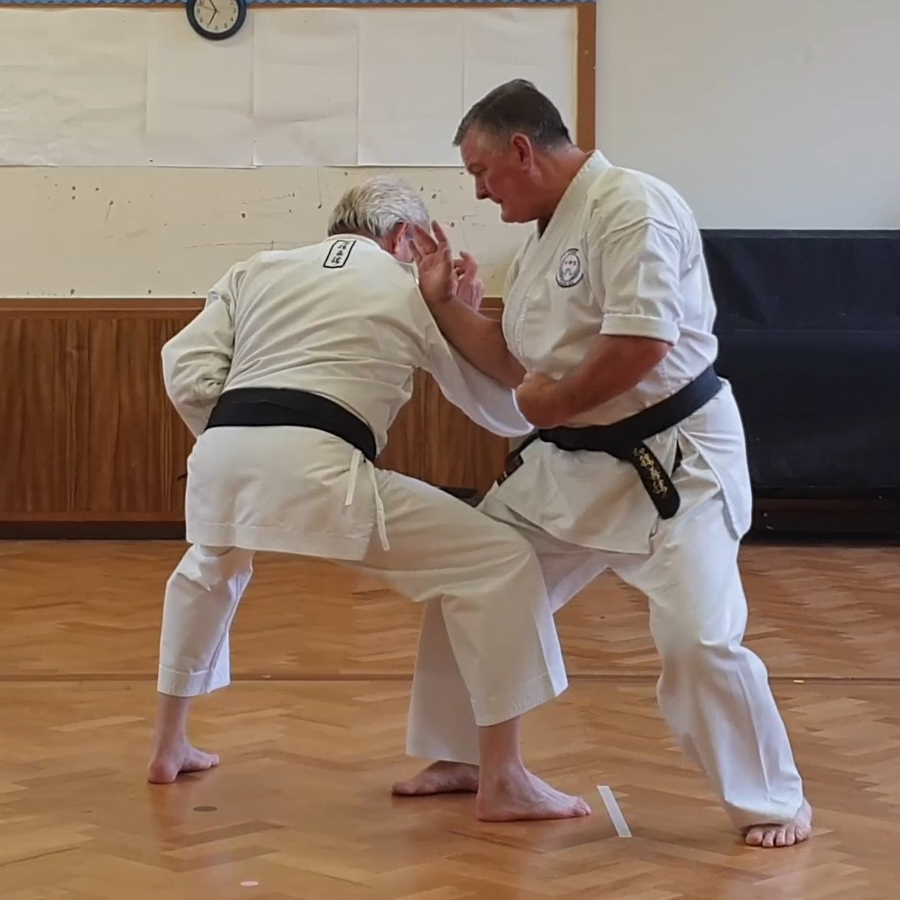
From the alternative angle, the diagonal line of pressure is clear. Tori has used body rotation, the arm line, and leg action to direct Uke into a compromised posture.
The technique finishes with Tori in control of both the space and the direction of Uke’s balance.
Return to Kamae
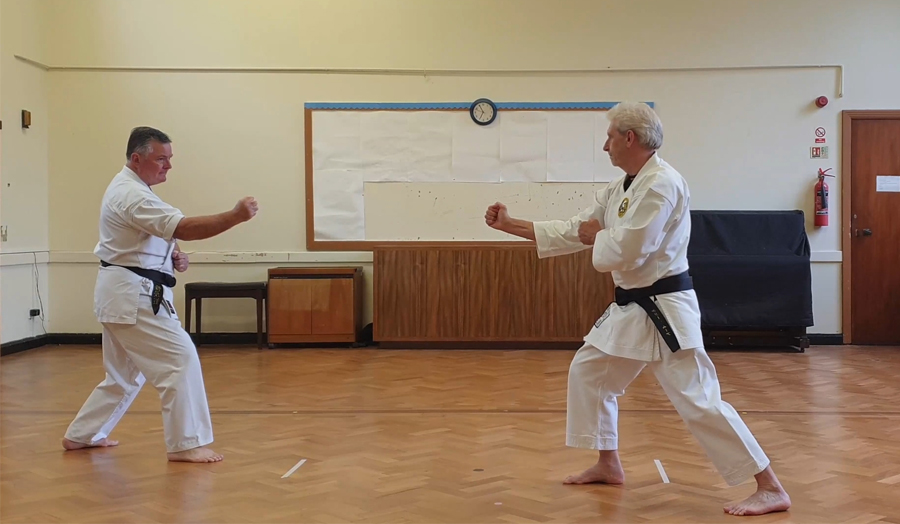
After the technique is complete, both partners return to kamae. This final reset is important: the form ends with control, awareness, and readiness, not collapse or loss of posture.
What Uke Should Experience
- a diagonal loss of balance rather than being pulled straight back or sideways
- continuous pressure on the elbow line
- the feeling that Tori’s hip, hand, and knee are all connected
- a short kick delivered while the arm pressure remains active
- downward pressure after the kick preventing recovery
- crowding and control through the final position
Key Principles
- Centre movement — dropping, lifting, and sliding before turning
- Rotation — using the body turn to remove danger and apply control
- Vector pressure — combining two directions into one effective line
- Elbow control — applying pressure carefully and continuously
- Short kicking — using the most direct route rather than a large swing
- Continuous pressure — maintaining control before, during, and after the kick
Common Errors
- moving the hands without moving the centre
- turning too late and leaving the body in the line of attack
- pulling in only one direction instead of creating a vector
- releasing the elbow pressure before the kick
- using a large sweeping kick rather than a short direct one
- standing up or relaxing after the kick instead of continuing downward pressure
Final Thoughts
Jūponme is a fitting conclusion to the Ippon Kumite series. It brings together many of the themes developed throughout the earlier waza: body movement, angle, timing, pressure, control, and responsibility to the partner.
Its most important lesson is that control must be continuous. The pressure begins as the body moves, continues through the rotation, remains during the kick, and is maintained into the final downward control.
“There was no loss of pressure on the elbow… the big thing is to maintain that pressure.”
Practised carefully, Jūponme offers a deep study in how Wadō-Ryū uses small movements, correct direction, and connected body mechanics to create powerful effects without relying on brute force.
📅 4. Upcoming Courses, Events, or Updates
- Please note we will be moving the proposed October Benkyō course to November. More information on that new date will follow soon.
- Courses and events are live on the website events calendar and will be updated regularly, so please bookmark it and check it.
- Videos from the 3rd May Course started to be released from 30th May 2026.
🧠 5. Wado Ryu Principle of the Week
Ma-ai (間合い) — Distance, Timing and Combative Interval in Wadō-Ryū
Ma-ai (間合い) is often translated simply as “distance,” but in Wadō-Ryū it means far more than physical range alone.
Ma-ai is the living combative interval between two people — the relationship of distance, timing, posture, intention, and possibility. It is not merely how far apart two practitioners happen to be standing. It is whether that distance is favourable, dangerous, stable, collapsing, or about to disappear.
For this reason, ma-ai is never static. It changes constantly as bodies move, posture shifts, intention develops, and opportunity appears. A distance that is safe one moment may become dangerous the next. A gap that looks small may in fact be empty and unusable, while a longer interval may already be under control because timing and line have been taken. In Wadō-Ryū, correct ma-ai is not measured by tape — it is understood through feeling, movement, and relationship.
What Ma-ai Means in Wadō-Ryū
The word itself suggests the meeting of space and timing. In practice, ma-ai includes several inseparable elements:
- distance — how far apart the bodies are
- timing — when that distance can be used or lost
- position — what line, angle, and posture each person occupies
- intention — how likely action is to emerge from that moment
Because of this, ma-ai is best understood not as “range” in the simple sense, but as the entire combative relationship that exists between two people. It tells you whether attack is possible, whether evasion is available, whether entry can succeed, and whether control can be established.
More Than Being Near or Far
A common misunderstanding is to think that ma-ai means standing at the correct distance before something begins. In reality, ma-ai is not a fixed starting position. It is something that is constantly being created, destroyed, adjusted, and manipulated.
Two people may appear to be standing at the same physical distance, yet one has good ma-ai and the other does not. Why? Because line, posture, readiness, and timing are different. One person may be balanced and able to act; the other may be slightly square, overcommitted, or late. The physical gap may look identical, but the combative reality is completely different.
Why Ma-ai Is Central to Wadō-Ryū
Wadō-Ryū does not rely on forceful collision or trading blows at close range. Its character depends on moving at the right moment, taking the correct line, and avoiding the need to oppose force directly. None of this is possible without ma-ai.
When ma-ai is correct:
- Taisabaki becomes effective because the body can move before danger settles fully
- Dōjini becomes possible because defence and response happen within the right interval
- Kuzushi develops more naturally because the opponent is made to overreach or misalign
- Ryūsui can continue because the body is not forced into abrupt recovery
When ma-ai is poor, even strong technique becomes unreliable. The body arrives too early, too late, too square, or too deep. The result is forcing, reaching, bracing, or colliding — all of which move Wadō away from its natural character.
Ma-ai Is Dynamic, Not Fixed
One of the most important lessons in Wadō is that ma-ai is not something you simply “have.” It is something you constantly manage. Sometimes it must be preserved. Sometimes it must be broken. Sometimes it must be stolen from the opponent.
This is why experienced practitioners often appear to control distance without obvious movement. A slight shift of body angle, a subtle change of posture, a small foot adjustment, or a change of timing may be enough to transform the whole relationship. The opponent feels close when they are actually late, or safe when they are already exposed.
Where Ma-ai Appears in Training
Although often discussed as an abstract principle, ma-ai becomes visible everywhere in Wadō practice:
- Kihon — where students begin to understand how posture and movement affect usable distance
- Kihon Kumite — where each form depends on the correct interval for attack, evasion, and entry
- Kumite Kata — where ma-ai becomes more subtle through angle, pressure, and control
- Kata — where line, embusen, and body position all imply changing combative intervals
- Jiyū Kumite — where poor ma-ai is exposed immediately and good ma-ai creates calm control
In each case, the key issue is not how far apart people appear to be, but whether the interval is truly functional.
Ma-ai and the Opponent
Ma-ai is never yours alone. It always exists between two people. This means it is influenced not only by your own movement, but also by the opponent’s posture, balance, confidence, rhythm, and intention.
Good Wadō practice therefore does not treat distance as a neutral measurement. It studies how to influence the opponent so that their sense of ma-ai becomes unreliable. They reach when they should wait. They hesitate when they should move. They overcommit because the line appears open, only to find that the interval has changed before their technique arrives.
In this way, ma-ai becomes strategic as well as technical. It is one of the main ways in which initiative is quietly taken.
Ma-ai and Timing
Distance without timing is incomplete. In Wadō-Ryū, ma-ai is always tied to the moment at which action occurs. This is why the term naturally connects to ideas such as Sen, Go-no-sen, and Sen-no-sen. The same physical distance can be either favourable or unfavourable depending entirely on when the movement takes place.
If the body moves too soon, intention is revealed. If it moves too late, collision becomes more likely. But if the movement occurs at the correct moment, the same distance suddenly becomes alive — opening evasion, entry, or control with very little effort.
Ma-ai and Position
It is also important to remember that ma-ai is shaped by line and angle, not just straight-line separation. A person standing seemingly “close” may actually be poorly placed, while another at similar range may already be in a dominant angle. This is why ma-ai links so closely with Taisabaki and San Mi Tai.
Correct body movement alters the combative interval even if the feet have barely travelled. By changing line, narrowing profile, or taking the stronger angle, the practitioner changes the meaning of the distance itself.
Common Misunderstandings
- Ma-ai is not just physical distance
- Ma-ai is not a fixed gap to be memorised
- Ma-ai is not separate from timing
- Ma-ai is not something that belongs to one person only
It is the living interval between two people, shaped by distance, timing, position, and intention.
How It Connects to Other Wadō Principles
Ma-ai sits quietly beneath many of Wadō’s best-known principles:
- Taisabaki — changing body position changes the interval
- San Mi Tai — the relationship between bodies and space defines usable ma-ai
- Dōjini — simultaneous defence and attack depend on the correct combative interval
- Kuzushi — poor ma-ai often causes the opponent to stretch or misalign
- Ryūsui — flowing movement preserves and transforms distance without interruption
For this reason, ma-ai is not simply one topic among many. It is one of the invisible conditions that allows all the others to function properly.
Closing Thoughts
Ma-ai is one of the most important principles in Wadō-Ryū precisely because it is so easy to reduce to something too simple. It is not just how far away the opponent is. It is whether the relationship of distance, timing, and line allows action to emerge naturally and effectively. When ma-ai is correct, movement becomes calmer, cleaner, and more efficient. The need to rush disappears. The need to force disappears. Technique begins to feel appropriate rather than imposed. In this sense, ma-ai is not merely a matter of where you stand — it is a matter of whether the moment belongs to you.
🙏 Thank You for Being Part of the Community
If you have any questions, video requests, or feedback, simply contact us here — we read everything.
Wishing you a fantastic week of training,
Roger and The Team
Wado-Ryu Benkyō
https://wadoryubenkyo.co.uk/