Traditional Karate
Weekly Newsletter • 14 June 2026
Weekly Update from Wadō-Ryū Benkyō
Hello,
Welcome to your 25th weekly update from Wado-Ryu Benkyō.
Please note: this will be the last weekly update. From this edition onwards we will be moving to a monthly release schedule. The newsletter is now averaging 4,500 to 5,000 words, which is more like a magazine than a short weekly update. From July, we will release a newsletter on the first Sunday of every month — but be assured it will contain more information going forward.
Now on to the newsletter.
🥋 1. Saturday Benkyō Review
Another excellent Saturday Benkyō session, and one that continually returned to a central theme: the interconnected nature of Wadō-Ryū. Throughout the class we explored how the same principles, movements, and ideas appear repeatedly across Kihon, Kata, and Kumite, reinforcing the idea that nothing in Wadō-Ryū exists in isolation.
After a thorough warm-up—which would make several reappearances throughout the session—we began by examining the importance of the rear foot in both Shuto Waza and Junzuki No Tsukomi. Particular attention was given to how the rear foot drives the body forward and creates power throughout the technique. We also explored the role of the feet in Hiraki Ashi and body movement, learning how subtle footwork can take the body off the attacking line while still advancing forward. The lesson was clear: effective defence often begins before the arms have even come into play.
From there we expanded the discussion by relating these principles to other areas of training. Looking at the double Uke sequence towards the end of Pinan Shodan, we continued the theme of recognising where techniques and principles reappear throughout the system. Once a principle has been learned, it does not need to be learned again simply because it appears in a different context. The same ideas are woven throughout Wadō-Ryū, linking Kata, Kihon, and Kumite together in a purposeful and structured way.
With this in mind, we returned to Pinan Shodan and began to break the Kata apart to study the transitions between sections. We looked at dropping weight, body rotation, maintaining the centre, and using natural momentum to carry the body into the next technique. A particularly good example was the first turn into Yoko Mae Geri. By dropping to the correct working height for the kick and accompanying Uke, we could then use that same dropping action and momentum to drive the body naturally into the following Shuto Uke. Rather than seeing each movement as separate, we explored how one action generates the next.
After several further run-throughs of the Kata, we moved on to the Nihon Kumite derived from Pinan Shodan. Once again, the links between Kata, Kihon, and Kumite became clear. We attempted to carry the lessons from the Kata directly into the paired practice: dropping weight, shifting the body, maintaining posture, and generating power through coordinated body movement rather than relying on the arms in isolation. This created a very different experience from simply moving through a sequence of techniques as disconnected actions.
Continuing the theme of transferring learning from one area of practice to another, we moved on to Kumite Kata No. 1. The question was simple: what had we already learned from Pinan Shodan, Shuto Waza, and Junzuki No Tsukomi that could be applied here? The answers included posture, centre control, timing, footwork, and the integration of the whole body working as one unit.
After practising the paired form together, we gathered to examine some of the underlying principles that make Kumite Kata so valuable. Particular attention was given to Irimi—entering and taking the opponent's space—and Kuzushi, the disruption of balance and structure. These principles form the foundation of effective Wadō-Ryū movement and can be seen repeatedly throughout the system.
To demonstrate how these same lessons can be carried into other forms of Kumite, we then looked at Kihon Kumite No. 1, identifying where the same principles of posture, timing, body movement, Irimi, and Kuzushi are present and can be consciously developed.
As this was an extended session, we also had time to revisit Kihon Kumite No. 4 and No. 5. Again, we searched for elements that could be reused from the training that had come before. This time the emphasis shifted towards relaxed, flowing movement. We explored how to find Ryūsui within the techniques and how genuine power is often generated through relaxed speed, timing, and body coordination rather than muscular tension.
Taking this exploration further, we moved on to Chintō Kata. Chintō provides an excellent study in flowing, dynamic movement, but it also highlights the consequences of poor posture and misalignment. When posture and centre are not working together, we end up fighting our own bodies, slowing our techniques, compromising our balance, and reducing our effectiveness. When properly aligned, however, the Kata becomes significantly smoother, more powerful, and more efficient.
To bring the session full circle, we returned to Kumite Kata, this time focusing on Number 9. In many ways this served as a culmination of everything we had been studying throughout the day. Here we could clearly see body shifting creating Inasu and Nagasu, followed by Irimi and Kuzushi to establish control of the Uke. It was a fitting reminder of how the individual principles studied throughout the session come together within the paired forms.
A final reminder was given that the Kumite is not finished simply because the technique has been completed. The exchange continues until both practitioners have separated, regained awareness, and formally signalled the end of the encounter. We must remain present and focused until that moment.
As always, the time passed far too quickly, and before long it was time to bring the session to a close. It was an excellent class, full of thoughtful karate and detailed study, with a tremendous amount to reflect upon, unpack, and continue practising in the weeks ahead.
Saturday Benkyō session next week on 20th June, but there will be no class on 27th June 2026. Please look out for updates each week for any changes to when classes may or may not be running.
If you would like to attend a Saturday session for the first time, reply to the email and let us know, and check the events calendar for future session dates.
🎥 2. This Week’s Long-Format Video
The Importance of the Mind in Japanese Martial Arts – Part 3
The Importance of the Mind in Japanese Martial Arts – Part 3 | Roger Vickerman Renshi 7th Dan
This week’s long-format video continues Roger Vickerman Renshi’s exploration of the mental dimensions of traditional Japanese martial arts, developing the themes of awareness, timing, distance, connection, and the relationship between mind and body in effective Wadō-Ryū practice.
📝 3. Featured Article of the Week
Kumite Kata - Ippon Me
A study in entering, receiving, striking, covering, collapsing structure, and withdrawing with awareness
Read the standalone article page
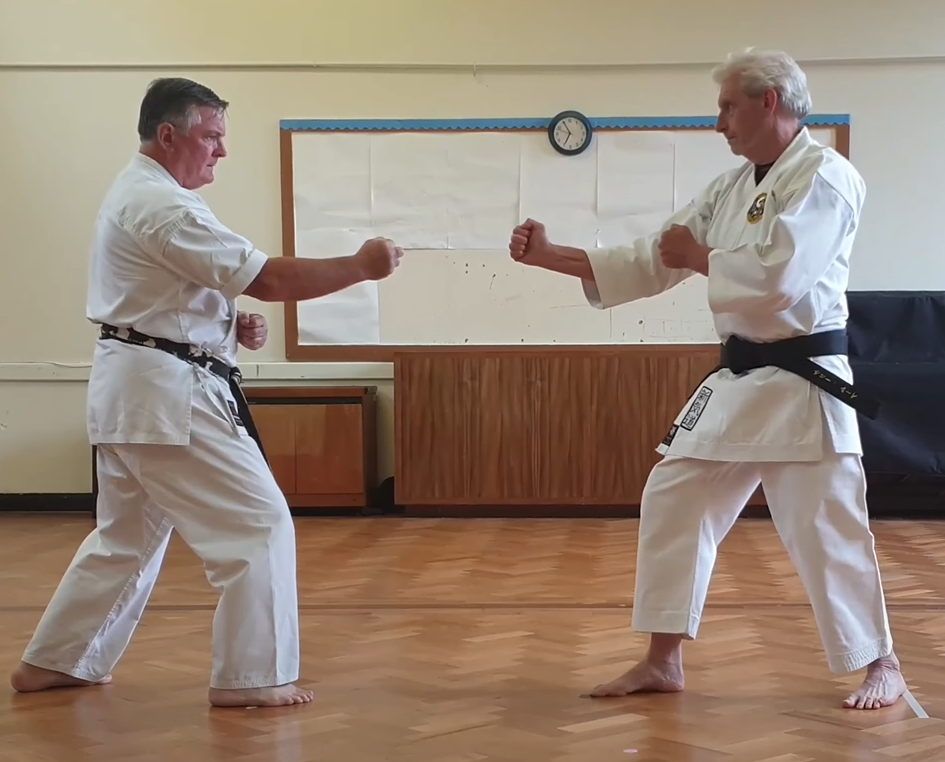
Kumite Kata No.1 – Ippon Me introduces the paired Kumite Kata series through a compact but important study of timing, entry, cover, and structural control.
At first glance the sequence appears direct: Uke attacks with Okuri Ashi Jōdan Zuki, Tori receives with Jōdan Naiwan Uke and counters with Chūdan Gyaku Zuki. However, as with all Wadō-Ryū paired work, the depth lies not in the external shape alone, but in how the body enters, how the centre is controlled, and how Uke’s structure is progressively taken.
This first form sets the tone for the series. Tori must move with purpose, avoid unnecessary collision, cover intelligently, strike through the centre, and finish by dropping weight in a way that collapses Uke’s posture before withdrawing into Hanmi Gamae.
Opening Kamae – Migi Tate Seishan Dachi
Both partners begin in Migi Tate Seishan Dachi. This is not simply a starting position. It establishes the correct relationship of distance, line, and readiness.
The posture should feel alive. Tori is not waiting passively, and Uke is not merely stepping through a rehearsed action. Both partners must maintain awareness, structure, and intent from the beginning.
Uke’s Attack – Okuri Ashi Jōdan Zuki
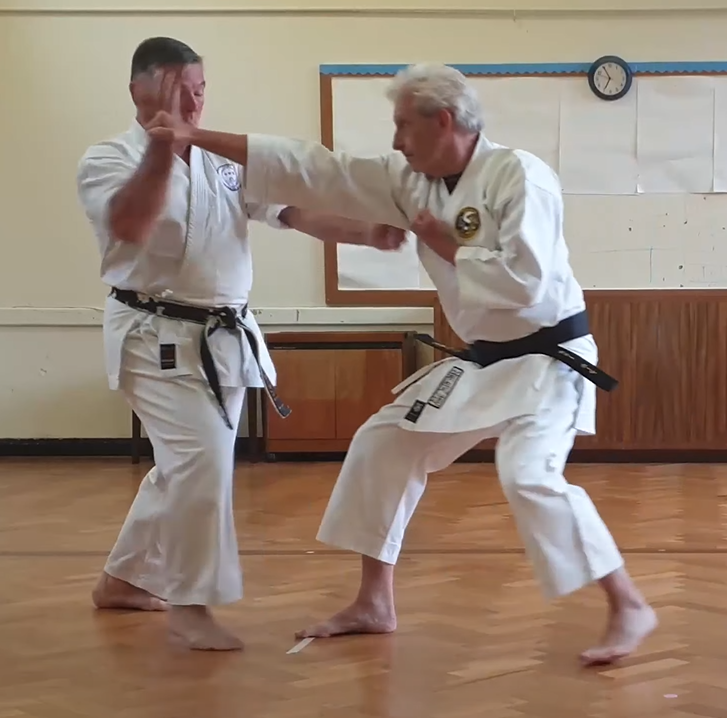
Uke attacks with Okuri Ashi Jōdan Zuki. The attack must be committed enough to create a genuine line of danger.
Tori responds with Jōdan Naiwan Uke and Chūdan Gyaku Zuki. The receiving action should not be a hard block that stops the movement dead. It should protect the line while allowing Tori to enter and counter immediately.
The gyaku zuki is not an afterthought. It is part of the same moment of receiving and entering. This is an early expression of kōbō-ittai — attack and defence as one.
Receive, enter and counter as one continuous action.
Chūdan Gyaku Zuki – Striking Through the Centre
The first counter should travel through Uke’s centre rather than simply touching the surface. Tori’s posture must remain settled, with the body supporting the strike.
If the punch is delivered only from the arm, the effect is limited. When the stance, hips, and centre are connected, the strike also begins to disturb Uke’s structure.
Uke should feel that Tori has entered decisively and is beginning to occupy the space, rather than merely defending from the outside.
Push In – Chūdan Zuki with Suri Uke
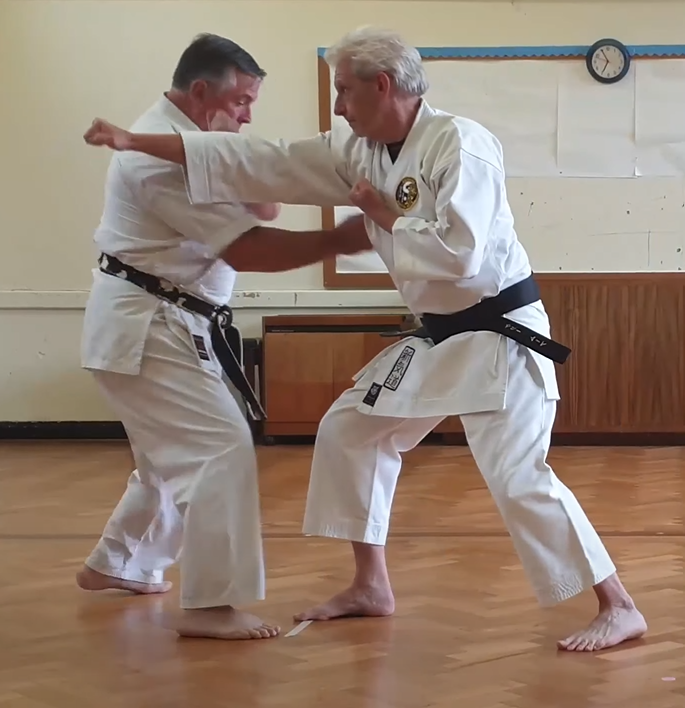
Tori continues by pushing in with Chūdan Zuki, while applying Suri Uke on Uke’s covering arm.
This is a key feature of the form. The second action is not simply another punch. The covering arm is managed and pressed so that Uke cannot freely recover, counter, or regain the line.
Suri Uke should feel like a sliding, controlling action. It does not snatch or grab unnecessarily. It occupies the arm line and allows Tori’s body to continue entering.
Controlling Uke’s Body
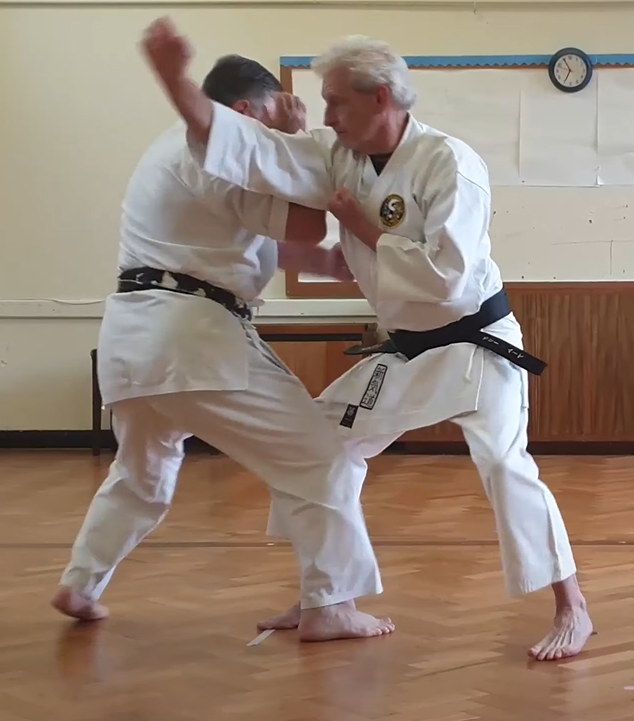
Tori then pushes in to control Uke’s body. This phase is where the form begins to move beyond simple striking.
The pressure should be applied through the whole body, not only through the hands. Tori’s stance, hip position, and line of entry all contribute to restricting Uke’s movement.
Uke should feel crowded. Their posture is being shortened and their ability to counter is being reduced.
Dropping Weight to Collapse Uke
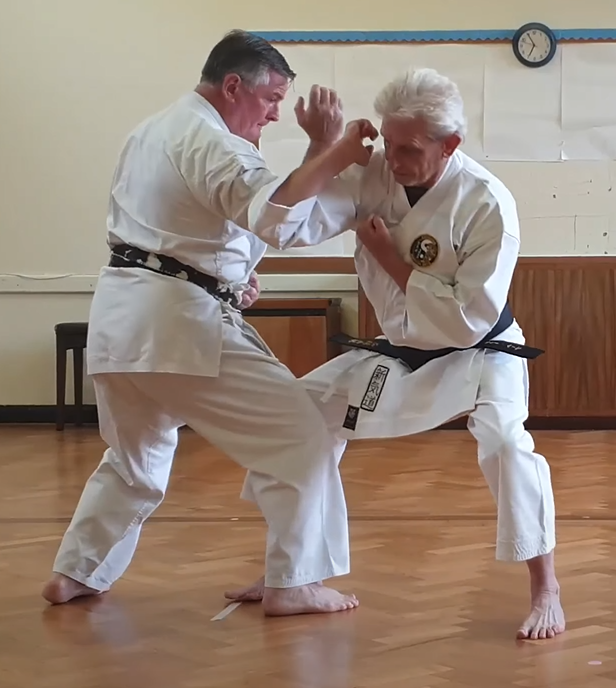
The next phase is to drop weight in order to collapse Uke.
This is not a downward shove with the arms. The effect comes from Tori lowering the centre while maintaining connection through the arm, shoulder, and body line.
When performed correctly, Uke’s structure folds because the centre is being taken. The collapse should feel inevitable rather than forced.
The body drops; the arms transmit the pressure.
Withdrawal – Sugi Ashi Kōtai into Hanmi Gamae
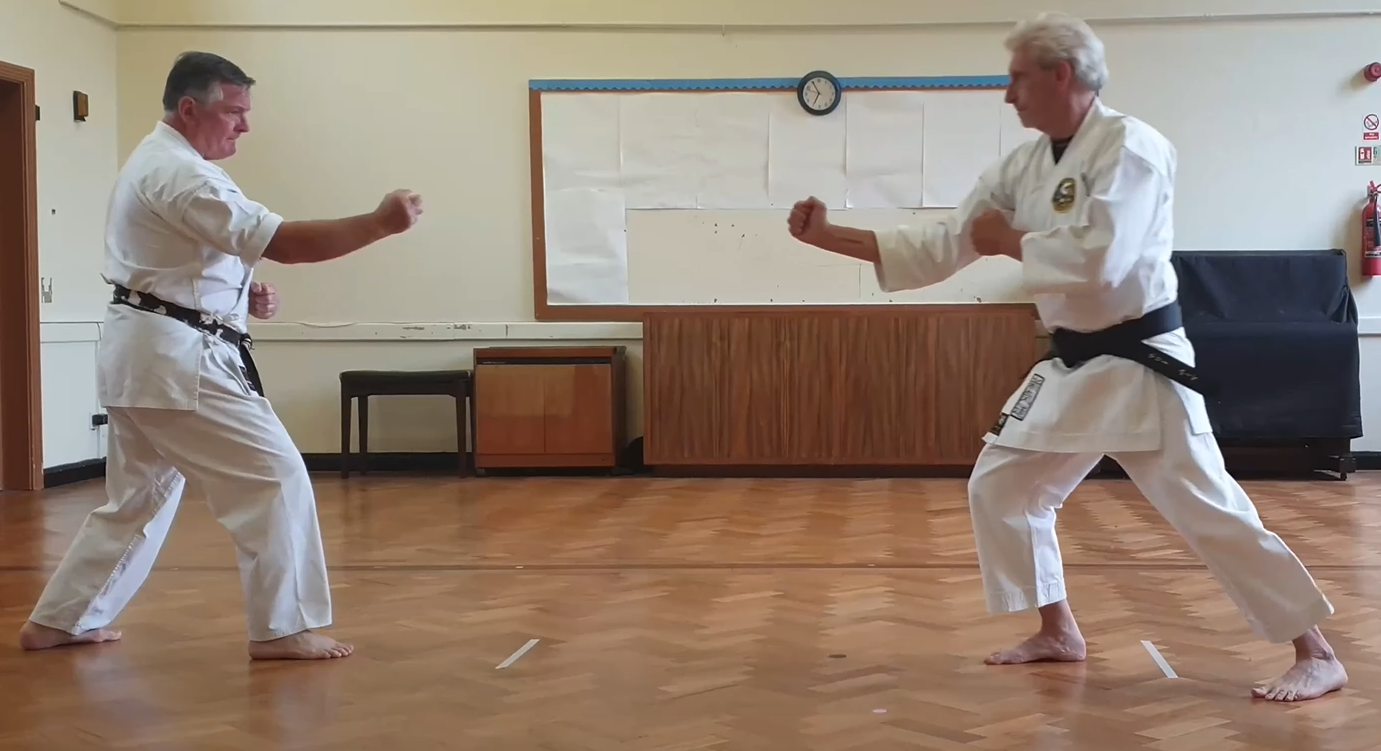
The sequence concludes with Sugi Ashi Kōtai into Hanmi Gamae.
The withdrawal is as important as the entry. Tori must leave with posture, distance, and awareness intact. The form should not finish in a collapsed or careless position.
This final movement reinforces an essential Wadō habit: enter cleanly, control decisively, and withdraw without losing readiness.
What Uke Should Experience
- a clear jōdan attack line being received without unnecessary collision
- Tori entering immediately with chūdan gyaku zuki
- the covering arm being controlled through suri uke
- pressure building through the body rather than just the hands
- loss of posture as Tori drops weight
- a controlled finish with Tori withdrawing into correct ma-ai
Key Principles
- Kōbō-ittai — receiving and countering as one action
- Ma-ai — entering and withdrawing with correct distance
- Suri Uke — sliding control of the covering arm
- Kuzushi — breaking posture through pressure and weight drop
- Shizumu — lowering the centre to create collapse
- Zanshin — maintaining awareness after the technique
Common Errors
- blocking the jōdan attack too hard and stopping the flow
- punching from the arm rather than entering with the body
- forgetting to control Uke’s covering arm
- pushing with the hands instead of using body pressure
- dropping the head rather than lowering the centre
- withdrawing casually without restoring ma-ai and posture
Final Thoughts
Kumite Kata No.1 is a strong opening to the series because it introduces many of the central concerns of Wadō-Ryū paired practice in a concise form.
The sequence teaches that a technique does not end with the first successful strike. Tori must continue to control the line, manage Uke’s arm, take the centre, and finish with awareness.
Practised carefully, Ippon Me becomes more than a formal drill. It becomes a study in how Wadō-Ryū links timing, body movement, control, and finishing posture into one complete exchange.
📺 Full Breakdown Video
Watch the full breakdown of Kumite Kata No.1 (Ippon Me), including detailed explanation of timing, Jōdan Naiwan Uke, Chūdan Gyaku Zuki, Suri Uke, body control, weight drop and withdrawal.
📅 4. Upcoming Courses, Events, or Updates
- Please note we will be moving the proposed October Benkyō course to November. More information on that new date will follow soon.
- Courses and events are live on the website events calendar and will be updated regularly, so please bookmark it and check it.
- Videos from the 3rd May Course started to be released from 30th May 2026.
🧠 5. Wado Ryu Principle of the Week
Kaisetsu (解説) and Bunkai (分解) — Understanding the Difference in Wadō-Ryū Karate
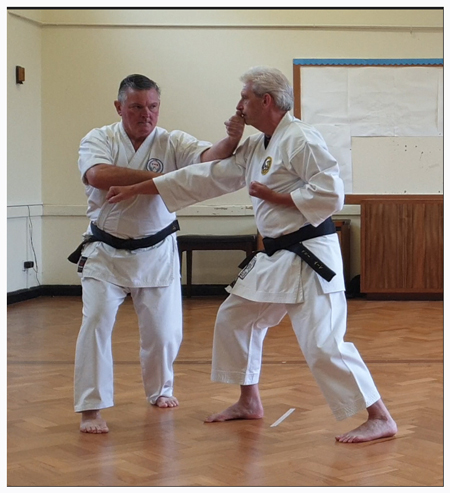
Kaisetsu (解説) and Bunkai (分解) are both concerned with understanding kata, but they lead the student towards different ways of thinking. In much of modern karate, the word bunkai is commonly used to describe kata application. Students are often encouraged to break the movements apart and find the practical fighting technique hidden within each action.
That approach can be useful, especially in the early stages of study. However, within traditional Wadō-Ryū there is a slightly different emphasis. Wadō-Ryū is not simply a system of fixed responses to fixed attacks. It is a system built upon principles: body movement, timing, distance, non-collision, balance breaking and the unity of attack and defence.
For that reason, the term Kaisetsu often gives a better description of how kata should be studied in Wadō-Ryū. Rather than asking only, “What is the application of this movement?”, we ask, “What principle is this movement explaining?”
What Does Bunkai Mean?
The word Bunkai (分解) literally carries the idea of breaking something apart in order to analyse it.
- Bun (分) — to divide, separate, or break apart
- Kai (解) — to untie, solve, analyse, or explain
Together, bunkai can be understood as “analysis through breaking apart”. In karate practice, this usually means taking an individual kata movement and assigning a practical combat application to it.
A movement may be explained as a block, a strike, a joint lock, a throw, a release from a grip, or a method of controlling the opponent. This can be valuable because it encourages students to look beyond the surface of kata and consider how the movements may function with a partner.
The limitation appears when the application becomes too fixed. A kata movement can become reduced to one answer, one opponent, one attack, and one solution.
The Problem with Fixed Applications
When kata is treated only as a collection of fixed applications, students can become trapped by certainty. A movement becomes “this technique” and nothing more.
Real conflict is not fixed. Distance changes. Timing changes. The opponent changes. The angle changes. The pressure changes. A useful kata principle must therefore be adaptable.
This does not mean that applications are wrong. Practical examples are important. But if the example becomes the whole meaning of the movement, the student may miss the deeper lesson.
In Wadō-Ryū, the deeper lesson is usually found in the principle behind the movement rather than in one single interpretation of it.
What Does Kaisetsu Mean?
Kaisetsu (解説) has a different feeling. It is usually translated as explanation, interpretation, commentary, or exposition.
- Kai (解) — to explain, clarify, reveal, or understand
- Setsu (説) — explanation, theory, teaching, or account
Rather than breaking kata into isolated fragments, kaisetsu seeks to explain what the kata is teaching. It asks us to look at the relationship between movement, body structure, timing, direction, and combative principle.
“What principle is this movement teaching?”
Why Wadō-Ryū Tends Towards Kaisetsu
Wadō-Ryū was shaped by Ōtsuka Hironori’s understanding of both karate and Japanese jūjutsu. As a result, the style places great importance on principles that cannot be fully explained by a single fixed application.
- Taisabaki — body movement and repositioning
- Ma-ai — combative distance and relationship
- Kuzushi — breaking balance and structure
- Nagasu — flowing, receiving and redirecting
- Dōjini — simultaneous action
- Kōbō-ittai — attack and defence as one
These are not merely techniques. They are organising principles. They can appear in kata, kihon, kumite kata, kihon kumite, tanto dori, jiyū kumite and self-defence practice.
A fixed bunkai may show one example of a movement. Kaisetsu allows that movement to reveal the principle that can then be applied in many different circumstances.
Kata as a Record of Principles
One useful way to understand kata in Wadō-Ryū is to see it as a record of principles rather than a catalogue of techniques.
- methods of body movement
- methods of receiving and redirecting force
- strategies of positioning
- timing relationships
- methods of controlling balance
- ways of expressing attack and defence together
The physical movement is the vehicle. The principle is the destination.
This is why experienced practitioners may demonstrate different applications from the same kata movement while still being faithful to the kata. They are not necessarily contradicting one another. They may be expressing the same principle in different circumstances.
An Example: Looking Beyond the Surface
Imagine a kata movement that appears to be a simple outside block.
A bunkai approach might say: “This is a defence against a right punch.”
A kaisetsu approach might also accept that as one possible example, but then look deeper: How is the line of attack being changed? Is the body moving off the line? Is the opponent’s centre being controlled? Is the movement receiving, redirecting, striking, or entering? Is kuzushi being created? What timing relationship is being shown?
Suddenly the movement is no longer just one technique. It becomes an illustration of several interconnected principles.
The Influence of Jūjutsu
Ōtsuka Hironori’s background in Shindō Yōshin-ryū jūjutsu is central to understanding the Wadō approach. In many jūjutsu traditions, the outer form of a technique is important, but the real teaching lies in the principles that make the technique work.
Balance, posture, timing, entry, angle, body shifting and control of the centre are all more important than copying the outside shape alone.
This influence helps explain why kaisetsu feels so appropriate within Wadō-Ryū. It allows kata to be explored as a source of principle, strategy and body method rather than only as a list of hidden fighting tricks.
Bunkai and Kaisetsu Are Not Enemies
It is important not to create an artificial conflict between bunkai and kaisetsu. Bunkai can be useful. Students need practical examples. A movement has to be tested, felt and studied with a partner.
However, a practical application should be a doorway, not the destination.
Bunkai may help reveal a principle. Kaisetsu helps explain the principle so that the student can recognise it elsewhere.
In this sense, the two ideas can work together, but kaisetsu gives a broader and more faithful way of understanding the Wadō-Ryū approach.
What Should the Wadō Student Look For?
- What line is being controlled?
- Where is the centre moving?
- How is distance being created or destroyed?
- Is the body avoiding collision?
- How is balance being affected?
- What role does timing play?
- How does the movement relate to taisabaki?
- Is attack and defence being expressed together?
These questions often reveal more than asking only, “What is the application?”
Why This Matters
If kata is approached only through fixed application, the student may collect many techniques but still miss the character of Wadō-Ryū.
If kata is approached through kaisetsu, the student begins to see how the same principles appear across the whole system. The links between kata, kumite kata, kihon kumite, tanto dori, and jiyū kumite become clearer.
The art becomes more integrated. Movements stop feeling like isolated techniques and begin to feel like expressions of a shared body method.
Common Misunderstandings
- Kaisetsu is not vague theory with no practical value
- Kaisetsu is not an excuse to avoid testing movements with a partner
- Bunkai is not useless or wrong
- Kata is not simply a dictionary of fixed self-defence techniques
Kaisetsu should make kata more practical, not less. It encourages the student to understand why a movement works, not merely to memorise one example of how it might be used.
Closing Thoughts
The distinction between Bunkai (分解) and Kaisetsu (解説) reflects two different ways of approaching kata.
Bunkai breaks movements apart to analyse possible applications. Kaisetsu explains and reveals the principles that give those movements meaning.
In Wadō-Ryū, where body movement, timing, balance, non-collision and continuous action are central themes, kaisetsu often gives us a more complete way of understanding what kata is trying to teach.
Kata is not merely a collection of hidden techniques. It is a method of transmitting principles from one generation to the next.
When we study kata through kaisetsu, we begin to see beyond individual techniques and towards the ideas that make Wadō-Ryū unique.
And it is within those principles that the true value of kata is found.
🙏 Thank You for Being Part of the Community
If you have any questions, video requests, or feedback, simply reply to this email — we read everything.
Wishing you a fantastic week of training,
Roger and The Team
Wado-Ryu Benkyō
https://wadoryubenkyo.co.uk/
If you no longer wish to receive these weekly updates, simply reply with “UNSUBSCRIBE” and we will remove you from the mailing list.