Traditional Karate
Monthly Newsletter • 4 October 2026
Monthly Update from Wadō-Ryū Benkyō
Hello,
Welcome to your 29th monthly update from Wadō-Ryū Benkyō.
🥋 1. Saturday Benkyō — The Role of Weight Shifting in Effective Movement
Recently in the Saturday Benkyō classes we have been taking a deeper look at movement: how we move from one stance to another, from one technique to another, and how effective weight shifting makes that movement smoother, faster and more controlled. This includes something as simple as moving from a stationary position to perform a geri — understanding when and where to post, and when to release. We have explored this in kata and Kumite Waza too, with Bassai particularly central to our study over the last month.
A very clear example can be found at the end of Pinan Yondan. In the final change of direction, from Mahamni Neko Ashi facing left at 45°, we move to the mirrored position on the right. To move freely, smoothly and with control, the weight first needs to shift onto the left leg, which becomes the posting leg. Rather than making this a separate or exaggerated action, the whole body moves subtly over that leg. This naturally unloads the right leg, allowing it to move slightly inward before pushing out into the reverse Mahamni Neko Ashi Dachi. That small whole-body coordination is easy to miss, and when it is missing the change of direction often looks laboured or jerky.
The same principle applies to geri. Knowing when and how to shift weight onto the posting leg can dramatically improve the timing and fluidity of the kick. This is especially noticeable in combinations such as Junzuki Notsukomi or Gyakuzuki Notsukomi, where we move from a comparatively static, loaded stance but need a quick release and drive into the keri waza.
Bassai is especially useful because the kata repeatedly asks us to make rapid changes of stance and direction. Like everything in Wadō-Ryū, however, the lesson does not live in isolation. What we discover in kata should feed back into the rest of our karate: how the hips help drive a rapid change of direction or generate power, how dropping the body can release tension and allow rapid movement, and how shifting bodyweight lets us post and release efficiently.
We have covered this subject before in videos, but it is one of those areas we need to return to regularly. Different parts of the body may appear to work independently, yet effective Wadō movement comes from understanding how they continue to work together.
🎥 2. Latest Videos
Four more videos have been added this month, continuing our study of the fundamentals and the body mechanics beneath the visible technique.
📝 3. Kumite Kata No.5 – Gohon Me
A study in irimi, kuzushi, circular shoulder control, structural manipulation, spiralling body movement and complete control of Uke.

Kumite Kata No.5 – Gohon Me is a more complex exchange in which striking, entering and control blend into one continuous action. Uke attacks with Okuri Ashi Jōdan Zuki. Tori receives the attack with Jōdan Gaiwan Uke and counters with Chūdan Gyaku Zuki, but this is only the beginning of the sequence.
From the first contact, Tori continues to move in. The action develops through irimi and kuzushi: the arm and shoulder are manipulated in a slight circular motion, Uke's structure is stretched and twisted, and the body is progressively placed in a position from which resistance becomes increasingly difficult.
The central lesson is not simply how to complete a particular lock or takedown. Gohon Me is a controlled experiment in understanding how body movement affects Uke's skeleton, joints and balance. The arms remain connected to the body, and the final control is created by whole-body movement rather than isolated muscular effort.
A Controlled Experiment – Finding the Overlap
One way of studying Gohon Me is to place it alongside Kihon Kumite No.5. Both contain complex body movement, but they approach the problem from different directions. In the Kumite Kata, the emphasis is on irimi and kuzushi; when these ideas are compared with the body movement found in Kihon Kumite, an interesting area of overlap appears.
The same is true when the study is broadened to include Idori. Across these forms, the practitioner begins to see how the shoulder, elbow and wrist relate to one another, and how stretching, twisting and locking one part of the structure influences the rest of Uke's body.
The purpose is not simply to repeat the movement, but to come out of the experiment asking: what have I learned?
Opening Kamae – Migi Tate Seishan Dachi
Both partners begin in Migi Tate Seishan Dachi. The distance must be appropriate for Uke to attack decisively with Jōdan Zuki while allowing Tori to receive the attack and immediately continue forward.
The posture should be alive rather than fixed. Tori is preparing not only to block and counter, but to enter through the attack and begin taking away Uke's ability to recover.
Uke's Attack – Okuri Ashi Jōdan Zuki

Uke attacks with Okuri Ashi Jōdan Zuki. Tori receives the punch with Jōdan Gaiwan Uke and counters with Chūdan Gyaku Zuki.
The counter should not bring the action to a halt. Tori uses the contact as a bridge into the next phase, continuing to move into Uke's space rather than separating after the strike.
Pushing In – Step Outside and Cover the Arm

Tori continues the Chūdan Zuki action while stepping to the outside of Uke's foot and covering the attacking arm. This places Tori in a stronger positional relationship and begins to restrict Uke's ability to withdraw or re-establish a useful line of attack.
The pressure here is not a crude push. The body continues to travel through the technique, and the arm contact is used to spread and influence Uke's structure while Tori maintains posture and forward intention.
Working the Shoulder – Irimi and Kuzushi

Tori begins to work through Uke's shoulder rather than treating the arm as an isolated limb. The contact is used to influence the shoulder line and, through it, the rest of the body.
This is where the relationship between irimi and kuzushi becomes especially clear. The arm is progressively stretched, twisted and prevented from relaxing back into a comfortable position, while Tori's body continues to move through the technique.
Lift and Pass Under the Arm

Tori pushes Uke's arm upward and begins to pass underneath it. The movement around the shoulder is slightly circular, allowing Tori to continue entering rather than stopping to apply a static lock.
The important point is that the lift comes from coordinated body movement. Tori is not simply raising Uke's arm with the hands; the whole body contributes to moving and turning the shoulder.
Strike Through the Transition

As Tori transitions through, there is a strike to the face. The movement should remain continuous: the strike is part of the same body action that is lifting, turning and controlling Uke's arm.
In the detailed breakdown, an additional close-range counter is described as Ippon Ken into the armpit. The intention is to reach high into the armpit area before the subsequent control develops. This should be treated carefully in partner practice because the area contains sensitive structures.
Rolling Over the Shoulder – Taking Balance

The striking arm rolls over Uke's shoulder, continuing the circular action and taking balance. At this point the shoulder and arm are not being treated as isolated parts; their position is being used to influence the trunk and spine.
A useful training idea is to give the movement a clear direction. During early practice, deliberately indicating the direction in which Uke is being taken can help the practitioner understand where both bodies' weight should travel. Once that direction has been internalised, the exaggerated indication can disappear while the intention remains.
Closing the Structure

As the balance is broken, Tori closes the structure rather than creating space. The shoulder, elbow and body are kept connected so that Uke remains stretched, twisted and unable to recover a comfortable posture.
This close position is important because it turns the earlier entry and shoulder manipulation into whole-body control. The movement is not finished simply because the arm has been trapped; Uke's centre must remain compromised.
Drop, Twist and Spiral Down

In the final movement, Tori sinks. The arms do not perform a separate downward pull. Instead, Tori lowers through the stance while keeping the contact anchored, allowing the natural action of the pelvis and hip joints to create a turning and spiralling effect.
The important sensation is a twist generated by the body and transferred through the arms into Uke's structure. The lowering action and the rotation happen together. This is why simply trying to drag Uke down with the shoulders and arms misses the point.
Withdrawal – Sugi Ashi Kōtai into Gyaku Hanmi Gamae

Once the exchange is complete, Tori withdraws with Sugi Ashi Kōtai into Gyaku Hanmi Gamae.
As with the other Kumite Kata, the withdrawal remains part of the form. Tori returns to distance without throwing away posture, balance or awareness.
Key Principles
- Continue through the first counter — do not let Jōdan Gaiwan Uke and Chūdan Gyaku Zuki become the end of the exchange.
- Irimi — enter into Uke's space and improve position as the technique develops.
- Kuzushi — disturb Uke's posture before expecting the final control to work.
- Work the shoulder through the arm — use circular movement to affect the whole body rather than forcing the limb locally.
- Stretch, twist and lock — progressively remove comfortable movement from Uke's structure.
- Use direction — understand where Uke's body weight is being taken and let your own movement support that line.
- Body fluidity — the arms accompany the movement; they do not replace it.
- Sink to finish — lower through the stance and let the hips create the final spiral.
- Maintain control — keep Uke structurally compromised through the completion of the movement.
Common Errors
- treating the opening block and punch as separate from the following entry
- pushing Uke with the arms instead of moving the body through the technique
- trying to force the shoulder without first improving position
- making the circular action too large and losing close structural contact
- allowing Uke's arm to relax and recover between phases of the movement
- trying to pull Uke downward with the upper body instead of sinking through the hips and stance
- confusing pressure with muscular effort rather than using alignment, direction and body weight
- applying excessive pressure to vulnerable areas during cooperative practice
- releasing control before the withdrawal is complete
Training Progression
- Opening exchange: practise Okuri Ashi Jōdan Zuki, Jōdan Gaiwan Uke and Chūdan Gyaku Zuki without continuing further.
- Entry and foot position: add the step to the outside of Uke's foot while maintaining cover of the arm.
- Shoulder-circle drill: work slowly on the small circular action that lifts and turns Uke's arm without forcing it.
- Structure drill: explore how stretching and twisting the arm changes the shoulder and posture of the whole body.
- Direction drill: exaggerate the intended line of movement at first so that the body learns where Uke's weight is being taken.
- Sink-and-spiral drill: keep the arms anchored and lower through the stance, feeling the rotation produced by the pelvis and hip joints.
- Complete flow: connect attack, counter, entry, shoulder manipulation, transition strike, kuzushi, spiral and withdrawal without pauses.
Final Thoughts
Kumite Kata No.5 is particularly valuable because it sits in the grey area between striking and controlling. The first counter is recognisably karate, but the exchange quickly becomes an exploration of how the arm, shoulder, spine and balance can be influenced through movement.
The deeper study is therefore not the shape of the final position but the route into it. Irimi gives Tori the position, kuzushi takes away Uke's stability, the circular shoulder action restricts recovery, and the final sinking spiral transfers whole-body movement into the control.
Practised as a controlled experiment, Gohon Me becomes a way of studying body fluidity: learning how to move Uke by moving yourself, and how to make the final technique feel inevitable rather than forced.
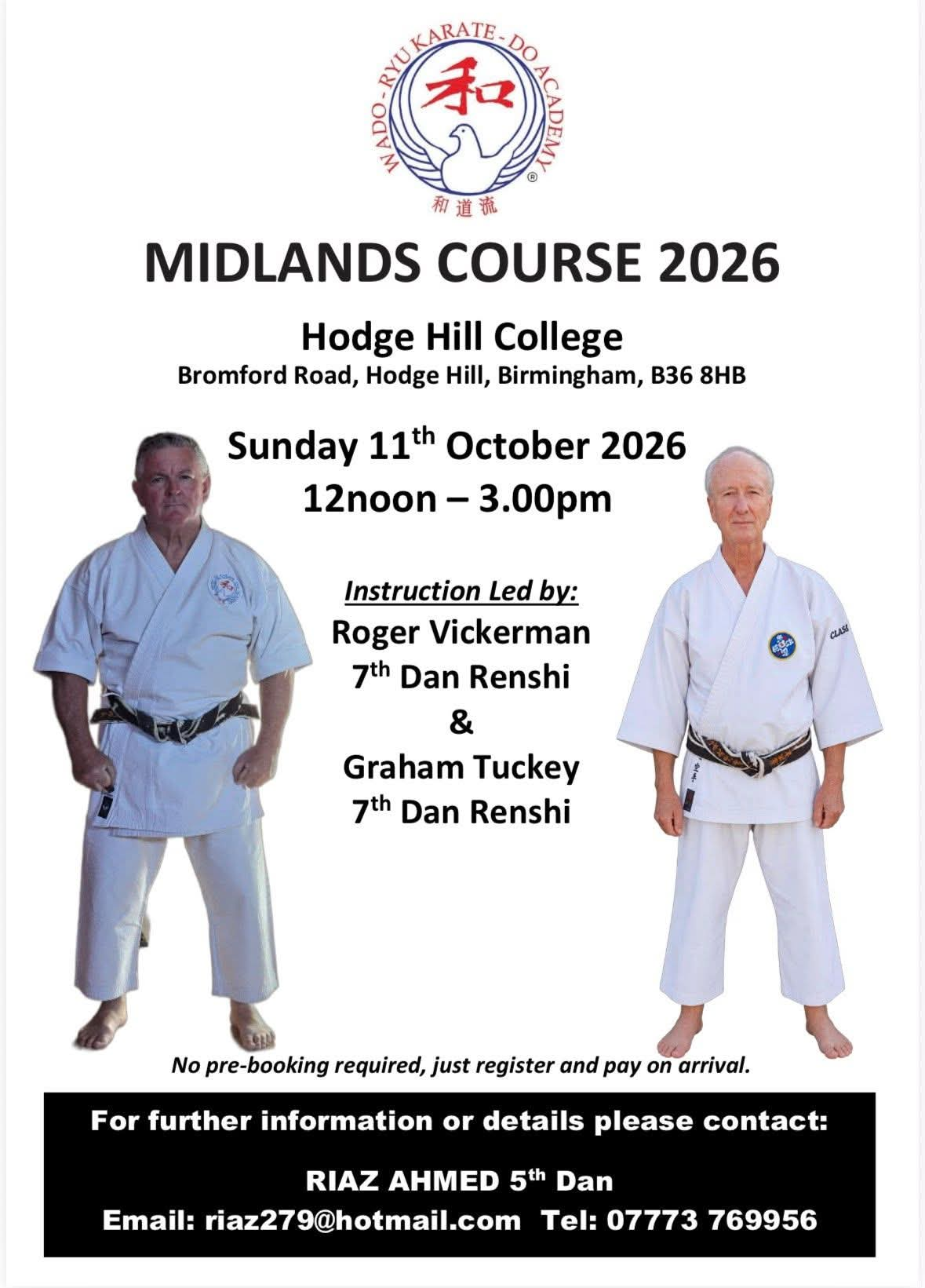
📅 4. West Midlands Wado Academy Course — 11 October 2026
Our next course takes place on Sunday 11 October 2026 at Hodge Hill College, Bromford Road, Hodge Hill, Birmingham, B36 8HB, from 12 noon to 3.00pm.
Instruction will be led jointly by Roger Vickerman, 7th Dan Renshi, and Graham Tuckey, 7th Dan Renshi. The course is open to all grades, clubs and styles.
No pre-booking is required — simply register and pay on arrival.
Further information: Riaz Ahmed, 5th Dan — riaz279@hotmail.com — 07773 769956.
✨ 5. Spotlight on the Wado-Ryu Community
From the Archive — Interview with M. Shiomitsu Sensei
Originally published in Wado Journal, Volume 1, No. 2, Winter 1994 • Interview by Domenic Capilongo
This month’s archive spotlight is a four-page interview with M. Shiomitsu Sensei, then described as 8th Dan Technical Advisor to Canada. It gives a fascinating first-hand account of his early karate, university training, competition years, move to Europe and thoughts on what makes Wadō-Ryū distinctive.
Shiomitsu Sensei recalls beginning karate at 15 and later training at university for around three to four hours a day, six days a week. The routine combined basics, makiwara work, running, dojo training, kata, Kihon Kumite and free fighting. He also discusses Ohtsuka Sensei’s visits to the university and his own route to Europe, including England and France.
“Karate as a sport and karate as a martial art should be like two wings and then you can fly.”
That comparison captures one of the strongest themes in the interview. Shiomitsu Sensei argues that sporting karate and martial-art karate need to work together rather than one replacing the other. He speaks about the intensity of university kumite and competition, but also stresses daily basics and the importance of kata as the essence of fighting — not simply reproducing movements, but practising, questioning and asking why a movement is done.
There are also several comments that feel particularly relevant to our current Benkyō study. Asked what makes Wadō-Ryū different from other karate styles, he identifies taisabaki and nagashitsuki as key differences, explaining the idea that when blocking we must also attack while moving the body out of the way. Later, when discussing teaching, he says beginners must practise basics for black belts and meditation, and encourages students to sit or kneel in seiza, breathe deeply and think deeply about a single problem — comparing this to a Zen Buddhist koan.
The interview closes with his hope that Wadō-Ryū and Wadō-Kai would come together with that aim in mind, and with a simple message to Canadian students: improvement was visible, but all martial artists should always continue training.
🧠 6. Principle of the Month — Jūryoku (重力): Using Gravity in Wadō-Ryū
Jūryoku (重力) means gravity. It is something acting on us constantly, yet in karate we can easily spend much of our training trying to work against it. We brace, lift, push and tense when often a more natural solution is simply to allow the body to fall, settle or move with gravity.
Within Wadō-Ryū this idea fits naturally with the way we use taisabaki, body weight, relaxation and economical movement. Gravity can help us leave the line of attack, accelerate the body, change level and add mass to a technique. Rather than thinking of a drop as a separate action before a technique, the drop itself can become part of the technique.
Gravity Is Already Giving Us Movement
A common way of beginning movement is to push ourselves from one position to another. This works, but it can introduce unnecessary muscular effort and often gives the movement a visible preparation. An alternative is to release the body in the direction we want to travel and allow the centre of mass to begin moving under gravity, with the legs guiding and supporting that movement.
This is a subtle distinction. Jūryoku is not simply bending the knees or deliberately squatting. The aim is not to collapse the posture. The body remains organised, but instead of fighting to hold the centre at a fixed height we allow weight to settle and use that change to initiate or assist movement.
Jūryoku and Taisabaki
Wadō taisabaki is concerned with changing our relationship to an attack rather than simply trying to stop it. A small drop of the centre can change the line of the body without requiring a large step. Combined with turning or diagonal movement, gravity can therefore become part of our evasion.
Instead of first avoiding and then preparing a counter, the body can drop, turn and move off line as one continuous action. This is particularly important in Wadō because effective taisabaki should not leave us disconnected from the opponent. We want to remove the target while retaining position, structure and the ability to act.
Generating Force and Power
Gravity also gives us a simple source of acceleration. If the body's mass is allowed to descend while a strike is being delivered, the technique is no longer produced by the arm alone. The movement of the whole body contributes to the action.
The timing is crucial. Dropping first and punching afterwards separates the movements. Punching and then dropping wastes the opportunity. When the settling of the body and the technique arrive together, body weight can be transmitted through the strike while the practitioner remains comparatively relaxed.
This also helps explain why powerful Wadō technique does not always look powerful. There may be little obvious winding-up or muscular effort. The visible movement can be small, while the mass of the body is being organised and delivered efficiently.
Speed Without Trying to Be Fast
Jūryoku can also contribute to speed. Muscular tension often means that one group of muscles is working against another. If we first have to push, lift or prepare the body before moving, we have added another action before the technique has even begun.
Allowing the centre to release removes some of that preparation. The body begins to move as soon as balance is allowed to change, and the legs then control and redirect that movement. In this sense, speed is not always created by trying to move the limbs faster; it can come from removing the things that slow the whole body down.
Moving More Naturally
We already use gravity this way outside the dōjō. Natural walking is not a sequence of rigid positions. We continually allow our balance to move forward and then place the next foot to receive the body. Good Wadō movement can have the same quality: the body moves and the feet support the movement, rather than the feet moving first and dragging the body after them.
This connects jūryoku closely with datsuryoku. If unnecessary tension prevents the body from settling, gravity cannot be used freely. Relaxation allows the centre to move; structure ensures that movement remains controlled and useful.
Finding Jūryoku in Kata
Kata gives us an ideal environment in which to explore this. A change in stance does not always need to be interpreted as simply stepping from one fixed position into another. Sometimes the important part is the movement of the centre between those positions.
Look for places where the body lowers, turns or changes direction. Ask whether you are mechanically placing the feet and then performing a technique, or whether the body's weight can begin the movement and allow the stance and technique to emerge from it. A movement that initially feels like several separate actions can become one continuous action: release, move, settle and strike.
This can make kata faster and more fluid without rushing it. The purpose is not to perform the sequence more quickly, but to remove unnecessary stops and starts. Gravity helps connect one movement to the next.
Kihon Kumite No. 1 — A Clear Example
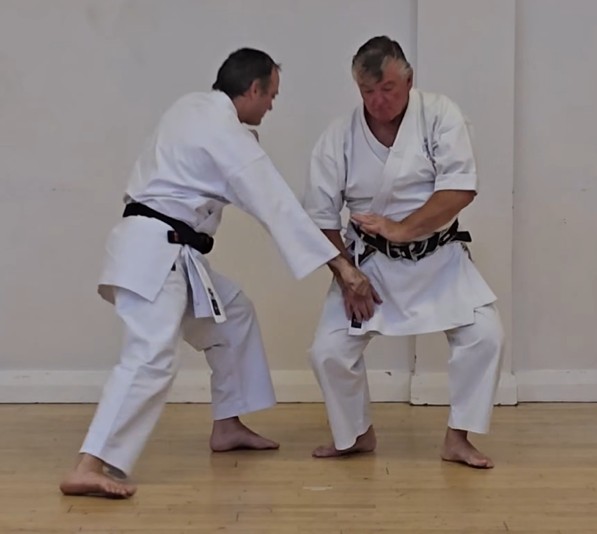
A useful place to feel this principle is Kihon Kumite No. 1. In the second defensive movement, the defender drops the body and then turns to deal with the attack. It is easy to see the drop merely as a way of getting underneath or away from the incoming technique, but it can do considerably more than that.
As the centre drops, gravity has already started moving the body. The turn can grow out of that movement rather than being performed as a separate muscular action. The same descending body weight that helps remove us from danger can then contribute to the counter punch. Evasion, taisabaki and power generation are therefore not three separate events — they are different consequences of the same coordinated body movement.
This is an important Wadō idea. We have not dropped and then turned and then generated power. Ideally, the drop creates the conditions for the turn, the turn creates the position for the counter, and the movement of the body's mass contributes to the force of the punch.
Common Misunderstandings
- Jūryoku is not simply bending the knees
- Jūryoku is not collapsing the posture or becoming heavy and immobile
- Jūryoku is not dropping before every technique
- Jūryoku is not a replacement for correct structure, timing or taisabaki
The useful principle is to recognise when gravity can do work that we might otherwise try to perform with unnecessary muscular effort.
Connecting the Principles
Like many Wadō principles, jūryoku becomes most interesting when it stops being considered in isolation. Datsuryoku allows the body to release; jūryoku allows gravity to act upon that released body; taisabaki gives that movement direction and purpose; and correct timing allows the resulting body mass to contribute to technique.
Seen this way, gravity is not an additional technique that we have to learn. It is a force that is already present. Our task is simply to stop fighting it unnecessarily and learn how to use it.
Closing Thoughts
Jūryoku offers a useful way of looking again at movements we may have performed thousands of times. Where are we lifting when we could settle? Where are we pushing when we could release? Where are we making three movements when gravity could help turn them into one?
In kihon, kata and Kihon Kumite, the principle encourages movement that is more economical, more natural and potentially more powerful. The body does not need to manufacture gravity. It only needs to learn how to cooperate with it.
🙏 Thank You for Being Part of the Community
If you have any questions, video requests, or feedback, simply contact us here — we read everything.
Wishing you a fantastic month of training,
Roger and The Team
Wadō-Ryū Benkyō
wadoryubenkyo.co.uk