Traditional Karate
Free Videos
Courses and Events
Traditional Wadō-Ryū Karate-dō articles
Dōjini (同時に) — Simultaneous Action in Wadō-Ryū
· by Roger Vickerman Renshi (7th Dan) · Principles
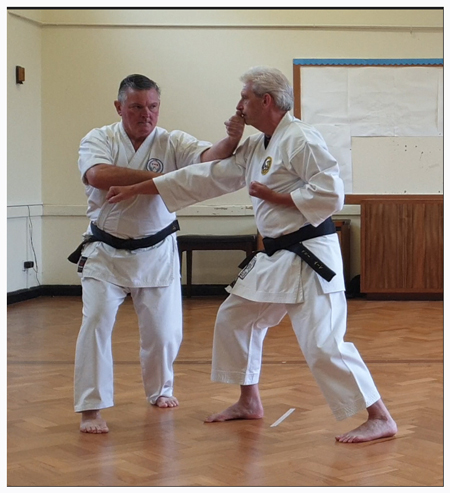
Dōjini (同時に) is commonly translated as “simultaneously” or “at the same time”. In Wadō-Ryū Karate, it describes the ability to perform defensive and offensive actions as a single, unified movement rather than as separate steps.
At a basic level, this may appear to mean blocking and countering together. However, in Wadō, the idea runs deeper. Defence and attack are not two distinct actions performed quickly one after the other — they are part of the same movement, occurring within the same moment.
In this way, Dōjini reflects a more refined understanding of timing, efficiency, and structure.
Understanding the Meaning of Dōjini
The phrase is composed of three elements:
- Dō (同) — same
- Ji (時) — time
- Ni (に) — indicating manner
Together they describe actions occurring within the same moment.
In everyday Japanese, this simply means doing two things at once. In Wadō-Ryū, however, it becomes a principle of movement — ensuring that no action is wasted and no gap exists between defence and response.
Why Wadō-Ryū Emphasises Dōjini
Wadō-Ryū places strong emphasis on efficiency and natural movement. Techniques are not intended to rely on strength or excessive speed, but on correct timing and positioning.
If defence and attack are separated, even by a fraction of time, several problems arise:
- the opponent may recover or adjust
- the practitioner may become fixed or rigid
- the flow of movement is broken
- opportunity is lost
Dōjini avoids these issues by ensuring that the moment of defence is also the moment of control.
Rather than thinking in terms of “block, then counter”, Wadō encourages the practitioner to act in a way where the defensive movement itself creates the attack.
Timing Rather Than Sequence
A common misunderstanding is to treat technique as a sequence of steps.
Step 1: defend
Step 2: counter
In practice, this often leads to hesitation or delay.
Dōjini removes this separation. The correct approach is not to move faster between steps, but to eliminate the steps altogether.
The action becomes:
One movement, one moment, one intention.
This is why effective Wadō technique often appears effortless. There is no visible transition between defence and attack — they are inseparable.
Dōjini in Wadō Movement
Dōjini is expressed through several key aspects of Wadō practice.
Taisabaki (Body Movement)
As the body moves off the line of attack, it simultaneously creates the position for counter-technique. The evasion is not separate from the response — it is the beginning of it.
Nagasu and Inasu (Flowing and Deflecting)
Rather than stopping the attack, the practitioner redirects it while applying technique. The redirection and the counter occur together, without interruption.
Irimi (Entering)
Entering movement often takes place at the same moment the attack is avoided. This creates immediate control of distance and position, leaving little opportunity for the opponent to continue.
Examples in Wadō Training
Dōjini appears throughout Wadō practice.
In Kihon Kumite, the defender does not block and then counter as two separate actions. Instead, the body movement, deflection, and counter-technique occur together as one integrated response.
In kata, many movements that are often interpreted as blocks can be understood as simultaneous defensive and offensive actions. The apparent “block” is frequently the moment of control.
In kumite, Dōjini becomes essential. If actions are separated, even slightly, the opponent can exploit the gap. When movement is unified, control is established immediately.
Dōjini and the Mind
To apply Dōjini effectively, the mind must also be unified.
If the practitioner thinks in stages, the body will move in stages.
If the mind is divided between defence and attack, the technique will also be divided.
The correct state is one of calm awareness, where action emerges naturally without conscious separation. This aligns closely with principles such as Mushin and Fudōshin.
Common Misunderstandings
Dōjini is sometimes misunderstood in practice.
- it is not performing two techniques quickly one after the other
- it is not rushing to counterattack
- it is not relying on speed alone
Instead, it is the removal of separation between actions. The technique becomes a single, continuous expression of movement.
In Simple Terms
Dōjini means that defence and attack occur together, within the same moment.
In Wadō-Ryū, this reflects a deeper principle — that effective technique does not come from doing more, but from doing less, with greater precision.
When movement is unified, timing becomes natural, effort is reduced, and control is established immediately.