Traditional Karate
Weekly Newsletter • 21 February 2026
Weekly Update from Wadō-Ryū Benkyō
Hello, welcome to your 11th weekly update from Wadō-Ryū Benkyō. Below you’ll find this week’s notes, the latest long-format video, a featured article, course updates, and this week’s principle.
🥋 1. Saturday Benkyō Class Review – Today’s Training
No training this week — we are away at the Winter Course.
🎥 2. This Week’s Long-Format Video
Part 19 – Nagashi Zuki — Kihon Fundamentals
Watch here: https://youtu.be/NDdDnRSqgUg
Kihon Fundamentals – Nagashi Zuki: Technical Breakdown with Roger Vickerman Renshi (7th Dan) and Kash Bansal
In this volume of the Kihon Fundamentals series, Roger Vickerman Renshi and Kash Bansal build directly on Junzuki Notsukomi by introducing Nagashi Zuki — the next progression that takes Wadō-Ryū mechanics from a more formal stepping method into a freer, more usable movement for sparring. The focus is on keeping the technique calm, fluid, and structurally connected, using the hips and centre to drive the entry rather than leading with the head, and maintaining correct distance without collapsing the stance on the recovery.
A key theme throughout is that Nagashi Zuki is not “tight” movement — it must remain relaxed and adaptable, with the non-striking arm playing functional roles depending on context: lifting (age), lowering (otoshi), covering, or forming a kamae-like guard. The session also reinforces zanshin as part of the technique — awareness before, during, and especially after the action — so the movement doesn’t end with the punch, but continues into readiness for what comes next.
The video includes partner training to develop timing and recognition, showing how Nagashi Zuki can be applied against punches and kicks without meeting force with force, and how it naturally appears within Wadō training such as Kihon Kumite (including Number 7) and kata examples such as Pinan Godan. Emphasis is placed on staying on the centre line, keeping posture, and blending body turn with cover so the technique remains efficient and repeatable under pressure.
Key areas explored include:
- Transitioning from Junzuki Notsukomi into Nagashi Zuki for freer sparring application
- Driving the technique with hips and centre (not leading with the head)
- Maintaining distance and length on the recovery without collapsing the stance
- Functional uses of the non-striking arm: age, otoshi, cover, kamae, and combinations
- Partner drills for timing, recognition, and redirection (including responses to maegeri)
- Keeping the punch on the centre line and maintaining correct sen/chūshin-sen awareness
- Integrating zanshin before, during, and after the technique
This breakdown is ideal for practitioners looking to understand how Wadō fundamentals evolve into practical movement — where effectiveness comes from posture, timing, and connected body control rather than rigidity or force.
Watch on YouTube📝 3. Featured Article of the Week
Article: Wadō-Ryū Benkyō — Jion by Roger Vickerman Renshi
Jion – Calmness, Strength, and Subtlety
Jion is a kata often recognised for its strong structure and traditional feel, yet beneath its clear lines lies a wealth of subtle timing, entry, and tactical nuance. In this article, we look beyond “block and strike” to examine kuzushi, hip action, angles, and practical application — from variations of jōdan uke and taishō movement to the deeper meaning behind juji-uke and final shutō combinations. Alongside technical study, the article also explores Jion’s historical roots as a “Temple Kata” and its journey into Wadō-Ryū, highlighting how themes such as ma-ai, transferable skills, and hidden grappling appear throughout. Ultimately, Jion reveals itself not as a rigid form but as a living dialogue of movement and intent, especially when studied alongside its companion kata, Jitte.
Read the full article📅 4. Upcoming Courses, Events, or Updates
Things you may want to know about:
- Course and events calendar is now live on the website and will be updated regularly — please bookmark it and check it: Events
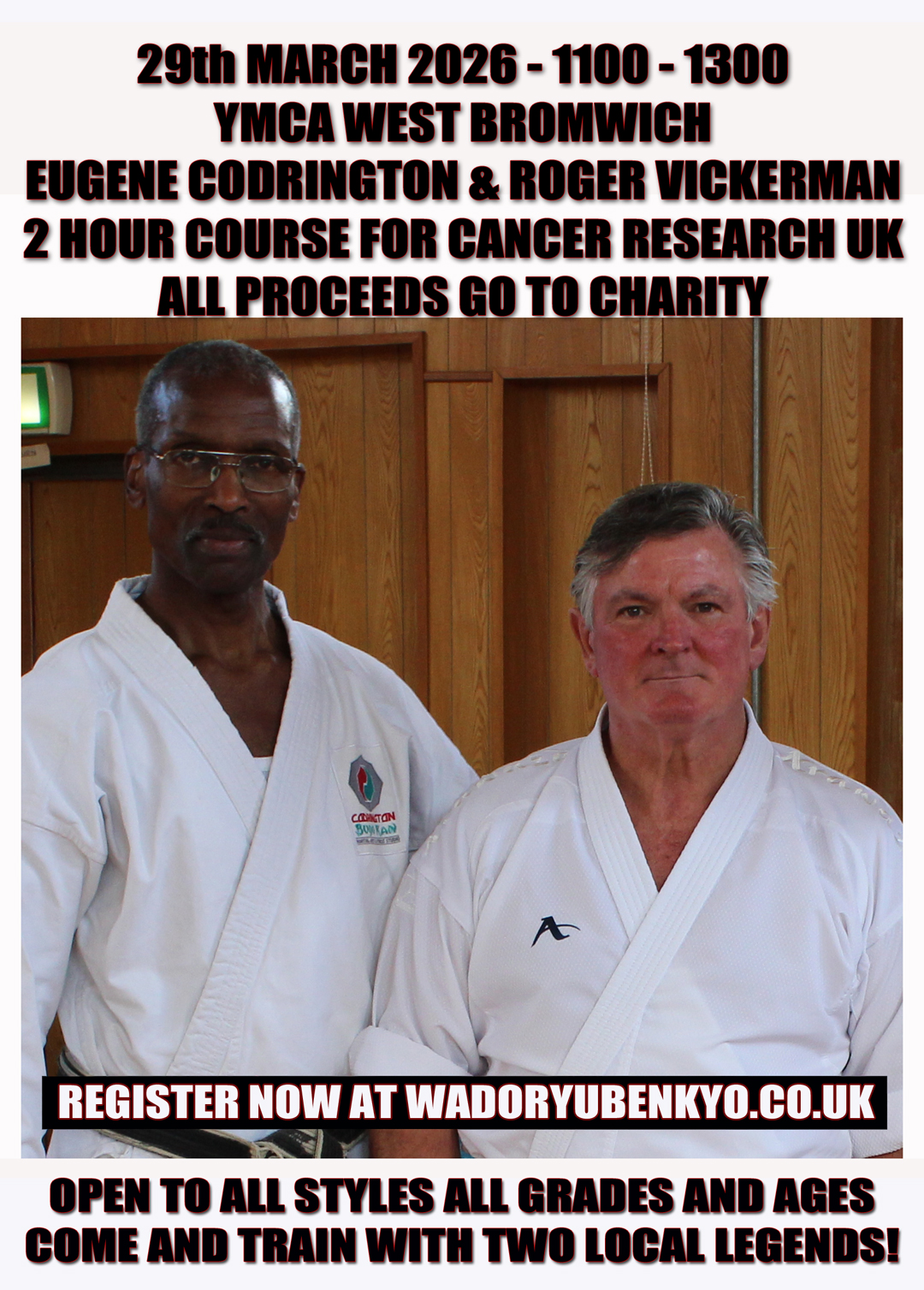
- 29th March 2026 Joint Charity Course with Eugene Codrington — full details here
- May 2026 course dates and location confirmed — details and booking
- October 2026 course now available for booking — full details here
🧠 5. Wadō-Ryū Principle of the Week
Fudōshin (不動心) — The Immovable Mind in Wadō-Ryū
Fudōshin translates as “immovable mind,” describing a state of calm, stable awareness that does not collapse under pressure. In Wadō-Ryū, it does not mean aggression or blind confidence — it means clarity, composure, and quiet certainty. Whether in kumite, kata, or life outside the dōjō, fudōshin reflects a mindset that remains steady regardless of circumstance.
When the mind becomes unsettled, the body tightens and movement loses its natural rhythm. When the mind is calm, posture settles, breathing becomes steady, and technique flows without hesitation. Fudōshin therefore represents the mental condition that allows Wadō principles to function without interference.
What Fudōshin Means in Wadō-Ryū
Fudōshin is not about forcing confidence or dominating an opponent. It is a quiet certainty that allows you to act clearly without emotional disturbance. In training this appears as:
- Remaining calm even when pressure increases
- Maintaining awareness without fixation
- Acting decisively without rushing
- Trusting training rather than reacting emotionally
Mind and Body Working Together
Fudōshin cannot be separated from physical training. A stable mind reduces unnecessary tension, allowing principles such as datsuryoku, ryūsui, and shizumu to emerge naturally. When fear or doubt appears, posture tightens and movement fragments; when the mind settles, technique becomes efficient and natural.
Where Fudōshin Appears in Training
- Kumite, where calm timing replaces frantic reaction
- Kihon Kumite entries performed without hesitation
- Kata performance under fatigue or observation
- Senior-level practice where nothing appears rushed
Common Misunderstandings
- Fudōshin is not aggression or dominance.
- Fudōshin is not stubbornness or rigidity.
- Fudōshin is not believing you cannot fail.
In simple terms: Fudōshin is the calm mind that does not waver. It allows Wadō movement to remain clear and efficient even under pressure, turning technique into living practice rather than performance.
🙏 Thank You for Being Part of the Community
If you have any questions, video requests, or feedback, simply get in touch — we read everything.
Wishing you a fantastic week of training,
Roger and The Team
Wadō-Ryū Benkyō