Go-no-sen (後の先) — Late Initiative in Wadō-Ryū
· by Roger Vickerman Renshi (7th Dan) · Principles
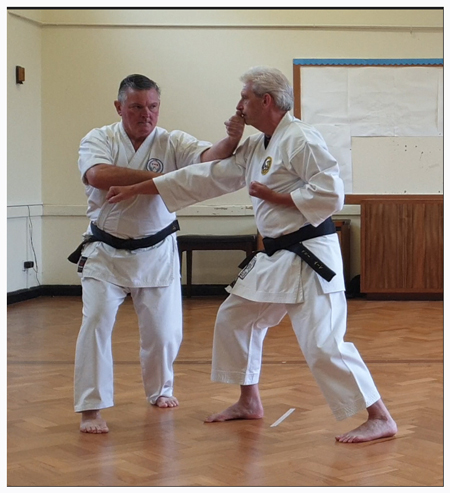
Go-no-sen (後の先) is commonly translated as “late initiative”. It describes the ability to respond only after the opponent has committed to their action, using timing, positioning, and awareness rather than attempting to move first.
In Wadō-Ryū Karate, this principle reflects a deeper strategic mindset. Rather than rushing to attack or attempting to overpower the opponent, the practitioner waits for the moment when the opponent’s intention becomes clear. Once the attack begins, movement occurs immediately — not in reaction alone, but in a way that places the body in a superior position.
In this way, go-no-sen is not passive. It is a form of controlled patience, where the practitioner allows the opponent’s commitment to create the opportunity for effective technique.
Understanding the Meaning of Go-no-sen
The phrase is composed of three elements:
- Go (後) — after or behind
- No (の) — possessive connector
- Sen (先) — initiative, timing, or precedence
Together they describe taking initiative after the opponent has moved.
However, this should not be misunderstood as simply reacting slowly. The moment the opponent commits to an action, their movement creates openings — changes in posture, balance, and intention. Go-no-sen uses this commitment to create advantage.
In Wadō terms, the opponent begins the movement, but the defender finishes the exchange.
Why Wadō-Ryū Emphasises Go-no-sen
Wadō-Ryū developed from both Okinawan karate and Japanese jujutsu traditions. In jujutsu systems, it is often safer and more effective to allow an attacker to initiate movement before applying technique.
When an attacker commits:
- their posture often stretches forward
- their balance shifts
- their intention becomes visible
- their options become limited
Responding at this moment allows the defender to apply technique with far greater efficiency.
Rather than meeting force with force, Go-no-sen allows the practitioner to use the opponent’s commitment as the beginning of their own technique.
Timing Rather Than Speed
A common misunderstanding is that successful technique depends primarily on speed. In reality, correct timing is far more important.
Speed attempts to arrive before the opponent.
Timing allows you to arrive exactly when the opponent becomes vulnerable.
Go-no-sen emphasises reading the moment of commitment. When the opponent’s body begins to move, their structure is temporarily unstable. Entering at this moment allows technique to work with much less effort.
This is why experienced practitioners often appear calm or unhurried. Their movement occurs at precisely the right moment rather than as a rushed reaction.
Go-no-sen in Wadō Movement
Go-no-sen is expressed through several characteristic aspects of Wadō movement.
Taisabaki (Body Movement)
Instead of blocking directly, the body shifts slightly off the line of attack. This movement occurs just as the opponent commits, allowing the attack to pass while maintaining position for counter-technique. See also Ashi-sabaki and Taisabaki.
Irimi (Entering)
Once the attack begins, the defender often enters decisively into the opponent’s space. This entry occurs after the attack is launched but before it can be completed. This is closely linked to Irimi and to Wadō’s preference for position over collision.
Kuzushi (Breaking Balance)
Because the opponent has already committed their weight or posture to the attack, subtle changes in position can easily disrupt their balance. For a fuller explanation, see Kuzushi.
Examples in Wadō Training
Go-no-sen appears throughout Wadō practice.
In Kihon Kumite, the defender rarely moves before the attack begins. Instead, movement occurs as the attacker commits, allowing the defender to reposition and counter.
In kata, many movements that appear to be blocks are actually examples of entering after the opponent has attacked. This can often be seen in forms such as Seishan, Chintō, and Jion.
In kumite, Go-no-sen becomes particularly important. Attempting to attack too early often exposes the practitioner to counterattack. Waiting for the moment of commitment allows technique to emerge naturally.
Go-no-sen and the Mind
Because Go-no-sen depends on timing and perception, it also requires the correct mental state.
A mind that is tense or impatient may move too early.
A mind that hesitates may move too late.
The ideal state lies between these extremes: calm awareness that allows the practitioner to recognise the moment of commitment.
This connects directly with other Wadō principles such as Mushin and Fudōshin.
Common Misunderstandings
Go-no-sen is sometimes misunderstood as simply waiting for the opponent to attack.
- it is not passive waiting
- it is not slow reaction
- it is not defensive hesitation
Instead, it is strategic timing. The practitioner allows the opponent to initiate movement, then immediately takes control of the exchange.
In Simple Terms
Go-no-sen means allowing the opponent to move first, then responding at the exact moment their commitment creates opportunity.
Rather than relying on speed or strength, it relies on timing, positioning, and awareness. In Wadō-Ryū, this principle reflects the deeper strategy of avoiding unnecessary collision while placing the body in a position where effective technique becomes inevitable.